


Review
doi: 10.1016/j.molcel.2011.05.008.
The SirT3 divining rod points to oxidative stress
Affiliations
- PMID: 21658599
- PMCID: PMC3526939
- DOI: 10.1016/j.molcel.2011.05.008
Item in Clipboard
Review
The SirT3 divining rod points to oxidative stress
Mol Cell.
.
Abstract
Sirtuins are NAD(+) dependent deacetylases that counter aging and diseases of aging. Sirtuin research has focused on SirT1, which deacetylates transcription factors and cofactors in the nucleus. More recent findings highlight SirT3 as a mitochondrial sirtuin that regulates metabolism and oxidative stress. This review focuses on new data linking SirT3 to management of reactive oxygen species from mitochondria, which may have profound implications for aging and late-onset diseases.
Copyright © 2011 Elsevier Inc. All rights reserved.
Figures
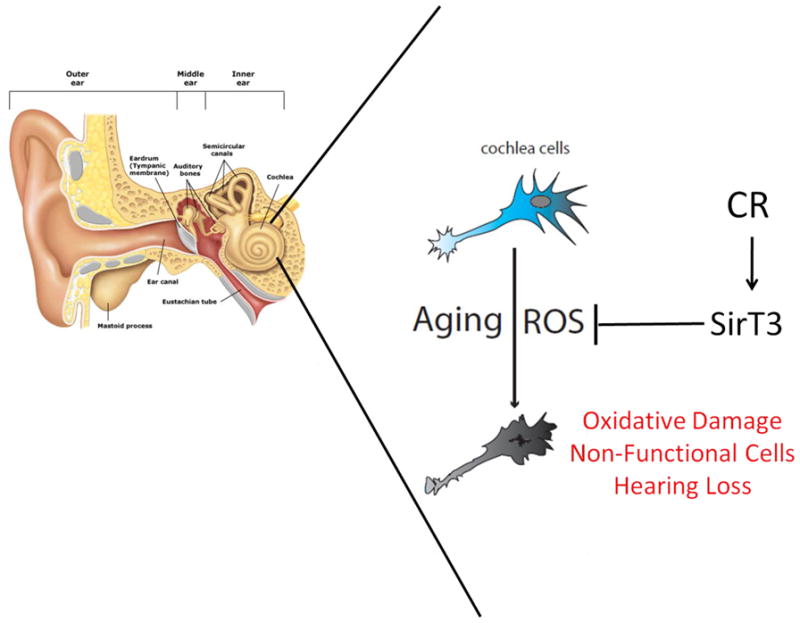
SirT3 is necessary for protection from hearing loss by calorie restriction. Aging induces ROS damage to inner ear cochlea neurons. In conditions of calorie restriction, SirT3 inhibits ROS mediated damage of cochlea neurons to delay hearling loss.
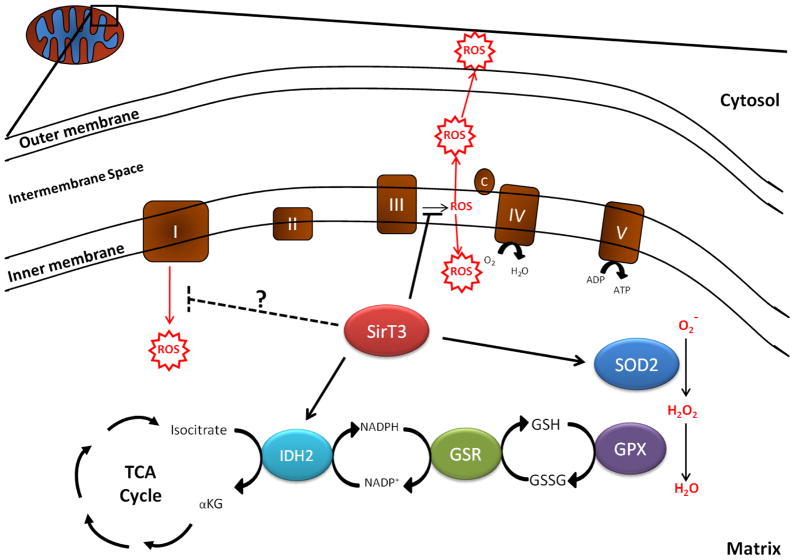
SirT3 protects against damage from mitochondrial derived ROS. ROS are primarily generated by complex I (matrix) and complex III (matrix and intermembrane space/cytosol). Superoxide (O2·) localized to the matrix are detoxified by manganese superoxide dismutase (SOD2) into hydrogen peroxide (H2O2), which is subsequently converted into water by glutathione peroxidase (GPX). GPX requires reduced glutathione (GSH) for enzymatic activity. Oxidized glutathione (GSSH) is reduced by glutathione reductase (GSR), which requires NADPH. NADPH is generated from NADP+ by isocitrate dehydrogenase 2 (IDH2). By activating SOD2 and IDH2 and inhibiting ROS generation by complex III and potentially complex I, SirT3 may be a major determinant of oxidative damage in cells.
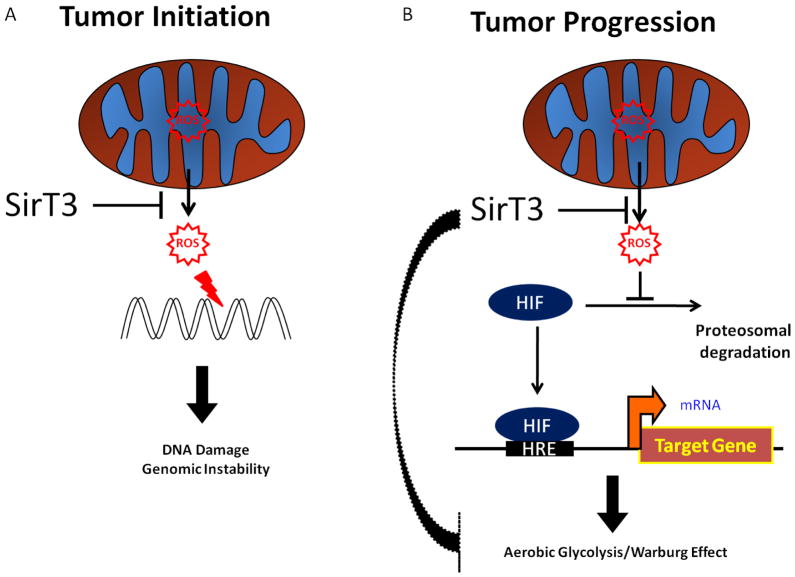
SirT3 acts as a tumor suppressor through the regulation of ROS. (A) SirT3 suppresses mitochondrial-generated ROS to reduce DNA damage and genomic instability. This may be important in the initiation of tumorigenesis. (B) By suppressing mitochondrial derived ROS, SirT3 also inhibits a signaling cascade resulting in the stabilization/activation of HIF-1α protein and activation of transcriptional targets that promote aerobic glycolysis, angiogenesis, and the progression of tumorigenesis.
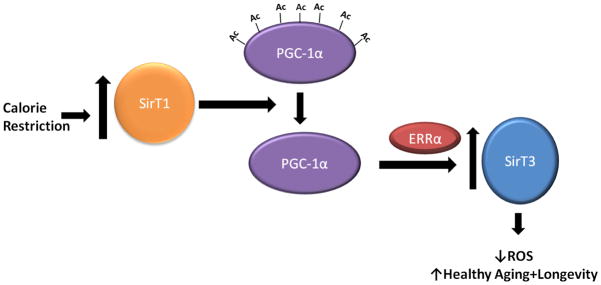
Model by which SirT1 and SirT3 cooperate during calorie restriction. In conditions of decreased caloric intake, SirT1 protein levels and activity are increased, leading to the deacetylation and activation of PGC-1α. Transactivation of ERRα by PGC-1α increases transcription of SirT3, resulting in a decrease in ROS and the promotion of healthy aging.
References
Publication types
MeSH terms
Substances
Grants and funding
LinkOut - more resources
Full Text Sources
Other Literature Sources
