. 2012 Jan;37(1):39-47.
doi: 10.1016/j.psyneuen.2011.04.015. Epub 2011 Jun 11.

Chronic juvenile stress produces corticolimbic dendritic architectural remodeling and modulates emotional behavior in male and female rats

Affiliations

Chronic juvenile stress produces corticolimbic dendritic architectural remodeling and modulates emotional behavior in male and female rats

Lisa Eiland et al. Psychoneuroendocrinology. 2012 Jan.

Abstract

Nearly 12% of US children are exposed to intense adverse experiences. Research has demonstrated that these experiences can negatively impact adult health, often resulting in psychopathology. Less attention, however, is given to the impact of childhood adverse experiences on childhood health and wellbeing. Using a rodent model of chronic juvenile stress (restraint 6 h daily from postnatal day 20 to 41), we report that chronic stress has significant immediate morbidities in both males and females during this developmental window. Specifically, we demonstrate that chronic juvenile stress produces depressive-like behavior and significant neuronal remodeling of brain regions likely involved in these behavioral alterations: the hippocampus, prefrontal cortex and amygdala. Chronically stressed males and females exhibit anhedonia, increased locomotion when exposed to novelty, and altered coping strategies when exposed to acute stress. Coincident with these behavioral changes, we report simplification of dendrites in the hippocampus and prefrontal cortex and concurrent hypertrophy of dendrites in the amygdala. Taken together, these results demonstrate that chronically stressed juveniles exhibit aberrant behavioral responses to acute challenges that occur in conjunction with stress-induced remodeling of brain regions intimately involved in regulating emotionality and stress reactivity. Further, the absence of sex differences in our reported stress responses, likely speaks to the decreased sensitivity of immature HPA regulating brain regions to sex hormones.


Figures

Figure 1
Figure 1
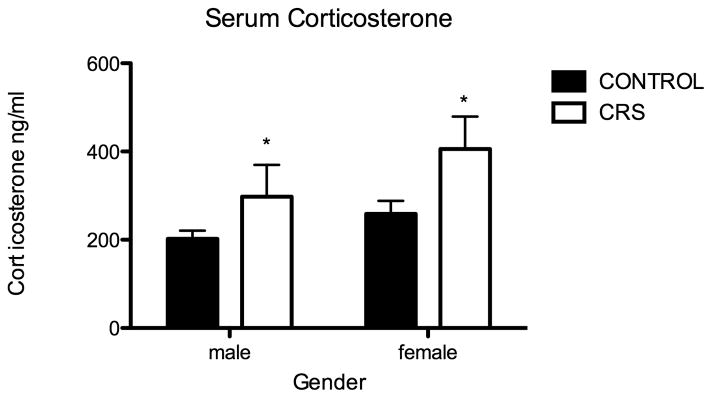
Juvenile chronic restraint stress (CRS) produces exaggerated stress induced corticosterone secretion. Serum corticosterone (ng/ml) 30 minutes following forced swim, CONT males (n=8) 202.4, CONT females (n=8) 258.9, CRS males (n=7) 297.7, CRS females (n=5) 406.0; stress effect two-way ANOVA F1,23=5.68, *P=0.03.
Figure 2
Figure 2
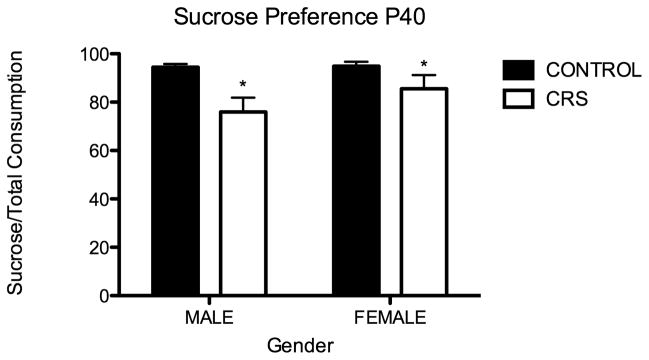
Juvenile chronic restraint stress (CRS) produces anhedonia in males and females. Percent consumption of 2% sucrose solution: CONT males 94.5% (n=8, 3 cages), CONT females 94.8% (n=8, 4 cages), CRS males 76% (n=8, 4 cages), Female CRS 85.6% (n=8, 4 cages). Stress effect two-way ANOVA F1,11=9.31, *P=0.01.
Figure 3
Figure 3
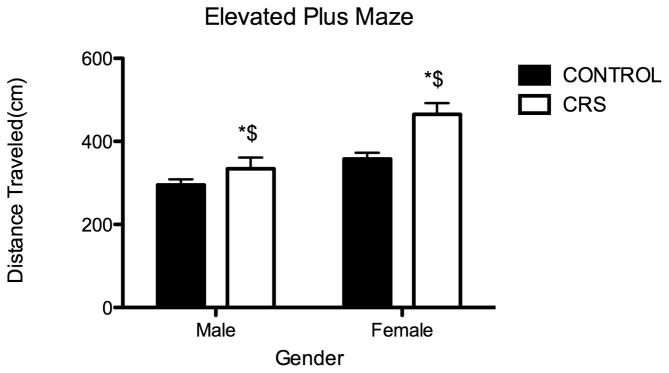
Juvenile chronic restraint stress (CRS) significantly increases locomotion. Groups were observed in EPM 24 hours after the last CRS session. CRS significantly increased the distance traveled in the EPM: CONT males 295.4 cm, CONT females 357.7 cm, CRS males 334.2 cm, CRS females 465.3 cm. Two-way ANOVA F1,25=11.94, *P=0.002, n=7 for all groups except CONT males n=8. In addition to the observed effect of stress on locomotion, females exhibited greater locomotion than males. Two-way ANOVA F1,25=20.86, $P=0.0001.
Figure 4
Figure 4
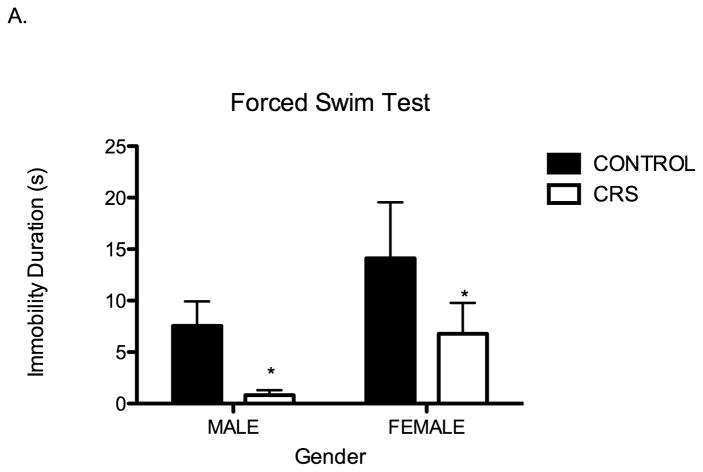
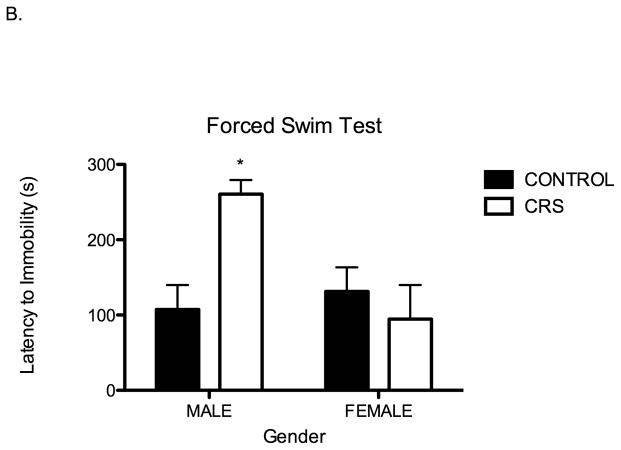
Juvenile chronic restraint stress (CRS) alters swim behavior during forced swim; CRS rats have significantly shorter immobility duration and prolonged latency to immobility. A. Immobility duration for CONT males 7.6 s, CONT females 14.1 s, CRS males 0.8 s, CRS females 6.8 s. Stress effect two-way ANOVA F1,28=4.41, *P=0.04, n= 8 for all groups. B. There is a significant interaction between sex and stress for latency to immobility; there is only a significant effect of chronic stress on latency to immobility in males. CONT males 107.3 s, CONT females 131.4 s, CRS males 260.0 s, CRS females 94.63 s. Two-way ANOVA F1,28=8.06, *P=0.01, n=8 for all groups.
Figure 4
Figure 4
Juvenile chronic restraint stress (CRS) alters swim behavior during forced swim; CRS rats have significantly shorter immobility duration and prolonged latency to immobility. A. Immobility duration for CONT males 7.6 s, CONT females 14.1 s, CRS males 0.8 s, CRS females 6.8 s. Stress effect two-way ANOVA F1,28=4.41, *P=0.04, n= 8 for all groups. B. There is a significant interaction between sex and stress for latency to immobility; there is only a significant effect of chronic stress on latency to immobility in males. CONT males 107.3 s, CONT females 131.4 s, CRS males 260.0 s, CRS females 94.63 s. Two-way ANOVA F1,28=8.06, *P=0.01, n=8 for all groups.
Figure 5
Figure 5
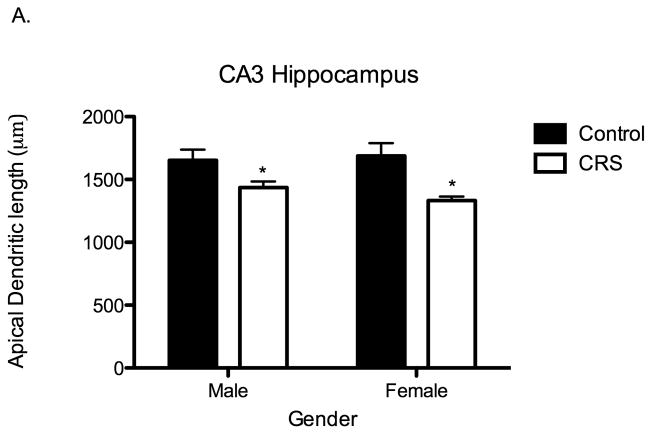
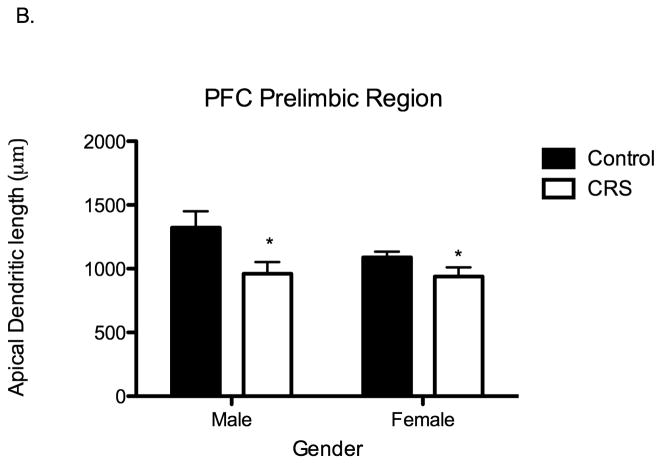
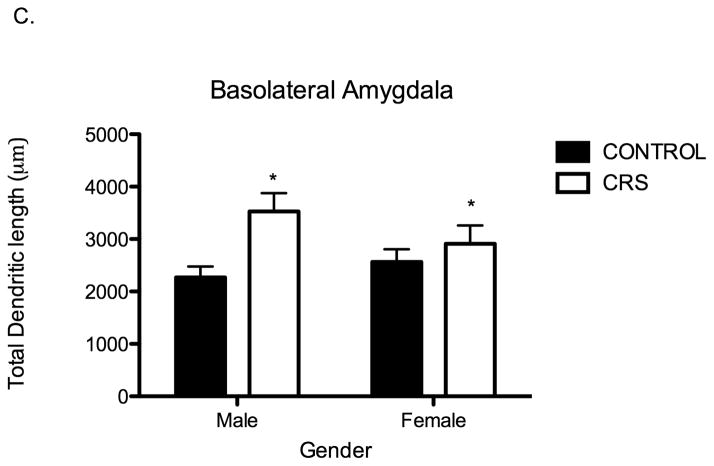
Juvenile chronic restraint stress (CRS) produces apical dendritic remodeling in the CA3 region of the hippocampus (CA3), the prelimbic prefrontal cortex (PFC) and in the basolateral amygdala (BLA) of both males and females. A. CRS significantly shortens apical dendritic length of CA3 pyramidal neurons: CONT males 1653 μms, CONT females 1688 μms, CRS males 1435 μms, CRS females 1332 μms. Two-way ANOVA F1,19=16.11, P=0.0007, n= 6 for all groups except control males n=5. B. CRS significantly shortens apical dendrites in the PFC: CONT males 1322 μms, CONT females 1089 μms, CRS males 961 μms, CRS females 939 μms. Two-way ANOVA F1,18=8.25, P=0.01, CONT groups n= 5, CRS groups n=6. C. CRS significantly increases total dendritic material of pyramidal-like neurons in the BLA. CONT males 2266 μms, CONT females 2558 μms, CRS males 3526 μms, CRS females 2911 μms. Two-way ANOVA F1,16=7.48, P=0.01, n= 5 for all groups.
Figure 5
Figure 5
Juvenile chronic restraint stress (CRS) produces apical dendritic remodeling in the CA3 region of the hippocampus (CA3), the prelimbic prefrontal cortex (PFC) and in the basolateral amygdala (BLA) of both males and females. A. CRS significantly shortens apical dendritic length of CA3 pyramidal neurons: CONT males 1653 μms, CONT females 1688 μms, CRS males 1435 μms, CRS females 1332 μms. Two-way ANOVA F1,19=16.11, P=0.0007, n= 6 for all groups except control males n=5. B. CRS significantly shortens apical dendrites in the PFC: CONT males 1322 μms, CONT females 1089 μms, CRS males 961 μms, CRS females 939 μms. Two-way ANOVA F1,18=8.25, P=0.01, CONT groups n= 5, CRS groups n=6. C. CRS significantly increases total dendritic material of pyramidal-like neurons in the BLA. CONT males 2266 μms, CONT females 2558 μms, CRS males 3526 μms, CRS females 2911 μms. Two-way ANOVA F1,16=7.48, P=0.01, n= 5 for all groups.
Figure 5
Figure 5
Juvenile chronic restraint stress (CRS) produces apical dendritic remodeling in the CA3 region of the hippocampus (CA3), the prelimbic prefrontal cortex (PFC) and in the basolateral amygdala (BLA) of both males and females. A. CRS significantly shortens apical dendritic length of CA3 pyramidal neurons: CONT males 1653 μms, CONT females 1688 μms, CRS males 1435 μms, CRS females 1332 μms. Two-way ANOVA F1,19=16.11, P=0.0007, n= 6 for all groups except control males n=5. B. CRS significantly shortens apical dendrites in the PFC: CONT males 1322 μms, CONT females 1089 μms, CRS males 961 μms, CRS females 939 μms. Two-way ANOVA F1,18=8.25, P=0.01, CONT groups n= 5, CRS groups n=6. C. CRS significantly increases total dendritic material of pyramidal-like neurons in the BLA. CONT males 2266 μms, CONT females 2558 μms, CRS males 3526 μms, CRS females 2911 μms. Two-way ANOVA F1,16=7.48, P=0.01, n= 5 for all groups.

References

    1. American Psychiatric Association. Diagnostic criteria from DSM-IV-TR. xii. Washington, D.C: American Psychiatric Association; 2000. p. 370.
    1. Angold A, Costello EJ, Erkanli A, Worthman CM. Pubertal changes in hormone levels and depression in girls. Psychol Med. 1999;29(5):1043–53. - PubMed
    1. Apter D. Development of the hypothalamic-pituitary-ovarian axis. Ann N Y Acad Sci. 1997;816:9–21. - PubMed
    1. Barha CK, Brummelte S, Lieblich SE, Galea LA. Chronic restraint stress in adolescence differentially influences hypothalamic-pituitary-adrenal axis function and adult hippocampal neurogenesis in male and female rats. Hippocampus 2010 - PubMed
    1. Bhatia SK, Bhatia SC. Childhood and adolescent depression. Am Fam Physician. 2007;75(1):73–80. - PubMed

Publication types

MeSH terms