


Propensity score-based sensitivity analysis method for uncontrolled confounding
- PMID: 21659349
- PMCID: PMC3202161
- DOI: 10.1093/aje/kwr096
Propensity score-based sensitivity analysis method for uncontrolled confounding
Abstract
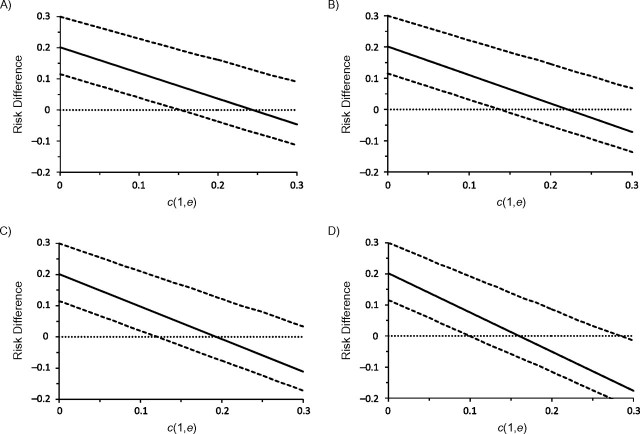
The authors developed a sensitivity analysis method to address the issue of uncontrolled confounding in observational studies. In this method, the authors use a 1-dimensional function of the propensity score, which they refer to as the sensitivity function (SF), to quantify the hidden bias due to unmeasured confounders. The propensity score is defined as the conditional probability of being treated given the measured covariates. Then the authors construct SF-corrected inverse-probability-weighted estimators to draw inference on the causal treatment effect. This approach allows analysts to conduct a comprehensive sensitivity analysis in a straightforward manner by varying sensitivity assumptions on both the functional form and the coefficients in the 1-dimensional SF. Furthermore, 1-dimensional continuous functions can be well approximated by low-order polynomial structures (e.g., linear, quadratic). Therefore, even if the imposed SF is practically certain to be incorrect, one can still hope to obtain valuable information on treatment effects by conducting a comprehensive sensitivity analysis using polynomial SFs with varying orders and coefficients. The authors demonstrate the new method by implementing it in an asthma study which evaluates the effect of clinician prescription patterns regarding inhaled corticosteroids for children with persistent asthma on selected clinical outcomes.
Figures
References
-
- Delaney JA, Platt RW, Suissa S. The impact of unmeasured baseline effect modification on estimates from an inverse probability of treatment weighted logistic model. Eur J Epidemiol. 2009;24(7):343–349. - PubMed
-
- Cornfield J, Haenszel W, Hammond EC, et al. Smoking and lung cancer: recent evidence and a discussion of some questions. J Natl Cancer Inst. 1959;22(1):173–203. - PubMed
-
- Rosenbaum P. Observational Studies. New York, NY: Springer-Verlag New York; 2002.
-
- McCandless LC, Gustafson P, Levy AR. A sensitivity analysis using information about measured confounders yielded improved uncertainty assessments for unmeasured confounding. J Clin Epidemiol. 2008;61(3):247–255. - PubMed
-
- Schlesselman JJ. Assessing effects of confounding variables. Am J Epidemiol. 1978;108(1):3–8. - PubMed
