Evidence against the proposition that "UK cancer survival statistics are misleading": simulation study with National Cancer Registry data
- PMID: 21659366
- PMCID: PMC3111483
- DOI: 10.1136/bmj.d3399
Evidence against the proposition that "UK cancer survival statistics are misleading": simulation study with National Cancer Registry data
Abstract
Objectives: To simulate each of two hypothesised errors in the National Cancer Registry (recording of the date of recurrence of cancer, instead of the date of diagnosis, for registrations initiated from a death certificate; long term survivors who are never notified to the registry), to estimate their possible effect on relative survival, and to establish whether lower survival in the UK might be due to one or both of these errors.
Design: Simulation study.
Setting: National Cancer Registry of England and Wales. Population Patients diagnosed as having breast (women), lung, or colorectal cancer during 1995-2007 in England and Wales, with follow-up to 31 December 2007.
Main outcome measure: Mean absolute percentage change in one year and five year relative survival associated with each simulated error.
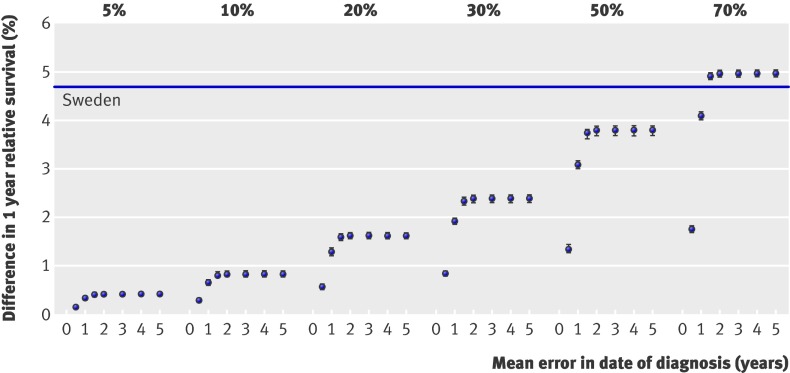
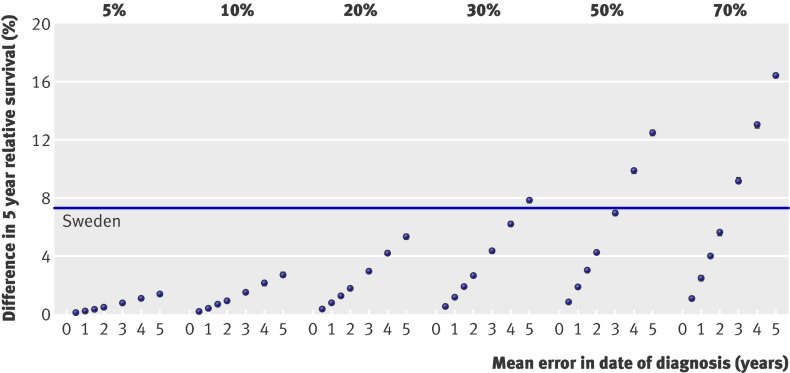
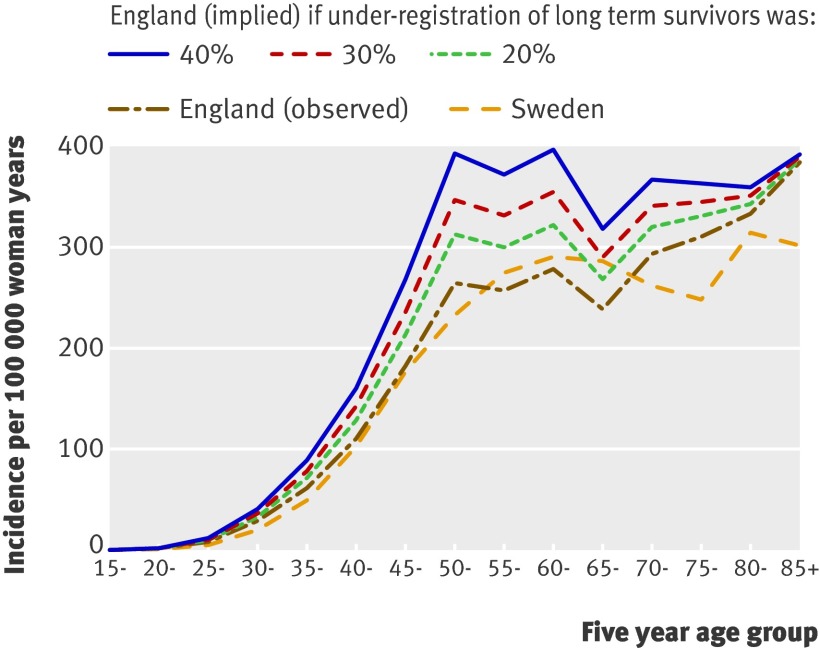
Results: To explain the differences in one year survival after breast cancer between England and Sweden, under the first hypothesis, date of diagnosis would have to have been incorrectly recorded by an average of more than a year for more than 70% of women known to be dead. Alternatively, under the second hypothesis, failure to register even 40% of long term survivors would explain less than half the difference in one year survival. Results were similar for lung and colorectal cancers.
Conclusions: Even implausibly extreme levels of the hypothesised errors in the cancer registry data could not explain the international differences in survival observed between the UK and other European countries.
Conflict of interest statement
Competing interests: All authors have completed the Unified Competing Interest form at
Figures
References
-
- Berrino F, Sant M, Verdecchia A, Capocaccia R, Hakulinen T, Estève J. Survival of cancer patients in Europe: the EUROCARE study. International Agency for Research on Cancer, 1995.
-
- Berrino F, Capocaccia R, Estève J, Gatta G, Hakulinen T, Micheli M, et al. Survival of cancer patients in Europe: the EUROCARE-2 study. International Agency for Research on Cancer, 1999.
-
- Coleman MP, Gatta G, Verdecchia A, Estève J, Sant M, Storm H, et al. EUROCARE-3 summary: cancer survival in Europe at the end of the 20th century. Ann Oncol 2003;14:128-49v. - PubMed
-
- Berrino F, De Angelis R, Sant M, Rosso S, Bielska-Lasota M, Coebergh JW, et al. Survival for eight major cancers and all cancers combined for European adults diagnosed in 1995-99: results of the EUROCARE-4 study. Lancet Oncol 2007;8:773-83. - PubMed
-
- Coleman MP, Forman D, Bryant H, Butler J, Rachet B, Maringe C, et al. Cancer survival in Australia, Canada, Denmark, Norway, Sweden, and the UK, 1995-2007 (the International Cancer Benchmarking Partnership): an analysis of population-based cancer registry data. Lancet 2011;377:127-38. - PMC - PubMed
MeSH terms
Grants and funding
LinkOut - more resources
Full Text Sources