Multicenter Study
. 2011 Aug 11;118(6):1675-84.
doi: 10.1182/blood-2010-11-319376. Epub 2011 Jun 9.

Long-term outcome and lineage-specific chimerism in 194 patients with Wiskott-Aldrich syndrome treated by hematopoietic cell transplantation in the period 1980-2009: an international collaborative study

Affiliations
Multicenter Study

Long-term outcome and lineage-specific chimerism in 194 patients with Wiskott-Aldrich syndrome treated by hematopoietic cell transplantation in the period 1980-2009: an international collaborative study

Daniele Moratto et al. Blood. .

Abstract

In this retrospective collaborative study, we have analyzed long-term outcome and donor cell engraftment in 194 patients with Wiskott-Aldrich syndrome (WAS) who have been treated by hematopoietic cell transplantation (HCT) in the period 1980- 2009. Overall survival was 84.0% and was even higher (89.1% 5-year survival) for those who received HCT since the year 2000, reflecting recent improvement of outcome after transplantation from mismatched family donors and for patients who received HCT from an unrelated donor at older than 5 years. Patients who went to transplantation in better clinical conditions had a lower rate of post-HCT complications. Retrospective analysis of lineage-specific donor cell engraftment showed that stable full donor chimerism was attained by 72.3% of the patients who survived for at least 1 year after HCT. Mixed chimerism was associated with an increased risk of incomplete reconstitution of lymphocyte count and post-HCT autoimmunity, and myeloid donor cell chimerism < 50% was associated with persistent thrombocytopenia. These observations indicate continuous improvement of outcome after HCT for WAS and may have important implications for the development of novel protocols aiming to obtain full correction of the disease and reduce post-HCT complications.


Figures
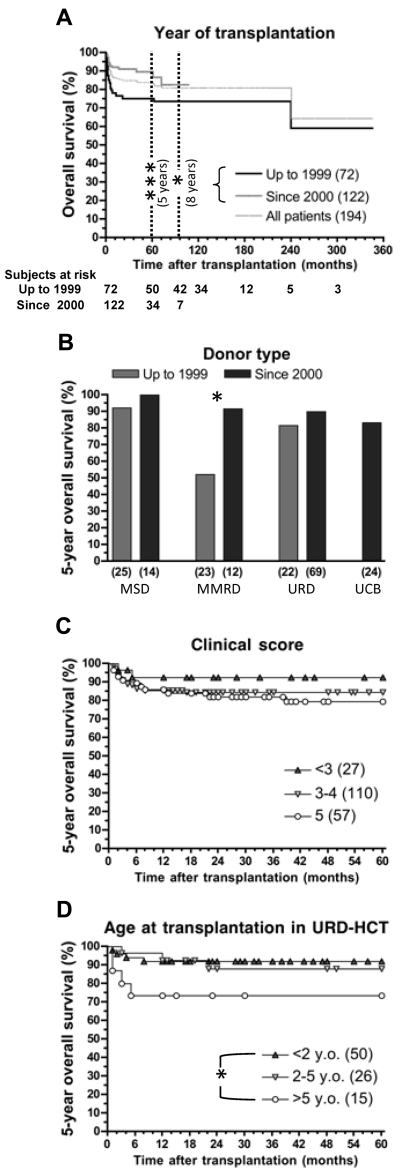
Figure 1
Figure 1
Outcome of 194 patients affected by WAS after HCT. (A) Probability of survival for all patients according to year of transplantation. (B-D) Five-year overall survival for patients who received a transplant up to 1999 and since 2000 and grouped by donor type (B), clinical status before transplantation, as measured by clinical score (C), or for 91 patients receiving URD-HCT and divided in 3 groups according to their age at transplantation (D). *P < .05. ***P < .005
Figure 2
Figure 2
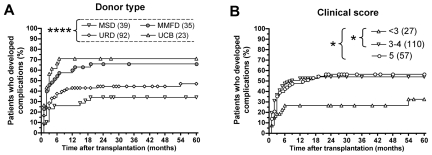
Probability of clinical and immunologic complications for 194 WAS patients who received HCT. (A) Percentage of patients who developed any complication (graft failure/rejection, acute GVHD grade 3 or 4, extensive cGVHD, severe infections, autoimmune manifestations, tumors, and post-HCT sequelae) up to 5 years after HCT, according to donor type. (B) Percentage of patients who developed any complication up to 5 years after HCT, according to clinical status (measured by clinical score) at the time of HCT. *P < .05. ****P < .001
Figure 3
Figure 3
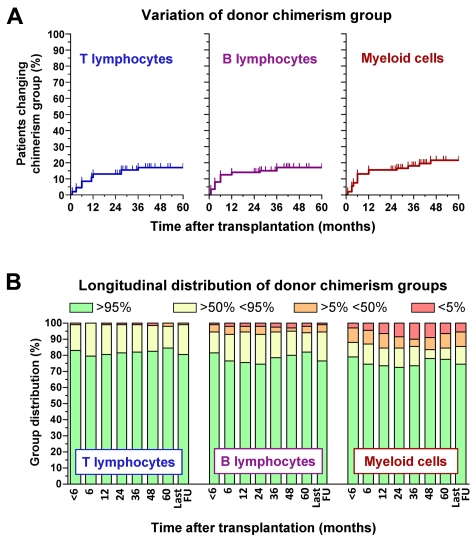
Longitudinal analysis of lineage-specific chimerism after HCT. Data were collected for 92 WAS-transplanted patients with at least 24 months of follow-up after HCT. Chimerism in the T- and B-lymphocyte and in the myeloid compartment was categorized according to the percentage of donor cells in 4 different groups ranging from full (defined by the presence of > 95% donor cells), high (> 50%-95%), low (5%-50%), to null (< 5%) chimerism. These data are reported for each cell type in panel A to show the longitudinal profile of donor chimerism variations, defined as changes in chimerism group, or in panel B to display the distribution of lineage-specific chimerism groups at various time points after HCT.
Figure 4
Figure 4
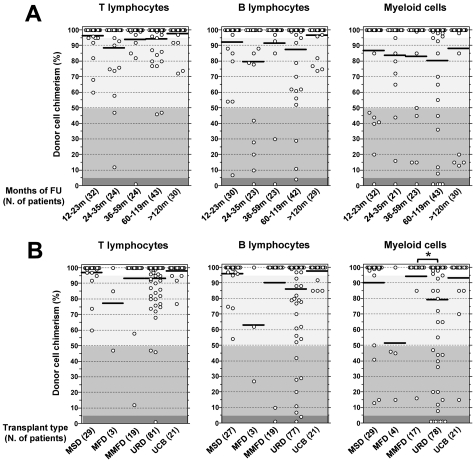
Quantitative analysis of lineage-specific chimerism at the time of last follow-up in 154 WAS-transplanted patients who had at least 12 months of follow-up after HCT. The percentage of donor-derived T, B, and myeloid cells is reported for each patient. (A) Data of lineage-specific chimerism at the time of last follow-up visit. Patients are grouped according to follow-up interval, and the number of patients studied at each interval is indicated in parentheses. (B) Patients are grouped according to donor type, and the number of patients receiving HCT from a specific type of donor is indicated in parentheses. *P < .05. Horizontal bars represent mean values (A-B).
Figure 5
Figure 5
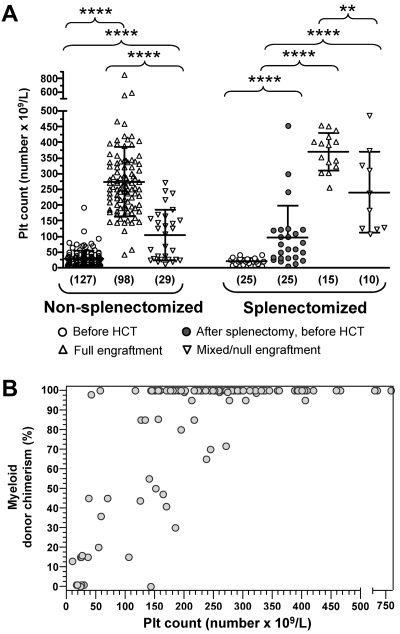
Influence of the degree of myeloid cell engraftment on platelet count. Platelet counts before and after HCT were reported for 152 WAS-transplanted patients, who had at least 12 months of follow-up after HCT and for whom quantitative analysis of donor cell engraftment on myeloid cells was available. Pretransplantation splenectomized patients were separated from nonsplenectomized patients. (A) Patients of both groups were further divided according to the degree of donor myeloid cell engraftment (full or mixed/null). For each of them, platelet (PLT) counts at diagnosis and at last follow-up are shown, with pretransplantation values of splenectomized patients reported both at diagnosis and after splenectomy. **P < .01. ****P < .001. (B) Correlation between the platelet (PLT) count of nonsplenectomized patients and the percentage of donor myeloid cell engraftment is shown. A significant correlation between these 2 parameters was observed according to the nonparametric Spearman test (r = 0.584, P < .001).
Figure 6
Figure 6
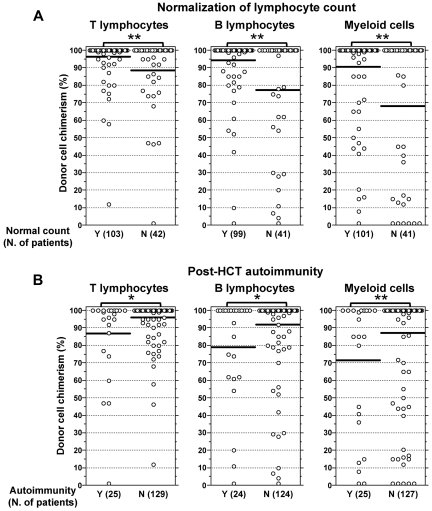
Influence of the degree of donor cell engraftment on the reconstitution of lymphocyte counts and autoimmunity after HCT. Data are shown for WAS-transplanted patients who had at least 12 months of follow-up after HCT and for whom data of lineage-specific chimerism were available. (A) The percentage of donor chimerism for each cell lineage at the time of last follow-up is shown for patients who attained (Y) or did not attain (N) normalization of T- and B-cell counts (defined as CD3+ > 1000 cells/μL, CD4+ > 600 cells/μL, CD8+ > 300 cells/μL, and CD19+ > 200 cells/μL). **P < .01. (B) The percentage of donor lineage-specific chimerism is shown for patients who developed (Y) or did not develop (N) autoimmunity. *P < .05. **P < .01. Horizontal bars represent mean values (A-B).

References

    1. Ochs HD, Filipovich AH, Veys P, Cowan MJ, Kapoor N. Wiskott-Aldrich syndrome: diagnosis, clinical and laboratory manifestations, and treatment. Biol Blood Marrow Transplant. 2009;15(1 suppl):84–90. - PubMed
    1. Ochs HD, Thrasher AJ. The Wiskott-Aldrich syndrome. J Allergy Clin Immunol. 2006;117(4):725–738. quiz 739. - PubMed
    1. Bouma G, Burns SO, Thrasher AJ. Wiskott-Aldrich syndrome: immunodeficiency resulting from defective cell migration and impaired immunostimulatory activation. Immunobiology. 2009;214(9):778–790. - PMC - PubMed
    1. Bosticardo M, Marangoni F, Aiuti A, Villa A, Grazia Roncarolo M. Recent advances in understanding the pathophysiology of Wiskott-Aldrich syndrome. Blood. 2009;113(25):6288–6295. - PubMed
    1. Derry JM, Ochs HD, Francke U. Isolation of a novel gene mutated in Wiskott-Aldrich syndrome. Cell. 1994;78(4):635–644. Erratum in: Cell. 1994;79(5):922. - PubMed

Publication types

MeSH terms