


Light treatment prevents fatigue in women undergoing chemotherapy for breast cancer
- PMID: 21660669
- PMCID: PMC3192914
- DOI: 10.1007/s00520-011-1203-z
Light treatment prevents fatigue in women undergoing chemotherapy for breast cancer
Abstract
Purpose: Fatigue is one of the most disturbing complaints of cancer patients and is often the reason for discontinuing treatment. This randomized controlled study tested the hypothesis that increased morning bright light, compared to dim light, would result in less fatigue in women with breast cancer undergoing chemotherapy.
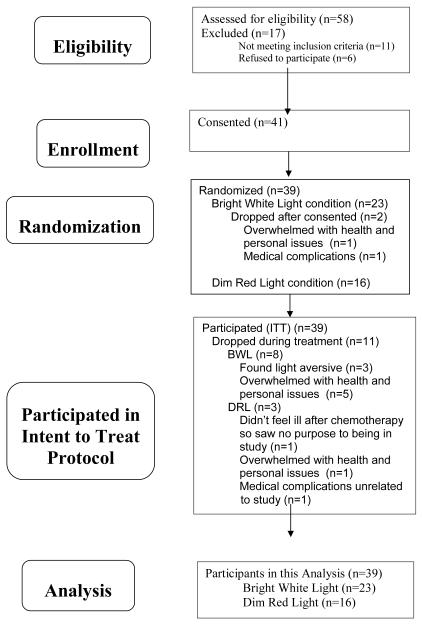
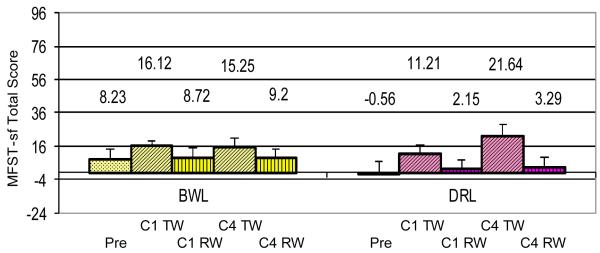
Methods: Thirty-nine women newly diagnosed with stage I-III breast cancer were randomized to either bright white light (BWL) or dim red light (DRL) treatment and were instructed to use the light box for 30 min every morning throughout the first four cycles of chemotherapy. The Multidimensional Fatigue Symptom Inventory was administered prior to the start of chemotherapy (baseline), during the chemotherapy treatment week of cycle 1 (C1TW), the last week (recovery week) of cycle 1 (C1RW), the chemotherapy treatment week of cycle 4 (C4TW), and the last week (recovery week) of cycle 4 (C4RW).
Results: The DRL group reported increased fatigue at C1TW (p = 0.003) and C4TW (p < 0.001) compared to baseline, while there was no significant change from baseline in the BWL group. A secondary analysis showed that the increases in fatigue levels in the DRL group were not mediated through nor associated with changes in sleep or in circadian rhythms as measured with wrist actigraphy.
Conclusions: The results of this study suggest that morning bright light treatment may prevent overall fatigue from worsening during chemotherapy. Although our hypothesis that overall fatigue would improve with bright light treatment was not supported, the lack of deterioration in total fatigue scores suggests that bright morning light may be a useful intervention during chemotherapy for breast cancer.
Figures
References
-
- Richardson A. Fatigue in cancer patients: a review of the literature. European Journal of Cancer Care. 1995;4:20–32. - PubMed
-
- Winningham ML, Nail LM, Burke MB, Brophy L, Cimprich B, Jones LS, Pickard-Holley S, Rhodes V, St.Pierre B, Beck S, Glass EC, Mock VL, Mooney KH, Piper B. Fatigue and the cancer experience; the state of the knowledge. Oncology Nursing Forum. 1994;21:23–36. - PubMed
-
- National Comprehensive Cancer Network . Cancer-related fatigue: NCCN clinical practice guidelines in oncology. NCCN; 2008.
-
- Stasi R, Abriani L, Beccaglia P, Terzoli E, Amadori S. Cancer-related fatigue: evolving concepts in evaluation and treatment. Cancer. 2003;98:1786–1801. - PubMed
-
- Mock V, Atkinson A, Barsevick A, Cella D, Cimprich B, Cleeland C, Donnelly J, Eisenberger MA, Escalante C, Hinds P, Jacobsen PB, Kaldor P, Knight SJ, Peterman A, Piper BF, Rugo H, Sabbatini P, Stahl C. NCCN Practice Guidelines for Cancer-Related Fatigue. Oncology (Williston.Park) 2000;14:151–161. - PubMed
Publication types
MeSH terms
Grants and funding
LinkOut - more resources
Full Text Sources
Medical
