Review
. 2011 Jun;30(5):673-82.
doi: 10.1002/nau.21078.

Models of inflammation of the lower urinary tract

Affiliations
Review

Models of inflammation of the lower urinary tract

Dale E Bjorling et al. Neurourol Urodyn. 2011 Jun.

Abstract

Inflammation of the lower urinary tract occurs frequently in people. The causes remain obscure, with the exception of urinary tract infection. Animal models have proven useful for investigating and assessing mechanisms underlying symptoms associated with lower urinary tract inflammation and options for suppressing these symptoms. This review will discuss various animal models of lower urinary tract inflammation, including feline spontaneous (interstitial) cystitis, neurogenic cystitis, autoimmune cystitis, cystitis induced by intravesical instillation of chemicals or bacterial products (particularly lipopolysaccharide or LPS), and prostatic inflammation initiated by transurethral instillation of bacteria. Animal models will continue to be of significant value in identifying mechanisms resulting in bladder inflammation, but the relevance of some of these models to the causes underlying clinical disease is unclear. This is primarily because of the lack of understanding of causes of these disorders in people. Comparative and translational studies are required if the full potential of findings obtained with animal models to improve prevention and treatment of lower urinary tract inflammation in people is to be realized.


Figures

Figure 1
Figure 1
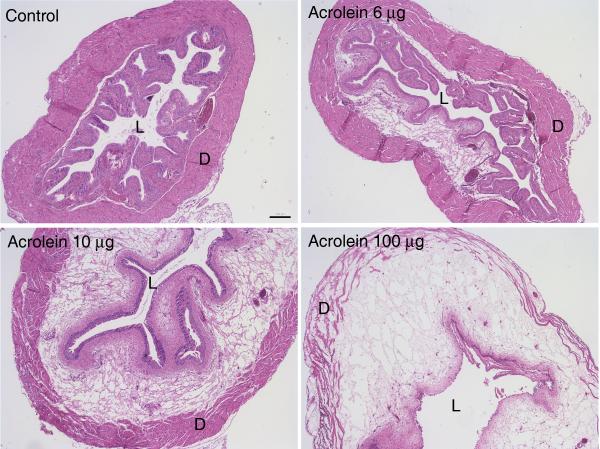
Four (A) and 24 hours (B) after instillation of acrolein (6, 10, or 100 μg; 15 μl total volume) or 15 μl phosphate buffered saline (PBS; control) into the bladders of female C57BL6N mice, it was observed that the severity of inflammation as indicated by intramural edema and hemorrhage correlated with increasing concentrations of acrolein. (L, lumen; D, detrusor); 40x original; scale bar = 200 μm. (With permission from: Bjorling DE, Elkahwaji JE, Bushman W, Janda LM, Boldon K, Hopkins WJ, Wang ZY. Acute acrolein-induced cystitis in mice. BJU Int 2007;99:1523-1529.)
Figure 1
Figure 1
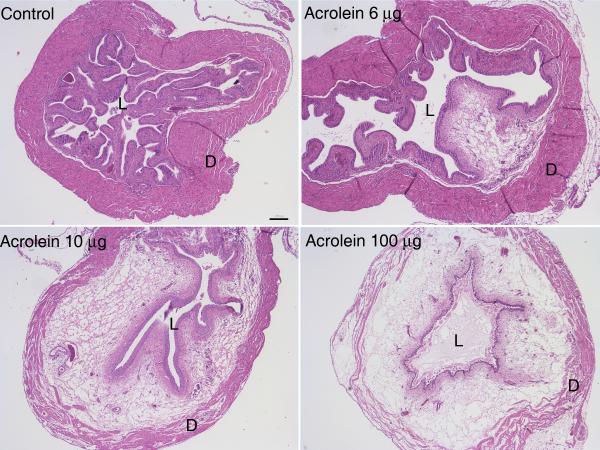
Four (A) and 24 hours (B) after instillation of acrolein (6, 10, or 100 μg; 15 μl total volume) or 15 μl phosphate buffered saline (PBS; control) into the bladders of female C57BL6N mice, it was observed that the severity of inflammation as indicated by intramural edema and hemorrhage correlated with increasing concentrations of acrolein. (L, lumen; D, detrusor); 40x original; scale bar = 200 μm. (With permission from: Bjorling DE, Elkahwaji JE, Bushman W, Janda LM, Boldon K, Hopkins WJ, Wang ZY. Acute acrolein-induced cystitis in mice. BJU Int 2007;99:1523-1529.)
Figure 2
Figure 2
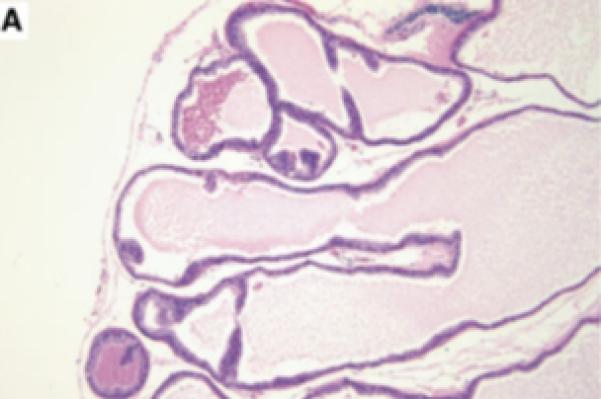
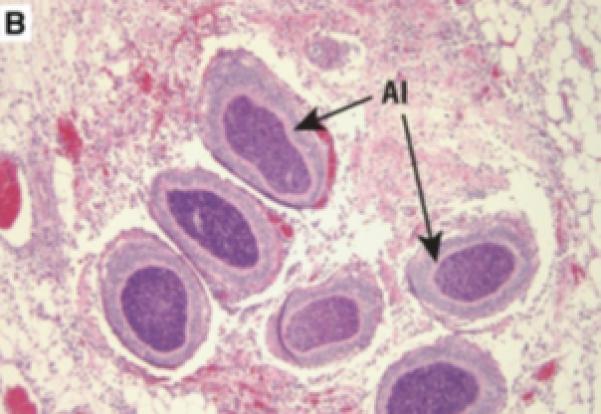
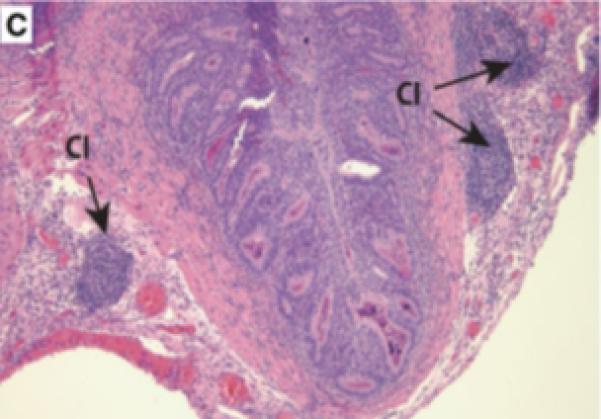
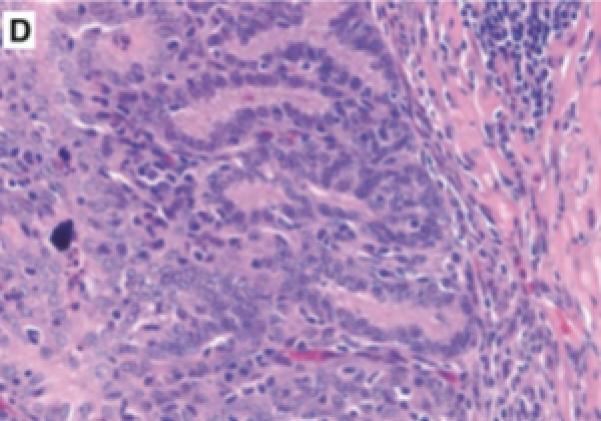
Prostatic inflammation was induced by a single transurethral instillation of E. coli 1677 in C3H/OuJ mice as previously described (141). A. Instillation of saline failed to cause any histological response when tissues from mice sacrificed 5 days after infusion were stained with hematoxylin and eosin. B. Five days after instillation of E. coli 1677, evidence of acute inflammation (AI) characterized by edema, inflammatory cell infiltrate, and exfoliation of epithelial cells into the ducts was observed. C. and D. Chronic inflammation (CI) consisting of dense accumulation of lymphocytes was present in the coagulating gland 12 weeks after instillation of bacteria, as well as evidence of early dysplastic changes in the ductal wall (D). 10x original. (With permission from: Elkahwaji JE, Zhong W, Hopkins WJ, Bushman W.Chronic bacterial infection and inflammation incite reactive hyperplasia in a mouse model of chronic prostatitis. Prostate 2007;67:14-21.)
Figure 2
Figure 2
Prostatic inflammation was induced by a single transurethral instillation of E. coli 1677 in C3H/OuJ mice as previously described (141). A. Instillation of saline failed to cause any histological response when tissues from mice sacrificed 5 days after infusion were stained with hematoxylin and eosin. B. Five days after instillation of E. coli 1677, evidence of acute inflammation (AI) characterized by edema, inflammatory cell infiltrate, and exfoliation of epithelial cells into the ducts was observed. C. and D. Chronic inflammation (CI) consisting of dense accumulation of lymphocytes was present in the coagulating gland 12 weeks after instillation of bacteria, as well as evidence of early dysplastic changes in the ductal wall (D). 10x original. (With permission from: Elkahwaji JE, Zhong W, Hopkins WJ, Bushman W.Chronic bacterial infection and inflammation incite reactive hyperplasia in a mouse model of chronic prostatitis. Prostate 2007;67:14-21.)
Figure 2
Figure 2
Prostatic inflammation was induced by a single transurethral instillation of E. coli 1677 in C3H/OuJ mice as previously described (141). A. Instillation of saline failed to cause any histological response when tissues from mice sacrificed 5 days after infusion were stained with hematoxylin and eosin. B. Five days after instillation of E. coli 1677, evidence of acute inflammation (AI) characterized by edema, inflammatory cell infiltrate, and exfoliation of epithelial cells into the ducts was observed. C. and D. Chronic inflammation (CI) consisting of dense accumulation of lymphocytes was present in the coagulating gland 12 weeks after instillation of bacteria, as well as evidence of early dysplastic changes in the ductal wall (D). 10x original. (With permission from: Elkahwaji JE, Zhong W, Hopkins WJ, Bushman W.Chronic bacterial infection and inflammation incite reactive hyperplasia in a mouse model of chronic prostatitis. Prostate 2007;67:14-21.)
Figure 2
Figure 2
Prostatic inflammation was induced by a single transurethral instillation of E. coli 1677 in C3H/OuJ mice as previously described (141). A. Instillation of saline failed to cause any histological response when tissues from mice sacrificed 5 days after infusion were stained with hematoxylin and eosin. B. Five days after instillation of E. coli 1677, evidence of acute inflammation (AI) characterized by edema, inflammatory cell infiltrate, and exfoliation of epithelial cells into the ducts was observed. C. and D. Chronic inflammation (CI) consisting of dense accumulation of lymphocytes was present in the coagulating gland 12 weeks after instillation of bacteria, as well as evidence of early dysplastic changes in the ductal wall (D). 10x original. (With permission from: Elkahwaji JE, Zhong W, Hopkins WJ, Bushman W.Chronic bacterial infection and inflammation incite reactive hyperplasia in a mouse model of chronic prostatitis. Prostate 2007;67:14-21.)

References

    1. Vital and Health Statistics. Hyattsville, MD: National Center for Health Statistics, Centers for Disease Control and Prevention, U.S. Dept. of Health and Human Services; Sep, 2004. Ambulatory Care Visits to Physician Offices, Hospital Outpatient Departments, and Emergency Departments: United States, 1999–2000. (Series 13). - PubMed
    1. Nicolle LE, Bradley S, Colgan R, Rice JC, Schaeffer A, Hooton TM. Infectious Diseases Society of America guidelines for the diagnosis and treatment of asymptomatic bacteriuria in adults. Clin Infect Dis. 2005;40:643–654. - PubMed
    1. Berry SH, Bogart LM, Pham C, Liu K, Nyberg L, Stoto M, Suttorp M, Clemens JQ. Development, validation and testing of an epidemiological case definition of interstitial cystitis/painful bladder syndrome. J Urol. 2010;183:1848–1852. - PMC - PubMed
    1. Clemens JQ, Joyce GF, Wise M, Payne CK. Litwin MS, Saigal CS, editors. Urologic Diseases in America. Washington, DC: US Department of Health and Human Services, National Institutes of Health, US Government Printing Office; 2007. Interstitial cystitis and painful bladder syndrome. pp. 123–154. NIH publication 07–5112.
    1. Wyndaele JJ, Van Dyck J, Toussaint N. Cystoscopy and bladder biopsies in patients with bladder pain syndrome carried out following ESSIC guidelines. Scand J Urol Nephrol. 2009;43:471–475. - PubMed

Publication types

LinkOut - more resources