


Racial disparities in quality of medication use in older adults: findings from a longitudinal study
- PMID: 21664193
- PMCID: PMC3152610
- DOI: 10.1016/j.amjopharm.2011.05.002
Racial disparities in quality of medication use in older adults: findings from a longitudinal study
Abstract
Background: The quality of medication use in older adults is suboptimal, with a large percentage of individuals not receiving recommended care. Most efforts to evaluate the quality of medication use target high-risk drugs, appropriate treatment of prevalent chronic disease states, or a set of predefined quality indicators of medication use rather than the patient. It is also suggested that racial differences in the quality of medication use may exist in older adults.
Objective: This study was conducted to determine the prevalence, number, and types of medication-related problems in older adults, examining the impact of race on quality medication use.
Methods: This was a prospective cohort study involving in-home interviews and medical record reviews of community-residing older adults, stratified by race, conducted 3 times over 1 year. No intervention to address medication-related problems was performed. The quality of medication use was reported as medication-related problems by clinical pharmacists.
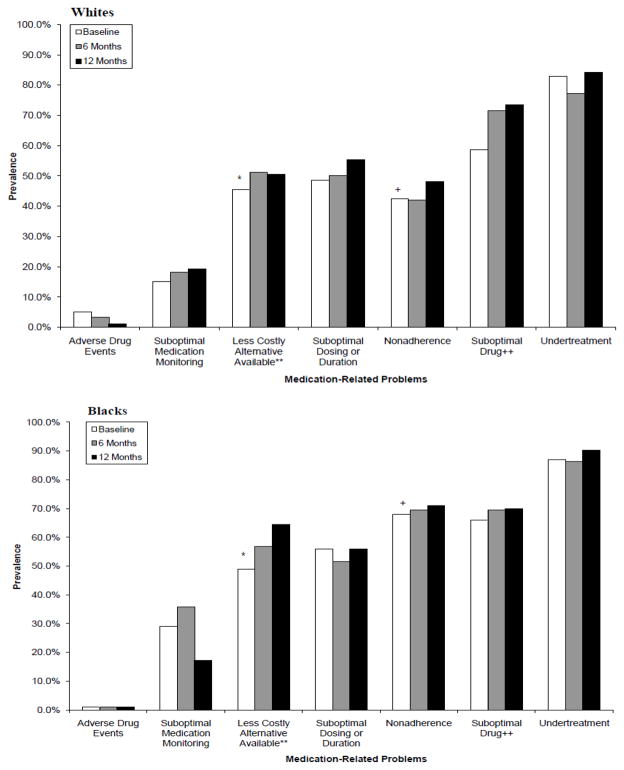
Results: Of the 200 participants (100 blacks, 100 whites), mean age was 78.3 (whites) and 75.5 (blacks), and the majority of patients were female. Although whites used more medications than blacks (mean, 11.6 vs 9.7; P < 0.01), blacks had more medication-related problems per person than whites (mean, 6.3 vs 4.9; P < 0.01). All patients had at least 1 medication-related problem. Common problems at baseline, 6 months, and 12 months for both whites and blacks were undertreatment, suboptimal drug use, suboptimal dosing, nonadherence, and less costly alternative available. Blacks had significantly higher rates of nonadherence than whites (68% vs 42%; P < 0.01). Over the 12-month study, the number of medication-related problems not only persisted but increased (adjusted P = 0.0168).
Conclusions: Medication-related problems were prevalent in both black and white older adults and persisted over 1 year. Blacks had more medication-related problems than whites, including higher rates of nonadherence. These findings require further study to better understand racial disparities in the quality of medication use in older adults and the impact of race on specific medication-related problems.
Copyright © 2011 Elsevier HS Journals, Inc. All rights reserved.
Conflict of interest statement
CONFLICT OF INTEREST
There are no conflicts of interest or financial interests to declare for any of the authors.
Figures
References
-
- Shrank WH, Asch SM, Adams J, et al. The quality of pharmacologic care for adults in the United States. Med Care. 2006;44:936–45. - PubMed
-
- Roth MT, Weinberger M, Campbell WH. Measuring the quality of medication use in older adults. J Am Geriatr Soc. 2009 Jun;57(6):1096–102. Epub 2009 Apr 16. - PubMed
-
- Hohl CM, Dankoff J, Colacone A, Afilalo M. Polypharmacy, adverse drug-related events, and potential adverse drug interactions in elderly patients presenting to an emergency department. Ann Emerg Med. 2001;38:666–71. - PubMed
-
- Higashi T, Shekelle PG, Adams JL, et al. Quality of care is associated with survival in vulnerable older patients. Ann Intern Med. 2005;143:274–81. - PubMed
Publication types
MeSH terms
Grants and funding
LinkOut - more resources
Full Text Sources
Medical
