


Unraveling the role of FoxOs in bone--insights from mouse models
- PMID: 21664311
- PMCID: PMC3143252
- DOI: 10.1016/j.bone.2011.05.023
Unraveling the role of FoxOs in bone--insights from mouse models
Abstract
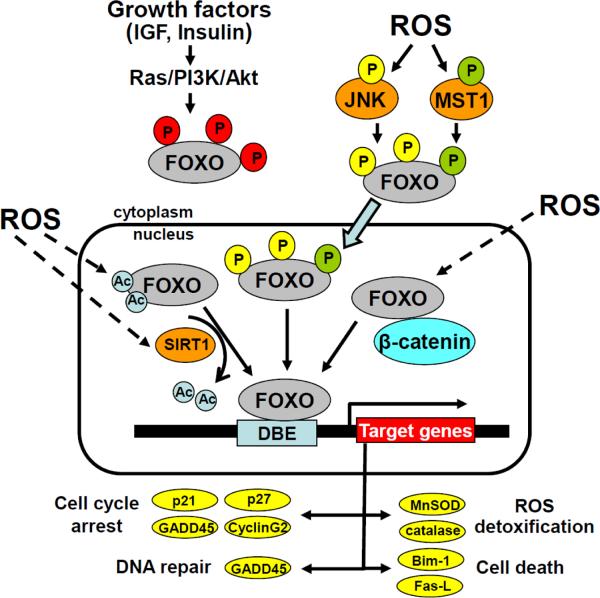
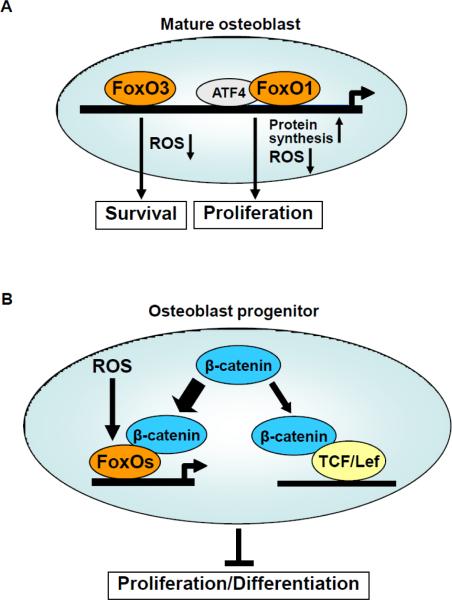
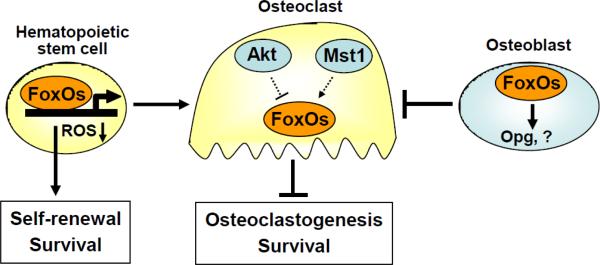
The FoxO subfamily of forkhead transcription factors plays a critical role in a variety of physiological processes including metabolism, differentiation, proliferation, apoptosis and protection from stress. FoxO activity is inhibited by growth factors and the insulin signaling pathways and stimulated by nutrient depletion and a plethora of reactive oxygen species (ROS)-induced post-translational modifications. Recent studies have uncovered a fundamental role for FoxOs in skeletal homeostasis. In cells of the osteoblast lineage, FoxOs modulate redox balance, protein synthesis, and differentiation through the activation of specific gene programs and interaction with other transcription factors and co-factors such as β-catenin, ATF-4, and Runx2. FoxO activation also attenuates osteoclastogenesis through both cell autonomous and indirect mechanisms. In this review I discuss recent advances in the understanding of FoxO specific actions in osteoblast progenitors, osteoblasts, and osteoclast, as well as the implications of FoxO activation for age-related skeletal involution.
Copyright © 2011 Elsevier Inc. All rights reserved.
Figures
References
-
- Greer EL, Brunet A. FOXO transcription factors at the interface between longevity and tumor suppression. Oncogene. 2005;24:7410–25. - PubMed
-
- Jacobs FM, van der Heide LP, Wijchers PJ, Burbach JP, Hoekman MF, Smidt MP. FoxO6, a novel member of the FoxO class of transcription factors with distinct shuttling dynamics. J Biol Chem. 2003;278:35959–67. - PubMed
-
- Arden KC. FOXO animal models reveal a variety of diverse roles for FOXO transcription factors. Oncogene. 2008;27:2345–50. - PubMed
-
- Puig O, Mattila J. Understanding Forkhead Box Class O Function: Lessons from Drosophila melanogaster. Antioxid Redox Signal. 2011;14:635–47. - PubMed
-
- Partridge L, Bruning JC. Forkhead transcription factors and ageing. Oncogene. 2008;27:2351–63. - PubMed
Publication types
MeSH terms
Substances
Grants and funding
LinkOut - more resources
Full Text Sources
