


Vitamin D metabolism and innate immunity
- PMID: 21664425
- PMCID: PMC3200473
- DOI: 10.1016/j.mce.2011.04.015
Vitamin D metabolism and innate immunity
Abstract
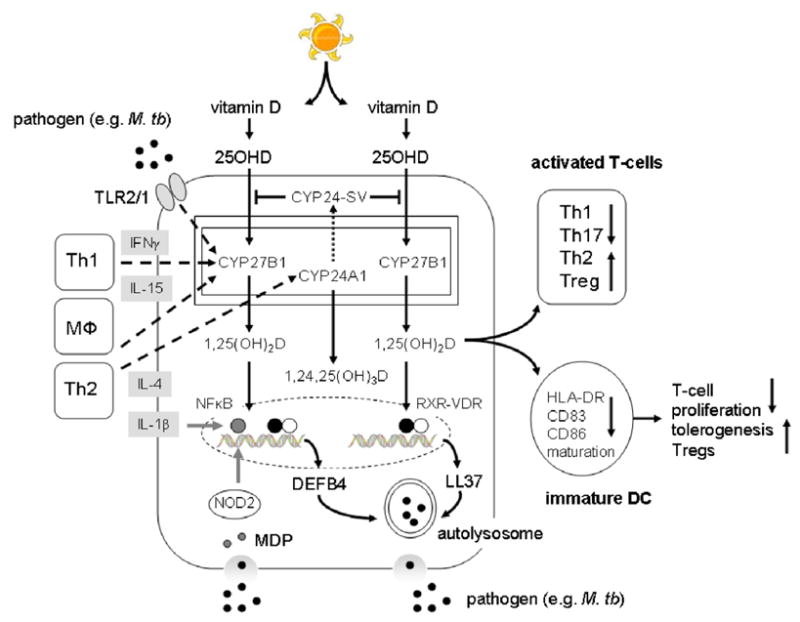
Effects of vitamin D on the immune system have been recognized for over 30 years and stemmed in part from analysis of the dysregulated vitamin D metabolism associated with granulomatous diseases. However, it is only in more recent years that a role for interaction between vitamin D and normal immune function has been proposed. As with the original studies, the basis for this new perspective on immunomodulation by vitamin D stems from studies of vitamin D metabolism by immune cells. In particular, induction of the vitamin D-activating enzyme CYP27B1 in monocytes via pathogen recognizing receptors has highlighted an entirely new function for vitamin D as a potent inducer of antibacterial innate immune responses. This has prompted a new potential role for vitamin D in protecting against infection in a wide range of tissues but has also prompted revision of the parameters for adequate vitamin D status. The following review describes some of the key developments in innate immune responses to vitamin D with particular emphasis on the role of key metabolic enzyme as determinants of localized immune activity of vitamin D.
Copyright © 2011 Elsevier Ireland Ltd. All rights reserved.
Figures
References
-
- Eisman JA, Martin TJ, MacIntyre I, Moseley JM. 1,25-dihydroxyvitamin-D-receptor in breast cancer cells. Lancet. 1979;2:1335–6. - PubMed
-
- Manolagas SC, Haussler MR, Deftos LJ. 1,25-dihydroxyvitamin D3 receptors in cancer. Lancet. 1980;1:828. - PubMed
-
- Colston K, Colston MJ, Feldman D. 1,25-dihydroxyvitamin D3 and malignant melanoma: the presence of receptors and inhibition of cell growth in culture. Endocrinology. 1981;108:1083–6. - PubMed
-
- Abe E, Miyaura C, Tanaka H, Shiina Y, Kuribayashi T, Suda S, Nishii Y, DeLuca HF, Suda T. 1 alpha,25-dihydroxyvitamin D3 promotes fusion of mouse alveolar macrophages both by a direct mechanism and by a spleen cell-mediated indirect mechanism. Proc Natl Acad Sci U S A. 1983;80:5583–7. - PMC - PubMed
Publication types
MeSH terms
Substances
Grants and funding
LinkOut - more resources
Full Text Sources
Other Literature Sources
Medical
Research Materials
