


All-cause, liver-related, and non-liver-related mortality among HCV-infected individuals in the general US population
- PMID: 21665867
- PMCID: PMC4542754
- DOI: 10.1093/cid/cir306
All-cause, liver-related, and non-liver-related mortality among HCV-infected individuals in the general US population
Abstract
Background: Liver-related mortality among those infected with hepatitis C virus (HCV) has been described, but little is known about non-liver-related mortality. Our objective was to determine HCV-associated all-cause, liver-, and non-liver-related mortality in the general US population.
Methods: A prospective cohort study of 9378 nationally representative adults aged 17-59 years was performed utilizing the Third National Health and Nutrition Examination Survey (NHANES III) Linked Mortality File that was made publicly available in 2010. HCV status was assessed from 1988 to 1994, with mortality follow-up of the same individuals through 2006.
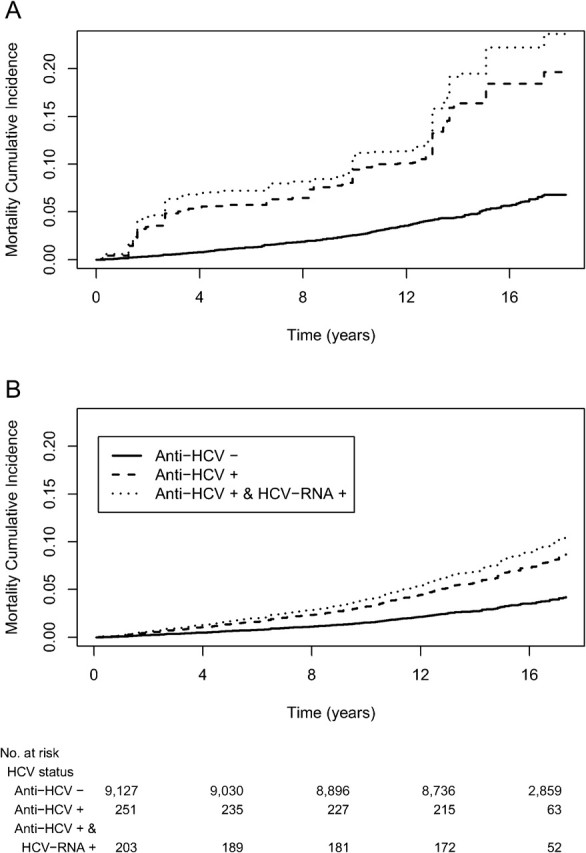
Results: There were 614 deaths over a median follow-up of 14.8 years. After adjusting for all covariate risk factors, HCV chronic infection had a 2.37 times higher all-cause mortality rate ratio [MRR] (95% CI: 1.28-4.38; P = .008), a 26.46 times higher liver-related MRR (95% CI: 8.00-87.48; P < .001), and 1.79 times higher non-liver-related MRR (95% CI: .77-4.19; P = .18), compared with being HCV-negative. This represents an estimated 2.46 million US adults aged 17-59 years with chronic HCV infection who had an estimated 31,163 deaths from all causes per year, of which 57.8% (95% CI: 21.9%-77.2%) were attributable to HCV. Among those, there was an estimated 9569 liver-related deaths per year, of which 96.2% (95% CI: 87.5-98.9%) were attributable to HCV. Non-liver-related deaths were not significantly associated with HCV status.
Conclusions: Chronic HCV all-cause mortality is more than twice that of HCV-negative individuals. This suggests that those with chronic HCV infection are at a higher risk of death even after accounting for liver-related morbidity and should be closely monitored.
Figures
References
-
- Global Burden Of Hepatitis C Working Group. Global burden of disease (GBD) for hepatitis C. J Clin Pharmacol. 2004;44:20–9. - PubMed
-
- Heintges T, Wands JR. Hepatitis C virus: epidemiology and transmission. Hepatology. 1997;26:521–6. - PubMed
-
- Kenny-Walsh E. Clinical outcomes after hepatitis C infection from contaminated anti-D immune globulin. Irish Hepatology Research Group. N Engl J Med. 1999;340:1228–33. - PubMed
-
- Shakil AO, Conry-Cantilena C, Alter HJ, et al. Volunteer blood donors with antibody to hepatitis C virus: clinical, biochemical, virologic, and histologic features. The Hepatitis C Study Group. Ann Intern Med. 1995;123:330–7. - PubMed
-
- Vogt M, Lang T, Frosner G, et al. Prevalence and clinical outcome of hepatitis C infection in children who underwent cardiac surgery before the implementation of blood-donor screening. N Engl J Med. 1999;341:866–70. - PubMed
