. 2011 Aug;130(2):265-80.
doi: 10.1007/s00439-011-1024-7. Epub 2011 Jun 12.

X-inactivation and X-reactivation: epigenetic hallmarks of mammalian reproduction and pluripotent stem cells

Affiliations

X-inactivation and X-reactivation: epigenetic hallmarks of mammalian reproduction and pluripotent stem cells

Bernhard Payer et al. Hum Genet. 2011 Aug.

Abstract

X-chromosome inactivation is an epigenetic hallmark of mammalian development. Chromosome-wide regulation of the X-chromosome is essential in embryonic and germ cell development. In the male germline, the X-chromosome goes through meiotic sex chromosome inactivation, and the chromosome-wide silencing is maintained from meiosis into spermatids before the transmission to female embryos. In early female mouse embryos, X-inactivation is imprinted to occur on the paternal X-chromosome, representing the epigenetic programs acquired in both parental germlines. Recent advances revealed that the inactive X-chromosome in both females and males can be dissected into two elements: repeat elements versus unique coding genes. The inactive paternal X in female preimplantation embryos is reactivated in the inner cell mass of blastocysts in order to subsequently allow the random form of X-inactivation in the female embryo, by which both Xs have an equal chance of being inactivated. X-chromosome reactivation is regulated by pluripotency factors and also occurs in early female germ cells and in pluripotent stem cells, where X-reactivation is a stringent marker of naive ground state pluripotency. Here we summarize recent progress in the study of X-inactivation and X-reactivation during mammalian reproduction and development as well as in pluripotent stem cells.


Figures
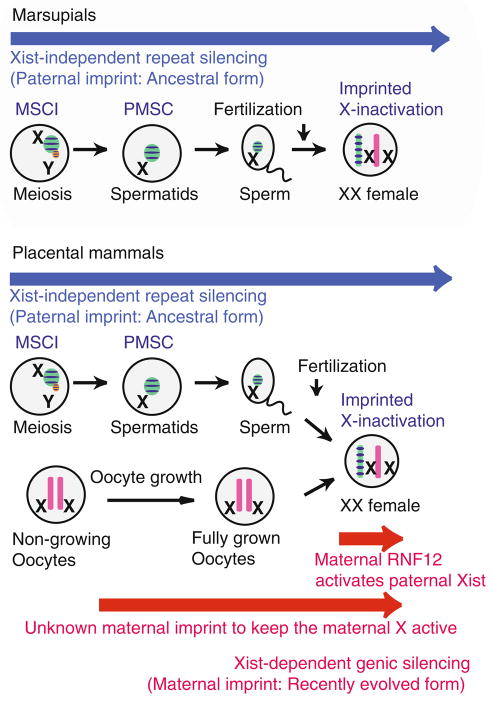
Fig. 1
Fig. 1
Models about the origin of imprinted X-inactivation. In marsupials, MSCI and PMSC may be the driving force of imprinted X-inactivation (upper panel). In placental mammals such as mice, imprinted X-inactivation is regulated by the bi-parental imprints (lower panels). Barred chromosomes represent silent imprints on the paternal X-chromosome
Fig. 2
Fig. 2
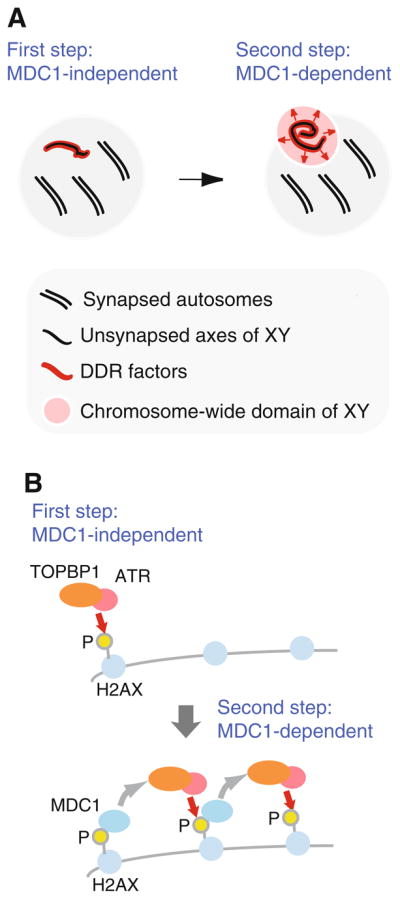
Models of the initiation of meiotic sex chromosome inactivation (MSCI). a Pictorial representation of the role of MDC1 in establishing chromosome-wide inactivation in MSCI (Ichijima et al. 2011). The first step is MDC1-independent recognition of the unsynapsed axis. The second step is MDC1-dependent spreading of DDR factors to the chromosome-wide domain. b Action of MDC1 in signal amplification of DDR factors. MDC1 binds γH2AX and recruits the ATR and TOPBP1 complex to spread γH2AX to the chromosome-wide domain of the sex chromosomes (Ichijima et al. 2011)
Fig. 3
Fig. 3
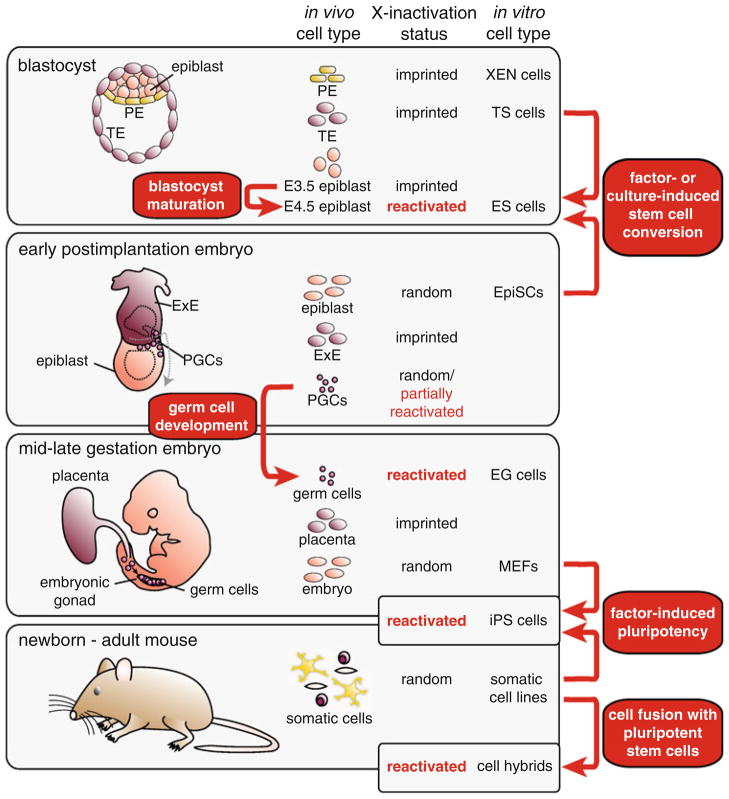
A developmental timeline of X-chromosome reactivation in mice. In vivo, X-reactivation (red arrows/ boxes) occurs in the epiblast of late blastocysts and during germ cell development. In vitro, X-reactivation is associated with reprogramming toward the naive pluripotent stem cell state like the conversion of trophoblast stem (TS) cells and epiblast stem cells (EpiSCs) to embryonic stem (ES) cells by overexpression of external factors or specific culture conditions (see text). Furthermore, X-reactivation happens during the reprogramming of adult somatic cells or mouse embryonic fibroblasts (MEFs) into induced pluripotent stem (iPS) cells by defined factors. The inactive X-chromosome in somatic cells is also reprogrammed when these cells are fused with pluripotent stem cells. EG cells embryonic germ cells, ExE extraembryonic ectoderm, PE primitive endoderm, PGCs primordial germ cells, TE trophectoderm, XEN cells extra-embryonic endoderm cell lines
Fig. 4
Fig. 4
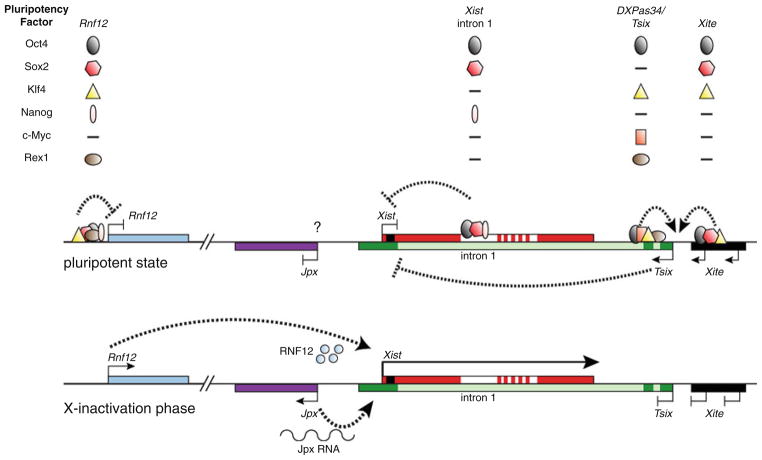
Model for the molecular link between pluripotency factors and Xist repression. In the pluripotent state (top), Oct4, Sox2 and Nanog bind to Xist intron 1 and thereby repress Xist transcription directly. Furthermore, Oct4, Sox2, Klf4, c-Myc and Rex1 also bind regions within the DXPas34 and/or Xite enhancers resulting in Tsix-activation. Tsix in turn is an inhibitor of Xist expression. The two activators of Xist expression Rnf12 and Jpx are expressed at low levels in pluripotent cells. In case of Rnf12, this is achieved by repressive action of pluripotency factors at regulatory regions (Barakat et al. 2011; Kim et al. 2008; Navarro et al. 2011). It is also unknown, what regulates Jpx (question mark). Thereby pluripotency factors appear to be involved in both direct and indirect mechanisms to repress Xist in pluripotent cells. During the X-inactivation phase (bottom), pluripotency factors dissociate from their binding sites, which has two effects. First, repression of Xist by pluripotency factors at intron 1 and Tsix is released and second, the Xist activators RNF12 and Jpx get upregulated, thereby elevating Xist expression

References

    1. Arpanahi A, Brinkworth M, Iles D, Krawetz SA, Paradowska A, Platts AE, Saida M, Steger K, Tedder P, Miller D. Endonuclease-sensitive regions of human spermatozoal chromatin are highly enriched in promoter and CTCF binding sequences. Genome Res. 2009;19:1338–1349. - PMC - PubMed
    1. Baarends WM, Wassenaar E, van der Laan R, Hoogerbrugge J, Sleddens-Linkels E, Hoeijmakers JH, de Boer P, Grootegoed JA. Silencing of unpaired chromatin and histone H2A ubiquitination in mammalian meiosis. Mol Cell Biol. 2005;25:1041–1053. - PMC - PubMed
    1. Bao S, Miyoshi N, Okamoto I, Jenuwein T, Heard E, Azim Surani M. Initiation of epigenetic reprogramming of the X chromosome in somatic nuclei transplanted to a mouse oocyte. EMBO Rep. 2005;6:748–754. - PMC - PubMed
    1. Bao S, Tang F, Li X, Hayashi K, Gillich A, Lao K, Surani MA. Epigenetic reversion of post-implantation epiblast to pluripotent embryonic stem cells. Nature. 2009;461:1292–1295. - PMC - PubMed
    1. Barakat TS, Jonkers I, Monkhorst K, Gribnau J. X-changing information on X inactivation. Exp Cell Res. 2010;316:679–687. - PubMed

Publication types

LinkOut - more resources