Progression along the bipolar spectrum: a longitudinal study of predictors of conversion from bipolar spectrum conditions to bipolar I and II disorders
- PMID: 21668080
- PMCID: PMC3192298
- DOI: 10.1037/a0023973
Progression along the bipolar spectrum: a longitudinal study of predictors of conversion from bipolar spectrum conditions to bipolar I and II disorders
Abstract
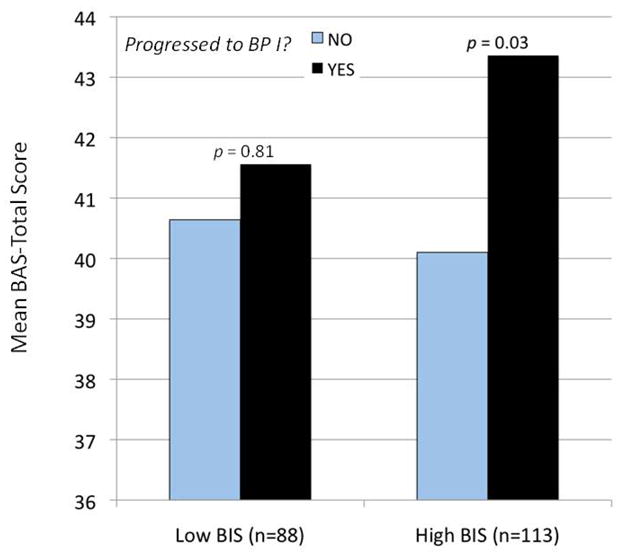
Little longitudinal research has examined progression to more severe bipolar disorders in individuals with "soft" bipolar spectrum conditions. We examine rates and predictors of progression to bipolar I and II diagnoses in a nonpatient sample of college-age participants (n = 201) with high General Behavior Inventory scores and childhood or adolescent onset of "soft" bipolar spectrum disorders followed longitudinally for 4.5 years from the Longitudinal Investigation of Bipolar Spectrum (LIBS) project. Of 57 individuals with initial cyclothymia or bipolar disorder not otherwise specified (BiNOS) diagnoses, 42.1% progressed to a bipolar II diagnosis and 10.5% progressed to a bipolar I diagnosis. Of 144 individuals with initial bipolar II diagnoses, 17.4% progressed to a bipolar I diagnosis. Consistent with hypotheses derived from the clinical literature and the Behavioral Approach System (BAS) model of bipolar disorder, and controlling for relevant variables (length of follow-up, initial depressive and hypomanic symptoms, treatment-seeking, and family history), high BAS sensitivity (especially BAS Fun Seeking) predicted a greater likelihood of progression to bipolar II disorder, whereas early age of onset and high impulsivity predicted a greater likelihood of progression to bipolar I (high BAS sensitivity and Fun-Seeking also predicted progression to bipolar I when family history was not controlled). The interaction of high BAS and high Behavioral Inhibition System (BIS) sensitivities also predicted greater likelihood of progression to bipolar I. We discuss implications of the findings for the bipolar spectrum concept, the BAS model of bipolar disorder, and early intervention efforts.
PsycINFO Database Record (c) 2012 APA, all rights reserved.
Figures
References
-
- Akiskal HS, Djenderedjian AH, Rosenthal RH, Khani MK. Cyclothymic disorder: Validating criteria for inclusion in the bipolar affective group. American Journal of Psychiatry. 1977;134:1227–1233. - PubMed
-
- Akiskal HS, Hantouche EG, Allilaire JF. Bipolar II with and without cyclothymic temperament: “dark” and “sunny” expressions of soft bipolarity. Journal of Affective Disorders. 2003;73:49–57. - PubMed
Publication types
MeSH terms
Grants and funding
LinkOut - more resources
Full Text Sources
Medical
Miscellaneous