


A genome-wide association study of DSM-IV cannabis dependence
- PMID: 21668797
- PMCID: PMC3117436
- DOI: 10.1111/j.1369-1600.2010.00255.x
A genome-wide association study of DSM-IV cannabis dependence
Abstract
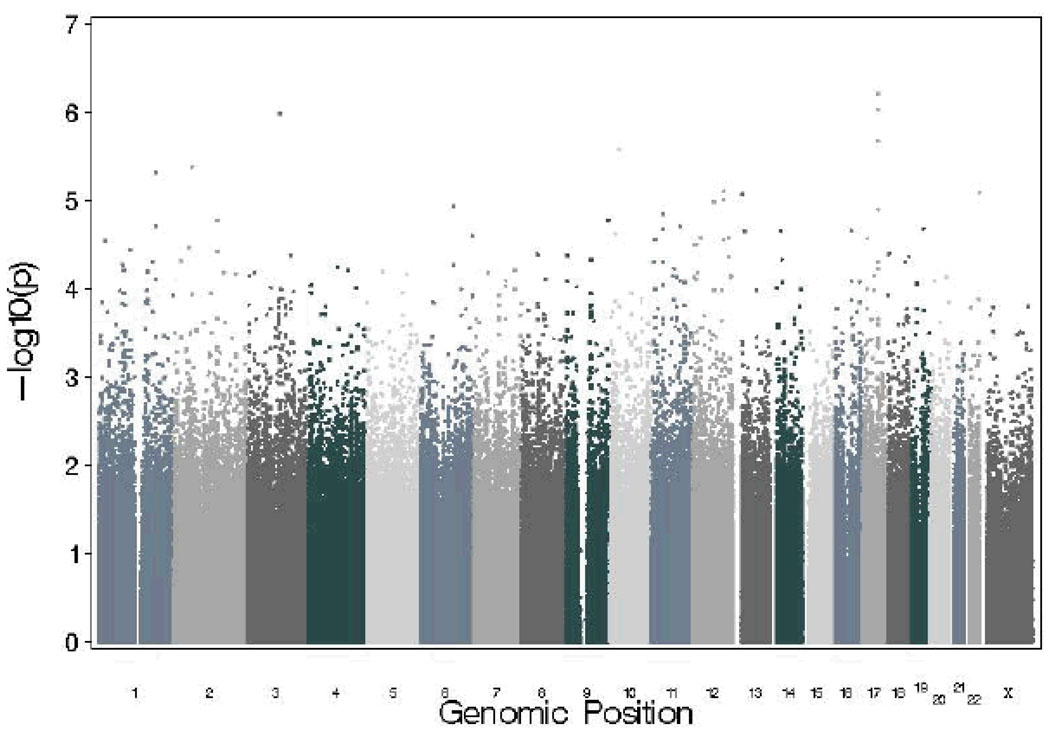
Despite twin studies showing that 50-70% of variation in DSM-IV cannabis dependence is attributable to heritable influences, little is known of specific genotypes that influence vulnerability to cannabis dependence. We conducted a genome-wide association study of DSM-IV cannabis dependence. Association analyses of 708 DSM-IV cannabis-dependent cases with 2346 cannabis-exposed non-dependent controls was conducted using logistic regression in PLINK. None of the 948 142 single nucleotide polymorphisms met genome-wide significance (P at E-8). The lowest P values were obtained for polymorphisms on chromosome 17 (rs1019238 and rs1431318, P values at E-7) in the ANKFN1 gene. While replication is required, this study represents an important first step toward clarifying the biological underpinnings of cannabis dependence.
© 2010 The Authors, Addiction Biology © 2010 Society for the Study of Addiction.
Figures
References
-
- Agrawal A, Lynskey M. The Genetic Epidemiology of Cannabis Use, Abuse and Dependence: A Review. Addiction. 2006;101:801–812. - PubMed
-
- Benjamini Y, Hochberg Y. Controlling the false discovery rate: a practical and powerful approach to multiple testing. Journal of the Royal Statistical Society Series B. 1995;57:289–300.
-
- Bierut L, Agrawal A, Bucholz K, Doheny KF, Laurie CC, Pugh EW, Fisher S, Fox L, Howells B, Bertelsen S, Hinrichs A, Almasy L, Breslau N, Culverhouse R, Dick D, Edenberg H, Foroud T, Grucza RA, Hatsukami D, Hesselbrock V, Johnson E, Kramer J, Krueger R, Kuperman S, Lynskey MT, Mann K, Neuman R, Nothen M, Nurnberger J, Jr, Porjesz B, Ridinger M, Saccone NL, Schuckit M, Tischfield J, Wang JC, Rietschel M, Goate A, Rice JP. A Genome-wide Association Study of Alcohol Dependence. Proc Natl Acad Sci U S A. 2010 In Press. - PMC - PubMed
-
- Bloom L, Calabro V. FN3: a new protein scaffold reaches the clinic. Drug Discov Today. 2009;14:949–955. - PubMed
Publication types
MeSH terms
Substances
Grants and funding
- U01HG004438/HG/NHGRI NIH HHS/United States
- U01 HG004438/HG/NHGRI NIH HHS/United States
- U01 HG004446/HG/NHGRI NIH HHS/United States
- R01 DA023668/DA/NIDA NIH HHS/United States
- R21DA026612/DA/NIDA NIH HHS/United States
- HHSN268200782096C/HG/NHGRI NIH HHS/United States
- K02 AA018755/AA/NIAAA NIH HHS/United States
- R21 DA026612/DA/NIDA NIH HHS/United States
- R01 DA018860/DA/NIDA NIH HHS/United States
- R01 AA01744/AA/NIAAA NIH HHS/United States
- R01 DA018660/DA/NIDA NIH HHS/United States
- DA23668/DA/NIDA NIH HHS/United States
- R01 AA017444/AA/NIAAA NIH HHS/United States
- P01 CA089392/CA/NCI NIH HHS/United States
- DA18860/DA/NIDA NIH HHS/United States
- R01 DA018267/DA/NIDA NIH HHS/United States
- U01 HG004422/HG/NHGRI NIH HHS/United States
- R01 DA019963/DA/NIDA NIH HHS/United States
- R01 DA013423/DA/NIDA NIH HHS/United States
- U10 AA008401/AA/NIAAA NIH HHS/United States
- DA18267/DA/NIDA NIH HHS/United States
LinkOut - more resources
Full Text Sources
Other Literature Sources
Medical
Miscellaneous
