


Selective breeding as a tool to probe skeletal response to high voluntary locomotor activity in mice
- PMID: 21669801
- PMCID: PMC6515713
- DOI: 10.1093/icb/icn057
Selective breeding as a tool to probe skeletal response to high voluntary locomotor activity in mice
Abstract
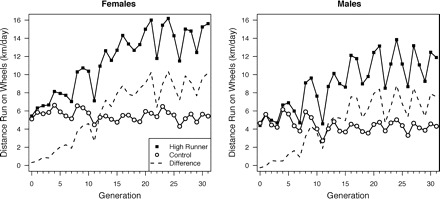
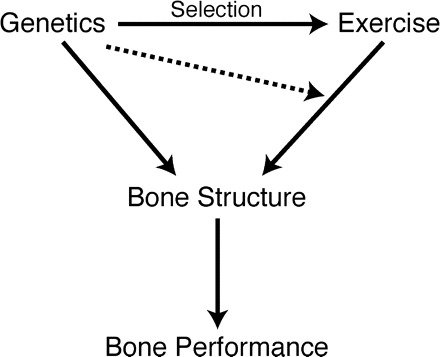
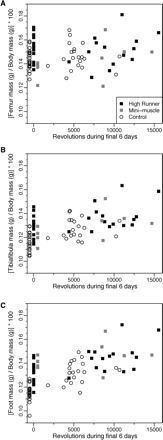
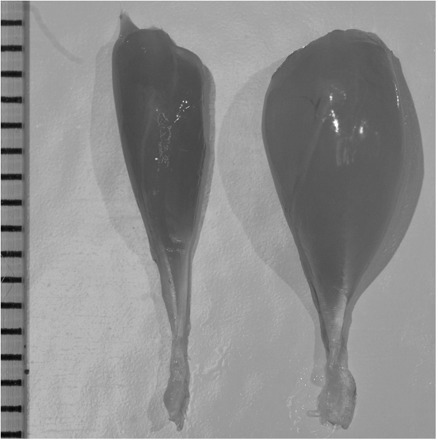
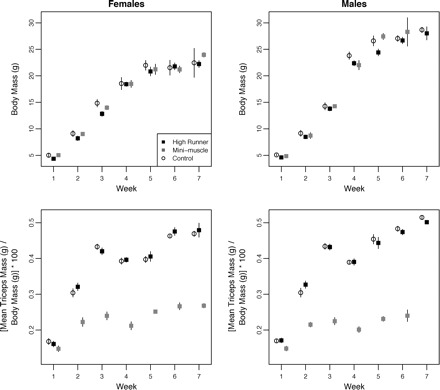
We present a novel mouse-model for the study of skeletal structure and evolution, based on selective breeding for high levels of voluntary wheel running. Whereas traditional models (originally inbred strains, more recently knockouts and transgenics) rely on the study of mutant or laboratory-manipulated phenotypes, we have studied changes in skeletal morphometrics resulting from many generations of artificial selection for high activity in the form of wheel running, in which mice engage voluntarily. Mice from the four replicate High Runner (HR) lines run nearly three times as many revolutions during days 5 and 6 of a 6-day exposure to wheels (1.12 m circumference). We have found significant changes in skeletal dimensions of the hind limbs, including decreased directional asymmetry, larger femoral heads, and wider distal femora. The latter two have been hypothesized as evolutionary adaptations for long-distance locomotion in hominids. Exercise-training studies involving experimental groups with and without access to wheels have shown increased diameters of both femora and tibiafibulae, and suggest genetic effects on trainability (genotype-by-environment interactions). Reanalysis of previously published data on bone masses of hind limbs revealed novel patterns of change in bone mass associated with access to wheels for 2 months. Without access to wheels, HR mice have significantly heavier tibiafibulae and foot bones, whereas with chronic access to wheels, a significant increase in foot bone mass that was linearly related to increases in daily wheel running was observed. Mice exhibiting a recently discovered small-muscle phenotype ("mini-muscle," [MM] caused by a Mendelian recessive gene), in which the mass of the triceps surae muscle complex is ∼50% lower than in normal individuals, have significantly longer and thinner bones in the hind limb. We present new data for the ontogenetic development of muscle mass in Control, HR, and MM phenotypes in mice of 1-7 weeks postnatal age. Statistical comparisons reveal highly significant differences both in triceps surae mass and mass-corrected triceps surae mass between normal and MM mice at all but the postnatal age of 1 week. Based on previously observed differences in distributions of myosin isoforms in adult MM mice, we hypothesize that a reduction of myosin heavy-chain type-IIb isoforms with accounts for our observed ontogenetic changes in muscle mass.
Figures
References
-
- Agbulut O, Noirez P, Beaumont F, Butler-Browne GS. Myosin heavy chain isoforms in postnatal muscle development of mice. Biol Cell. 2003;95:399–406. - PubMed
-
- Akhter MP, Cullen DM, Pedersen EA, Kimmel DB, Recker RR. Bone response to mechanical loading in two breeds of mice. Calcif Tissue Int. 1998;63:442–9. - PubMed
-
- Akhter MP, Iwaniec UT, Covey MA, Cullen DM, Kimmel DB, Recker RR. Genetic variation in bone density, histomorphometry, and strength in mice. Calcif Tissue Int. 2000;67:337–44. - PubMed
-
- Akhter MP, et al. Bone biomechanical properties in LRP5 mutant mice. Bone. 2004;35:162–9. - PubMed
-
- Allen DL, Leinwand LA. Postnatal myosin heavy chain isoform expression in normal mice and mice null for IIb or IId myosin heavy chains. Dev Biol. 2001;229:383–95. - PubMed
Grants and funding
LinkOut - more resources
Full Text Sources
