Comment
doi: 10.1158/1078-0432.CCR-11-1218.
Epub 2011 Jun 13.
Why is this effective HSP90 inhibitor not being developed in HER2+ breast cancer?
Affiliations
- PMID: 21670086
- PMCID: PMC3221729
- DOI: 10.1158/1078-0432.CCR-11-1218
Item in Clipboard
Comment
Why is this effective HSP90 inhibitor not being developed in HER2+ breast cancer?
Clin Cancer Res.
.
Abstract
Inhibition of the HSP90 chaperone leads to degradation of the HER2 receptor. The HSP90 inhibitor tanespimycin in combination with trastuzumab is active in patients with HER2-overexpressing metastatic breast cancer. This combination is one of several HER2-targeted therapies that will significantly improve the outcome of patients with this subtype of breast cancer.
©2011 AACR.
Figures
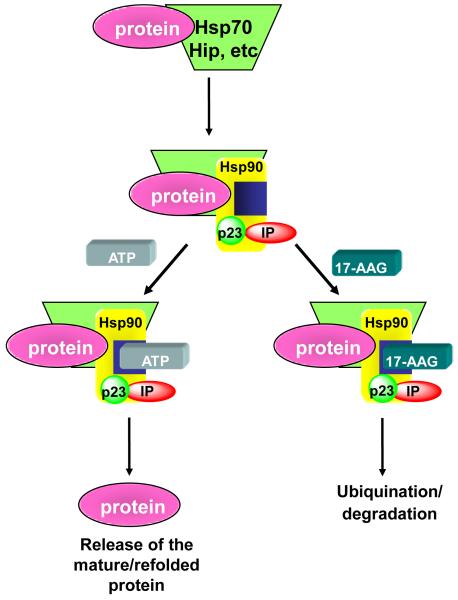
Ansamycins (17-AAG) bind the ADP/ATP switch site in HSP90. HSP90 (in orange) is a molecular chaperone involved in the maturation and refolding of several oncoproteins. It has three domains: an amino terminal region that binds ATP (blue box) and drugs and interacts with co-chaperones (i.e., HSP70, Hip, etc.); a middle domain with docking sites for client proteins and co-chaperones, which participates in generating the ATPase activity; and a carboxy-terminal domain that contains a dimerization motif, a second drug-binding region, and interaction sites for other co-chaperones (i.e. p23, IP). Binding of ATP to the amino-terminal domain and its subsequent hydrolysis by HSP90 result in a conformation that is essential for chaperone activity. All HSP90 inhibitors in clinical development interact with the amino-terminal ATP-binding pocket, prevent ATP binding, and disrupt the chaperone cycle, resulting in ubiquitination and degradation of client proteins such as HER2, EGFR, nuclear steroid receptors, RAF-1, CDK4, AKT, MET, HIF-1α, etc.
Comment on
-
HSP90 inhibition is effective in breast cancer: a phase II trial of tanespimycin (17-AAG) plus trastuzumab in patients with HER2-positive metastatic breast cancer progressing on trastuzumab.Clin Cancer Res. 2011 Aug 1;17(15):5132-9. doi: 10.1158/1078-0432.CCR-11-0072. Epub 2011 May 10. Clin Cancer Res. 2011. PMID: 21558407 Clinical Trial.
References
-
- Modi S, Stopeck AT, Linden HM, et al. HSP90 Inhibition is Effective in Breast Cancer: A Phase 2 Trial of Tanespimycin (17AAG) plus Trastuzumab in Patients with HER2-Positive Metastatic Breast Cancer Progressing on Trastuzumab. Clin Cancer Res. 2011 - PubMed
-
- Blackwell KL, Burstein HJ, Storniolo AM, et al. Randomized study of Lapatinib alone or in combination with trastuzumab in women with ErbB2-positive, trastuzumab-refractory metastatic breast cancer. J Clin Oncol. 2010;28:1124–30. - PubMed
-
- Baselga J, Bradbury I, Eidtmann H, et al. First results of the NeoALTTO trial (BIG 01-06/EGF 106903): A phase III, randomized, open label, neoadjuvant study of lapatinib, trastuzumab, and their combination plust paclitaxel in women with HER2-positive primary breast cancer. Cancer Res. 2010;70:82s.
Publication types
MeSH terms
Substances
Grants and funding
LinkOut - more resources
Full Text Sources
Medical
Research Materials
Miscellaneous