


The role of sensory fiber demography in trigeminal and postherpetic neuralgias
- PMID: 21670221
- PMCID: PMC3232114
- DOI: 10.1177/0022034511411300
The role of sensory fiber demography in trigeminal and postherpetic neuralgias
Abstract
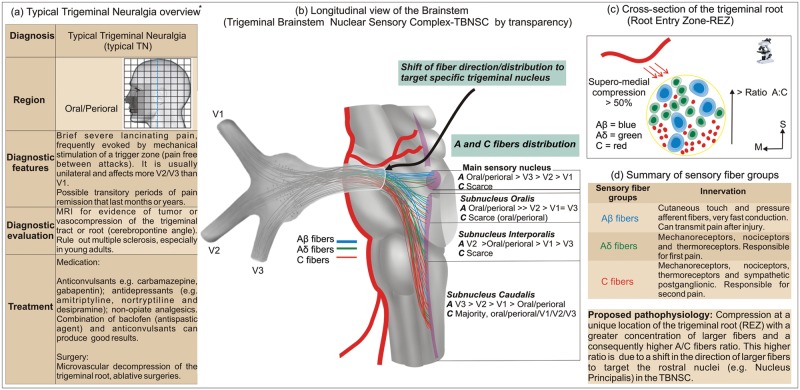
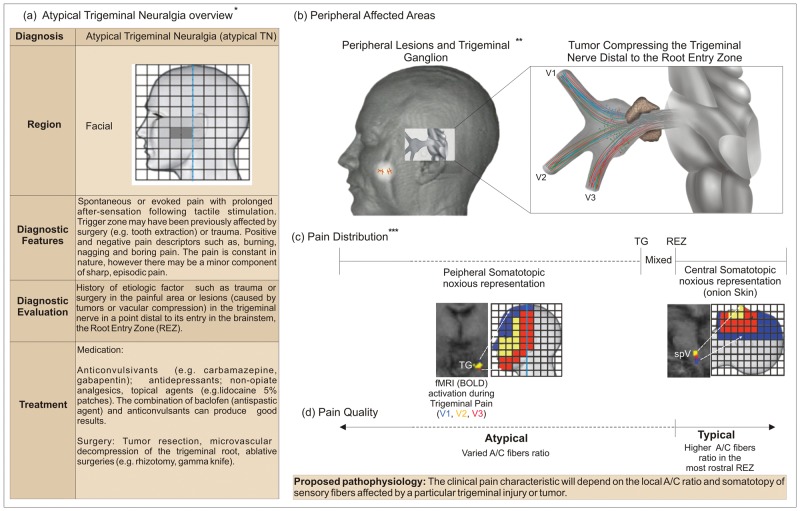
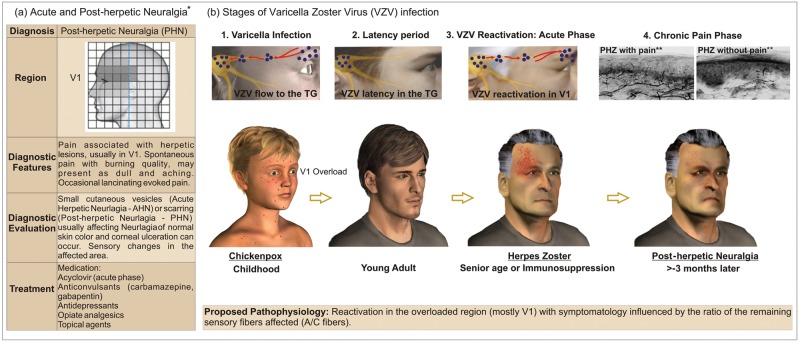
In this study, we systematically investigated fiber demography, based on function and distribution, from the periphery to their destinations in the various central (sub) nuclei in the trigeminal brainstem nuclear sensory complex. Conventional and novel compelling information is provided, demonstrating that the ratio and somatotopy of types A and C sensory fibers at the site of a lesion can elucidate important puzzles in TNP disorders. For instance, we explain how of a major shift in the fibers' direction and ratio at the level of the trigeminal root entry zone (REZ) influences the pathophysiology of pre- and typical trigeminal neuralgia. As a result, there is a high A/C ratio of oral and peri-oral fibers in the supero-medial region of the REZ, which is mostly susceptible to vascular compression. However, this A/C ratio varies considerably at lower proportions in other areas along the peripheral trigeminal pathway, where an injury (viral, vessel compression, or trauma) can lead to a broader spectrum of fiber involvement and, consequently, pain outcome. In summary, we explain how fiber demography can influence pain quality, location, temporal features, progress, and treatment prognosis of TNP in those patients who develop it.
Conflict of interest statement
The authors declare no potential conflicts of interest with respect to the authorship and/or publication of this article.
Figures
References
-
- Arvin AM, Gershon AA. (2000). Varicella-zoster virus: virology and clinical management. Cambridge, UK: Cambridge University Press.
-
- Azerad J, Woda A, Albe-Fessard D. (1982). Physiological-properties of neurons in different parts of the cat trigeminal sensory complex. Brain Res 246:7-21. - PubMed
-
- Bae YC, Oh JM, Hwang SJ, Shigenaga Y, Valtschanoff JG. (2004). Expression of vanilloid receptor TRPV1 in the rat trigeminal sensory nuclei. J Comp Neurol 478:62-71. - PubMed
-
- Boer A, Herder N, Blodorn-Schlicht N, Falk T. (2006). Herpes incognito most commonly is herpes zoster and its histopathologic pattern is distinctive! Am J Dermatopathol 28:181-186. - PubMed
Publication types
MeSH terms
Grants and funding
LinkOut - more resources
Full Text Sources
Medical
Research Materials
