


Increased risk of locoregional recurrence for women with T1-2N0 triple-negative breast cancer treated with modified radical mastectomy without adjuvant radiation therapy compared with breast-conserving therapy
- PMID: 21670451
- PMCID: PMC5073381
- DOI: 10.1200/JCO.2010.33.4714
Increased risk of locoregional recurrence for women with T1-2N0 triple-negative breast cancer treated with modified radical mastectomy without adjuvant radiation therapy compared with breast-conserving therapy
Abstract
Purpose: To evaluate the risk of locoregional recurrence (LRR) associated with locoregional treatment of women with primary breast cancer tumors negative for estrogen receptor, progesterone receptor, and human epidermal growth factor receptor 2 (triple-negative breast cancer [TNBC]).
Patients and methods: Patients diagnosed with TNBC were identified from a cancer registry in a single institution (n=768). LRR-free survival was estimated using Kaplan-Meier analysis. The Cox proportional hazards regression model was used to determine risk of LRR on the basis of locoregional management: breast-conserving therapy (BCT; ie, lumpectomy and adjuvant radiation therapy [RT]) and modified radical mastectomy (MRM) in the TNBC population and T1-2N0 subgroup.
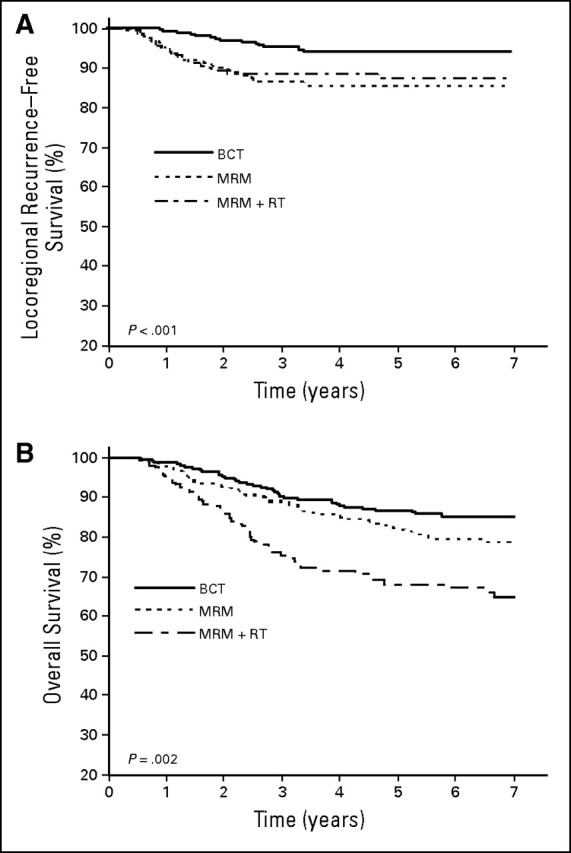
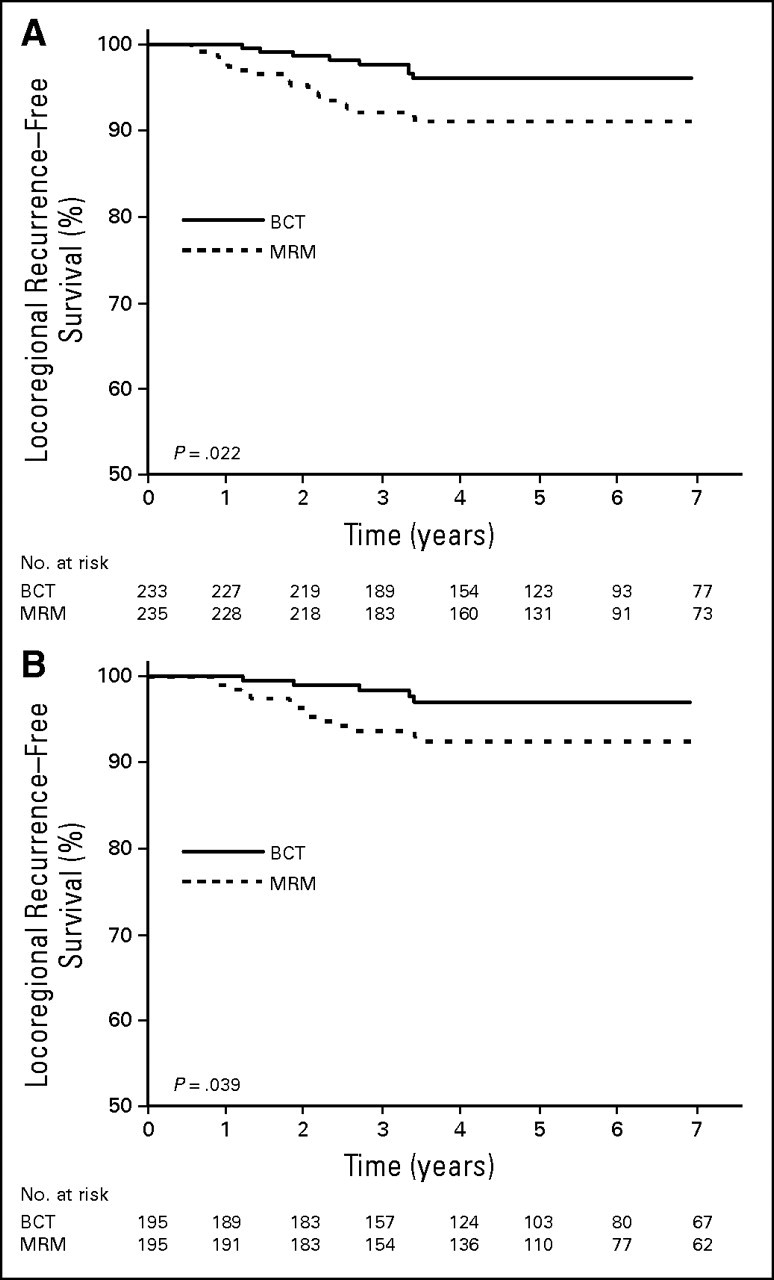
Results: At a median follow-up of 7.2 years, 77 patients (10%) with TNBC developed LRR. Five-year LRR-free survival was 94%, 85%, and 87% in the BCT, MRM, and MRM + RT groups, respectively (P < .001). In multivariate analysis, MRM (compared with BCT), lymphovascular invasion and lymph node positivity were associated with increased LRR. Conversely, adjuvant chemotherapy was associated with decreased risk of LRR. For patients with T1-2N0 tumors, 5-year LRR-free survival was 96% and 90% in the BCT and MRM groups, respectively (P = .027), and MRM was the only independent prognostic factor associated with increased LRR compared with BCT (hazard ratio, 2.53; 95% CI, 1.12 to 5.75; P = .0264).
Conclusion: Women with T1-2N0 TNBC treated with MRM without RT have a significant increased risk of LRR compared with those treated with BCT. Prospective studies are warranted to investigate the benefit of adjuvant RT after MRM in TNBC.
Conflict of interest statement
Authors’ disclosures of potential conflicts of interest and author contributions are found at the end of this article.
Figures
Comment in
-
Is breast conservation therapy superior to mastectomy for women with triple-negative breast cancers?J Clin Oncol. 2011 Jul 20;29(21):2841-3. doi: 10.1200/JCO.2011.35.8838. Epub 2011 Jun 13. J Clin Oncol. 2011. PMID: 21670459 No abstract available.
-
Personalizing locoregional treatment in the adjuvant setting of early breast cancer on the basis of molecular background: an exciting enigma.J Clin Oncol. 2011 Dec 10;29(35):4721-2; author reply 4723-4. doi: 10.1200/JCO.2011.38.5922. Epub 2011 Oct 31. J Clin Oncol. 2011. PMID: 22042936 No abstract available.
-
Breast conservation versus mastectomy in triple-negative breast cancer: two steps forward, one step back?J Clin Oncol. 2011 Dec 10;29(35):4722-3; author reply 4723-4. doi: 10.1200/JCO.2011.38.9684. Epub 2011 Oct 31. J Clin Oncol. 2011. PMID: 22042938 No abstract available.
References
-
- Fisher B, Anderson S, Bryant J, et al. Twenty-year follow-up of a randomized trial comparing total mastectomy, lumpectomy, and lumpectomy plus irradiation for the treatment of invasive breast cancer. N Engl J Med. 2002;347:1233–1241. - PubMed
-
- Veronesi U, Cascinelli N, Mariani L, et al. Twenty-year follow-up of a randomized study comparing breast-conserving surgery with radical mastectomy for early breast cancer. N Engl J Med. 2002;347:1227–1232. - PubMed
-
- Clarke M, Collins R, Darby S, et al. Effects of radiotherapy and of differences in the extent of surgery for early breast cancer on local recurrence and 15-year survival: An overview of the randomised trials. Lancet. 2005;366:2087–2106. - PubMed
-
- Perou CM, Sørlie T, Eisen MB, et al. Molecular portraits of human breast tumours. Nature. 2000;406:747–752. - PubMed
Publication types
MeSH terms
Substances
Grants and funding
LinkOut - more resources
Full Text Sources
Other Literature Sources
Medical
Research Materials
Miscellaneous
