


Improving glycaemic control and life skills in adolescents with type 1 diabetes: a randomised, controlled intervention study using the Guided Self-Determination-Young method in triads of adolescents, parents and health care providers integrated into routine paediatric outpatient clinics
- PMID: 21672252
- PMCID: PMC3164223
- DOI: 10.1186/1471-2431-11-55
Improving glycaemic control and life skills in adolescents with type 1 diabetes: a randomised, controlled intervention study using the Guided Self-Determination-Young method in triads of adolescents, parents and health care providers integrated into routine paediatric outpatient clinics
Abstract
Background: Adolescents with type 1 diabetes face demanding challenges due to conflicting priorities between psychosocial needs and diabetes management. This conflict often results in poor glycaemic control and discord between adolescents and parents. Adolescent-parent conflicts are thus a barrier for health care providers (HCPs) to overcome in their attempts to involve both adolescents and parents in improvement of glycaemic control. Evidence-based interventions that involve all three parties (i.e., adolescents, parents and HCPs) and are integrated into routine outpatient clinic visits are lacking. The Guided Self-Determination method is proven effective in adult care and has been adapted to adolescents and parents (Guided Self-Determination-Young (GSD-Y)) for use in paediatric diabetes outpatient clinics. Our objective is to test whether GSD-Y used in routine paediatric outpatient clinic visits will reduce haemoglobin A1c (HbA1c) concentrations and improve adolescents' life skills compared with a control group.
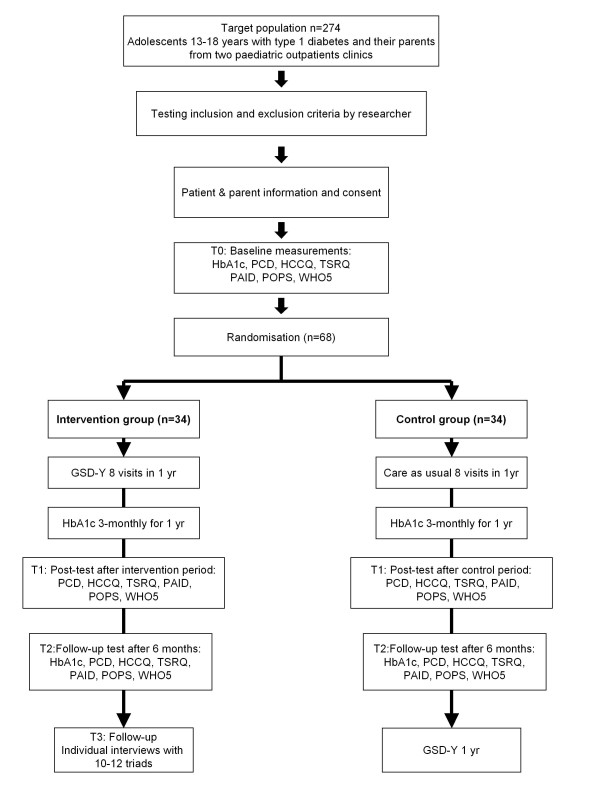
Methods/design: Using a mixed methods design comprising a randomised controlled trial and a nested qualitative evaluation, we will recruit 68 adolescents age 13-18 years with type 1 diabetes (HbA1c > 8.0%) and their parents from 2 Danish hospitals and randomise into GSD-Y or control groups. During an 8-12 month period, the GSD-Y group will complete 8 outpatient GSD-Y visits, and the control group will completes an equal number of standard visits. The primary outcome is HbA1c. Secondary outcomes include the following: number of self-monitored blood glucose values and levels of autonomous motivation, involvement and autonomy support from parents, autonomy support from HCPs, perceived competence in managing diabetes, well-being, and diabetes-related problems. Primary and secondary outcomes will be evaluated within and between groups by comparing data from baseline, after completion of the visits, and again after a 6-month follow-up. To illustrate how GSD-Y influences glycaemic control and the development of life skills, 10-12 GSD-Y visits will be recorded during the intervention and analysed qualitatively together with individual interviews carried out after follow-up.
Discussion: This study will provide evidence of the effectiveness of using a GSD-Y intervention with three parties on HbA1c and life skills and the feasibility of integrating the intervention into routine outpatient clinic visits. Danish Data Association ref nr. 2008-41-2322.
Trial registration: ISRCTN54243636.
References
-
- Court JM, Cameron FJ, Berg-Kelly K, Swift PG. Diabetes in adolescence. Pediatr Diabetes. 2009;10(Suppl 12):185–194. - PubMed
Publication types
MeSH terms
Substances
Associated data
LinkOut - more resources
Full Text Sources
Medical
