


Site-specific acetylation mark on an essential chromatin-remodeling complex promotes resistance to replication stress
- PMID: 21673141
- PMCID: PMC3127919
- DOI: 10.1073/pnas.1019735108
Site-specific acetylation mark on an essential chromatin-remodeling complex promotes resistance to replication stress
Abstract
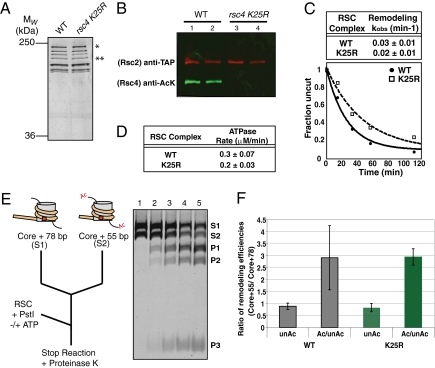
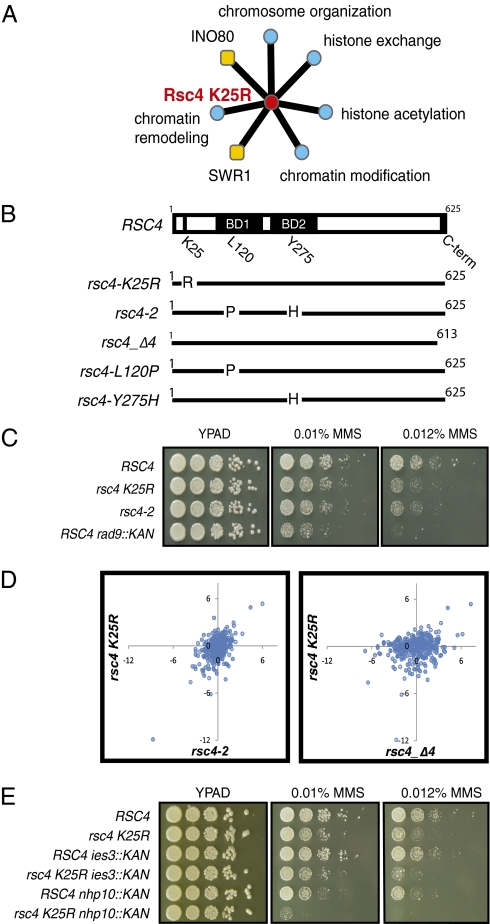
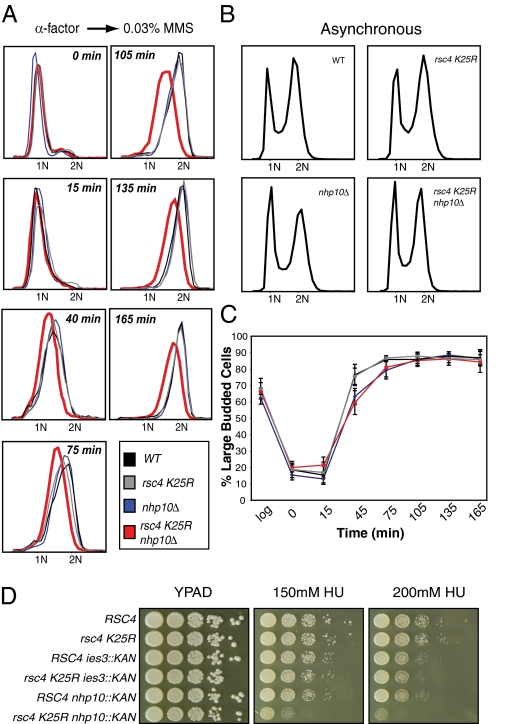
Recent work has identified several posttranslational modifications (PTMs) on chromatin-remodeling complexes. Compared with our understanding of histone PTMs, significantly less is known about the functions of PTMs on remodeling complexes, because identification of their specific roles often is hindered by the presence of redundant pathways. Remodels the Structure of Chromatin (RSC) is an essential, multifunctional ATP-dependent chromatin-remodeling enzyme of Saccharomyces cerevisiae that preferentially binds acetylated nucleosomes. RSC is itself acetylated by Gcn5 on lysine 25 (K25) of its Rsc4 subunit, adjacent to two tandem bromodomains. It has been shown that an intramolecular interaction between the acetylation mark and the proximal bromodomain inhibits binding of the second bromodomain to acetylated histone H3 tails. We report here that acetylation does not significantly alter the catalytic activity of RSC or its ability to recognize histone H3-acetylated nucleosomes preferentially in vitro. However, we find that Rsc4 acetylation is crucial for resistance to DNA damage in vivo. Epistatic miniarray profiling of the rsc4-K25R mutant reveals an interaction with mutants in the INO80 complex, a mediator of DNA damage and replication stress tolerance. In the absence of a core INO80 subunit, rsc4-K25R mutants display sensitivity to hydroxyurea and delayed S-phase progression under DNA damage. Thus, Rsc4 helps promote resistance to replication stress, and its single acetylation mark regulates this function. These studies offer an example of acetylation of a chromatin-remodeling enzyme controlling a biological output of the system rather than regulating its core enzymatic properties.
Conflict of interest statement
The authors declare no conflict of interest.
Figures

References
-
- Winter S, Fischle W. Epigenetic markers and their cross-talk. Essays Biochem. 2010;48:45–61. - PubMed
-
- Clapier CR, Cairns BR. The biology of chromatin remodeling complexes. Annu Rev Biochem. 2009;78:273–304. - PubMed
-
- Agalioti T, Chen G, Thanos D. Deciphering the transcriptional histone acetylation code for a human gene. Cell. 2002;111:381–392. - PubMed
-
- Agalioti T, et al. Ordered recruitment of chromatin modifying and general transcription factors to the IFN-beta promoter. Cell. 2000;103:667–678. - PubMed
Publication types
MeSH terms
Substances
Grants and funding
LinkOut - more resources
Full Text Sources
Molecular Biology Databases
Miscellaneous
