. 2011 Dec;107(6):548-57.
doi: 10.1038/hdy.2011.41. Epub 2011 Jun 15.

Colonization of Ireland: revisiting 'the pygmy shrew syndrome' using mitochondrial, Y chromosomal and microsatellite markers

Affiliations

Colonization of Ireland: revisiting 'the pygmy shrew syndrome' using mitochondrial, Y chromosomal and microsatellite markers

A D McDevitt et al. Heredity (Edinb). 2011 Dec.

Abstract

There is great uncertainty about how Ireland attained its current fauna and flora. Long-distance human-mediated colonization from southwestern Europe has been seen as a possible way that Ireland obtained many of its species; however, Britain has (surprisingly) been neglected as a source area for Ireland. The pygmy shrew has long been considered an illustrative model species, such that the uncertainty of the Irish colonization process has been dubbed 'the pygmy shrew syndrome'. Here, we used new genetic data consisting of 218 cytochrome (cyt) b sequences, 153 control region sequences, 17 Y-intron sequences and 335 microsatellite multilocus genotypes to distinguish between four possible hypotheses for the colonization of the British Isles, formulated in the context of previously published data. Cyt b sequences from western Europe were basal to those found in Ireland, but also to those found in the periphery of Britain and several offshore islands. Although the central cyt b haplotype in Ireland was found in northern Spain, we argue that it most likely occurred in Britain also, from where the pygmy shrew colonized Ireland as a human introduction during the Holocene. Y-intron and microsatellite data are consistent with this hypothesis, and the biological traits and distributional data of pygmy shrews argue against long-distance colonization from Spain. The compact starburst of the Irish cyt b expansion and the low genetic diversity across all markers strongly suggests a recent colonization. This detailed molecular study of the pygmy shrew provides a new perspective on an old colonization question.


Figures
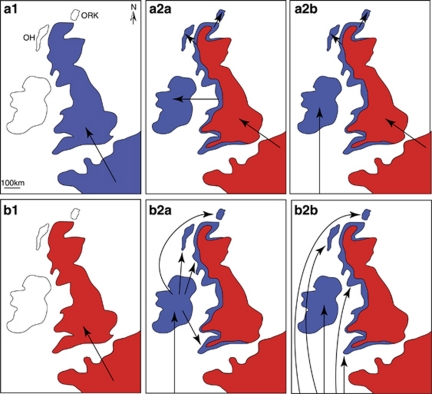
Figure 1
Figure 1
Possible routes of colonization of the British Isles by the pygmy shrew in relation to the current distribution of the western (grey) and northern (black) cyt b lineages shown schematically in a2a, a2b, b2a and b2b. Panel a1 represents the first stage in the colonization scenarios by a western lineage in a2a and a2b, and panel b1 by a northern lineage for scenarios b2a and b2b. The maps show continental Europe with Britain and the more westerly Ireland as the large offshore islands, and the Outer Hebrides and Orkney (labelled OH and ORK, respectively in a1). Arrows originating from the bottom of panels represent Iberia. The current peripheral distribution of the western lineage in Britain is shown in a highly stylized way in a2a, a2b, b2a and b2b. Actually, the northern lineage tends to be present right up to the western coast and occurs as a polymorphism with the western lineage there. So, in the Celtic fringe scenarios (a2a, a2b), the colonization of islands by the western lineage from the British mainland would have had to occur before the invading northern lineage became so predominant along the west coast (Searle et al., 2009).
Figure 2
Figure 2
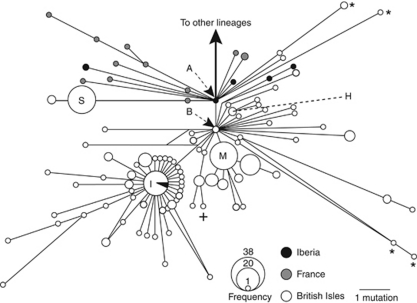
Median-joining (MJ) network of cyt b haplotypes of the western lineage with circles representing haplotypes and lines representing mutational steps. The two central haplotypes of the network are labelled (A, B). The central haplotypes of other expansions within the network are also highlighted (see text): H, Outer Hebrides; I, Ireland; M, Orkney (Mainland Orkney+Westray+Hoy); S, Orkney (South Ronaldsay). Within the central haplotype of the Irish expansion the black segment represents Iberian specimens with the same haplotype. Other haplotypes highlighted (see text): the divergent haplotypes found in the most southeasterly samples of the western lineage on mainland Britain (labelled *), the Hoy haplotype not in the Mainland Orkney expansion (labelled +).
Figure 3
Figure 3
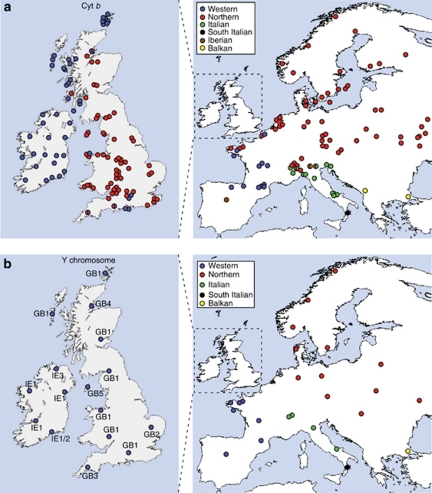
Maps showing the distribution of cyt b (a) and Y-intron (b) lineages in the British Isles in the context of continental Europe, including published data (Mascheretti et al., 2003; Searle et al., 2009; McDevitt et al., 2010; Vega et al., 2010a, 2010b). All the Irish data and the British data for Y-introns are new; likewise for some British and continental European cyt b data (see Supplementary Table S1). For the Y-intron data, the haplotypes in the British Isles are labelled according to Supplementary Table S1 and Figure 4. Only a single individual per locality was typed for the Y-introns, except one locality in Ireland where the two individuals yielded different haplotypes.
Figure 4
Figure 4
Median-joining (MJ) network of concatenated Y-intron haplotypes colored by lineage. Numbers on branches indicate more than one mutation event. Haplotypes found in Britain and Ireland are labelled GB and IE, respectively (see Figure 3b). See McDevitt et al. (2010) for sampling locations of continental European haplotypes.
Figure 5
Figure 5
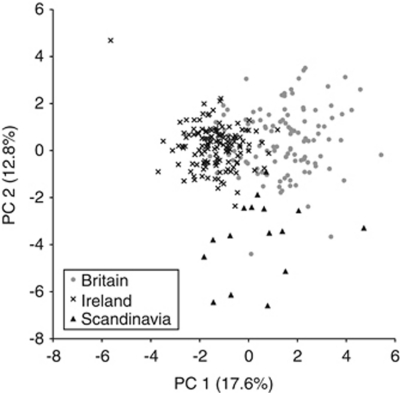
Principal Component Analysis of the microsatellite data, showing each individual classified according to the geographical area in which it occurred.
Figure 6
Figure 6
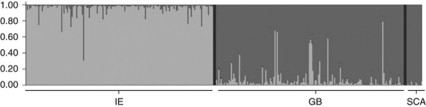
Graphical output from Bayesian analysis in STRUCTURE showing assignment probabilities to Clusters 1 (light grey) and 2 (dark grey). ‘IE' represents individuals from Ireland; ‘GB' Britain and ‘SCA' Scandinavia.

References

    1. Balloux F, Ecoffey E, Fumagalli L, Goudet J, Wyttenbach A, Hausser J. Microsatellite conservation, polymorphism, and GC content in shrews of the genus Sorex (Insectivora, Mammalia) Mol Biol Evol. 1998;15:473–475. - PubMed
    1. Bandelt HJ, Forster P, Rohl A. Median-joining networks for inferring intraspecific phylogenies. Mol Biol Evol. 1999;16:37–48. - PubMed
    1. Cassens I, Mardulyn P, Milinkovitch MC. Evaluating intraspecific ‘network' construction methods using simulated sequence data: do existing algorithms outperform the Global Maximum Parsimony approach. Syst Biol. 2005;54:363–372. - PubMed
    1. Churchfield S, Searle JB.2008aPygmy shrewIn: Harris S, Yalden DW (eds)Mammals of the British Isles Handbook4th edn.The Mammal Society: London; 267–271.
    1. Churchfield S, Searle JB.2008bCommon shrewIn: Harris S, Yalden DW (eds)Mammals of the British Isles Handbook4th edn,The Mammal Society: London; 257–265.

Publication types