. 2011 Jun 16:11:71.
doi: 10.1186/1471-2377-11-71.

Intrathecal lidocaine pretreatment attenuates immediate neuropathic pain by modulating Nav1.3 expression and decreasing spinal microglial activation

Affiliations

Intrathecal lidocaine pretreatment attenuates immediate neuropathic pain by modulating Nav1.3 expression and decreasing spinal microglial activation

Kuang-I Cheng et al. BMC Neurol. .

Abstract

Background: Intrathecal lidocaine reverses tactile allodynia after nerve injury, but whether neuropathic pain is attenuated by intrathecal lidocaine pretreatment is uncertain.

Methods: Sixty six adult male Sprague-Dawley rats were divided into three treatment groups: (1) sham (Group S), which underwent removal of the L6 transverse process; (2) ligated (Group L), which underwent left L5 spinal nerve ligation (SNL); and (3) pretreated (Group P), which underwent L5 SNL and was pretreated with intrathecal 2% lidocaine (50 μl). Neuropathic pain was assessed based on behavioral responses to thermal and mechanical stimuli. Expression of sodium channels (Nav1.3 and Nav1.8) in injured dorsal root ganglia and microglial proliferation/activation in the spinal cord were measured on post-operative days 3 (POD3) and 7 (POD7).

Results: Group L presented abnormal behavioral responses indicative of mechanical allodynia and thermal hyperalgesia, exhibited up-regulation of Nav1.3 and down-regulation of Nav1.8, and showed increased microglial activation. Compared with ligation only, pretreatment with intrathecal lidocaine before nerve injury (Group P), as measured on POD3, palliated both mechanical allodynia (p < 0.01) and thermal hyperalgesia (p < 0.001), attenuated Nav1.3 up-regulation (p = 0.003), and mitigated spinal microglial activation (p = 0.026) by inhibiting phosphorylation (activation) of p38 MAP kinase (p = 0.034). p38 activation was also suppressed on POD7 (p = 0.002).

Conclusions: Intrathecal lidocaine prior to SNL blunts the response to noxious stimuli by attenuating Nav1.3 up-regulation and suppressing activation of spinal microglia. Although its effects are limited to 3 days, intrathecal lidocaine pretreatment can alleviate acute SNL-induced neuropathic pain.


Figures
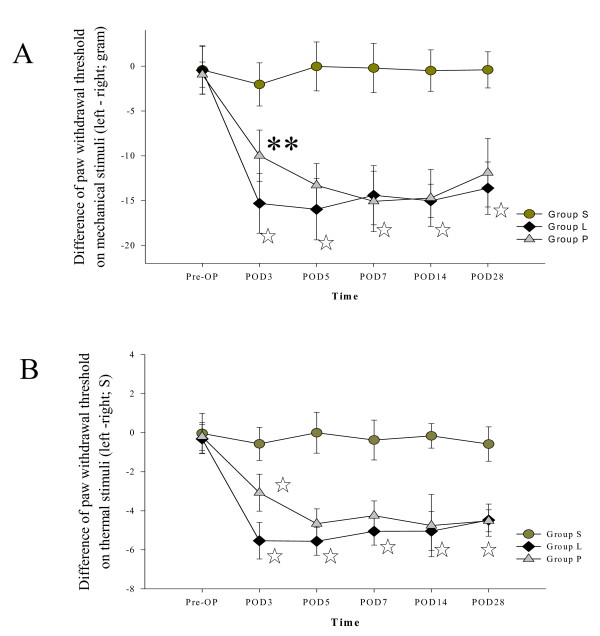
Figure 1
Figure 1
Intrathecal lidocaine pretreatment attenuated neurobehavioral responses to thermal and mechanical stimuli. (A) Mechanical responses. Comparison of mean paw withdrawal in response to a mechanical stimulus (F = 50 g; T = 20 seconds) between ipsilateral (left) and contralateral (right) sides in each group. Differences in mean paw withdrawal thresholds between hindpaws were significantly higher in Group L than in Group P on POD3 (**P <0.01). (B) Hyperalgesic responses. On POD3, the difference in mean withdrawal threshold between left and right hindpaws was significantly larger (☆P <0.001) in Group L than in Group P. Mean withdrawal thresholds did not significantly differ between left and right hindpaws in Group S. Data represent means ± SE.
Figure 2
Figure 2
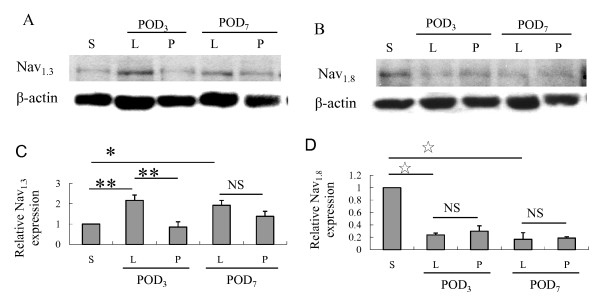
Western blot showing that intrathecal lidocaine pretreatment decreased Nav1.3 up-regulation in injured DRGs after SNL (A). Quantification of Nav1.3 band densities showed Nav1.3 expression was up-regulated after SNL, but was decreased on POD3 in Group P (C). Western blot and quantification of Nav1.8 band densities showing that intrathecal lidocaine pretreatment did not reduce Nav1.8 down-regulation in Group P (B, D). (*p < 0.05, **p < 0.01, ☆P <0.001, NS: not statistically significant; ANOVA with post hoc Scheffe's test.)
Figure 3
Figure 3
Intrathecal lidocaine pretreatment suppressed microglia-specific immunoreactivity induced by SNL in the spinal cord. Group S showed weak immunoreactivity of the microglial marker OX-42 in the left dorsal horn (A). In Group L, SNL induced a significant increase in microglia immunoreactivity in the ipsilateral spinal cord on POD3 (B) and POD7 (D). Intrathecal lidocaine pretreatment (Group P) decreased microglia immunoreactivity on POD3 (C) but not on POD7 (E). Data represent means ± SE (*p < 0.05, **p < 0.01, NS: not statistically significant; Mann-Whitney U test). Scale bars, 200 μm.
Figure 4
Figure 4
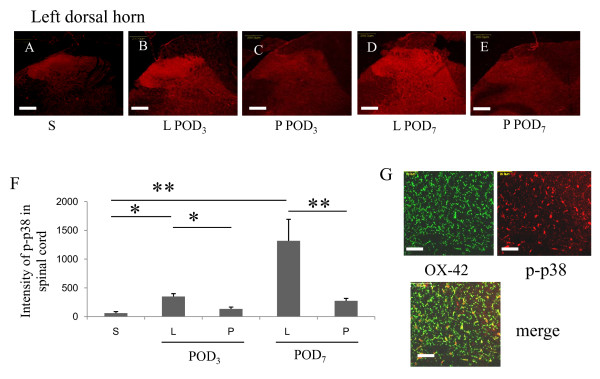
Intrathecal lidocaine pretreatment moderated the increase in p-p38 immunoreactivity induced by SNL. Group S exhibited weak p-p38 immunoreactivity in the left dorsal horn (A). In Group L, p-p38 immunoreactivity was significantly increased in the left dorsal horn on POD3 (B) and on POD7 (D). Intrathecal lidocaine pretreatment (Group P) decreased SNL-induced p-p38 immunoreactivity on POD3 (C) and POD7 (E). Quantification of p-p38 immunoreactivity revealed significant increases on POD3 and POD7 after SNL. Intrathecal lidocaine pretreatment reduced p-p38 immunoreactivity after SNL (F). Merged images from OX-42 (green) and p-p38 (red) in the ipsilateral L5 spinal cord on POD3 showed p-p38 colocalization with OX-42 (G). Data represent means ± SE (*p < 0.05, **p < 0.01; Mann Whitney U test). Scale bars, 200 μm (A-E) and 50 μm (G).

References

    1. Marchettini P, Formaglio F, Lacerenza M. Iatrogenic painful neuropathic complications of surgery in cancer. Acta Anaesthesiol Scand. 2001;45:1090–1094. doi: 10.1034/j.1399-6576.2001.450907.x. - DOI - PubMed
    1. Vuilleumier H, Hubner M, Demartines N. Neuropathy after herniorrhaphy: indication for surgical treatment and outcome. World J Surg. 2009;33:841–845. doi: 10.1007/s00268-008-9869-1. - DOI - PubMed
    1. Kehlet H, Jensen TS, Woolf CJ. Persistent postsurgical pain: risk factors and prevention. Lancet. 2006;367:1618–1625. doi: 10.1016/S0140-6736(06)68700-X. - DOI - PubMed
    1. Foley KM. Opioids and chronic neuropathic pain. N Engl J Med. 2003;348:1279–1281. doi: 10.1056/NEJMe030014. - DOI - PubMed
    1. Ong CK, Lirk P, Seymour RA, Jenkins BJ. The efficacy of preemptive analgesia for acute postoperative pain management: a meta-analysis. Anesth Analg. 2005;100:757–773. doi: 10.1213/01.ANE.0000144428.98767.0E. - DOI - PubMed

MeSH terms

LinkOut - more resources