


Inhibition of MMPs by alcohols
- PMID: 21676453
- PMCID: PMC3152585
- DOI: 10.1016/j.dental.2011.05.004
Inhibition of MMPs by alcohols
Abstract
Objectives: While screening the activity of potential inhibitors of matrix metalloproteinases (MMPs), due to the limited water solubility of some of the compounds, they had to be solubilized in ethanol. When ethanol solvent controls were run, they were found to partially inhibit MMPs. Thus, the purpose of this study was to compare the MMP-inhibitory activity of a series of alcohols.
Methods: The possible inhibitory activity of a series of alcohols was measured against soluble rhMMP-9 and insoluble matrix-bound endogenous MMPs of dentin in completely demineralized dentin. Increasing concentrations (0.17, 0.86, 1.71 and 4.28 mol/L) of a homologous series of alcohols (i.e. methanol, ethanol, propanols, butanols, pentanols, hexanols, the ethanol ester of methacrylic acid, heptanols and octanol) were compared to ethanediol, and propanediol by regression analysis to calculate the molar concentration required to inhibit MMPs by 50% (i.e. the IC(50)).
Results: Using two different MMP models, alcohols were shown to inhibit rhMMP-9 and the endogenous proteases of dentin matrix in a dose-dependent manner. The degree of MMP inhibition by alcohols increased with chain length up to 4 methylene groups. Based on the molar concentration required to inhibit rhMMP-9 fifty percent, 2-hydroxyethylmethacrylate (HEMA), 3-hexanol, 3-heptanol and 1-octanol gave the strongest inhibition.
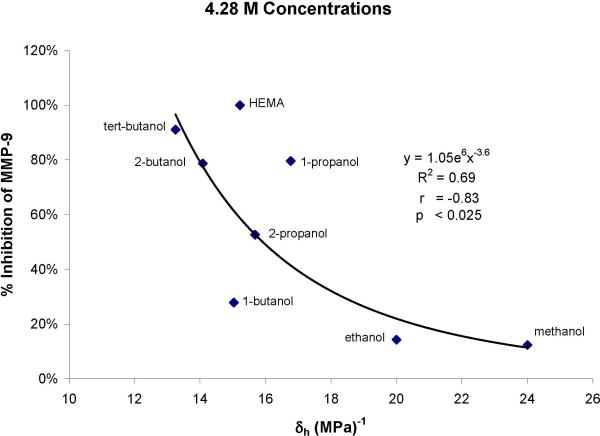
Significance: The results indicate that alcohols with 4 methylene groups inhibit MMPs more effectively than methanol or ethanol. MMP inhibition was inversely related to the Hoy's solubility parameter for hydrogen bonding forces of the alcohols (i.e. to their hydrophilicity).
Copyright © 2011 Academy of Dental Materials. Published by Elsevier Ltd. All rights reserved.
Figures
References
-
- Heikinheimo K, Sato T. Expression of basement membrane type IV collagen and type IV collagnases (MMP-2 and MMP-9) in human fetal teeth. J Dent Res. 1995;74:1226–1234. - PubMed
-
- Tjäderhane L, Palosaari H, Sulkala M, Wahlgren J, Salo T. The expression of matrix metalloproteinases (MMPs) in human odontoblasts. In: Ishikawa T, Takahashi K, Maeda T, Suda H, Shimono M, Inoue T, editors. Proceedings of the International Conference of the Dental/Pulp Complex. Quintessence Publishing Co., Ltd.; Tokyo: 2002. pp. 45–51.
-
- Bourd-Boittin K, Fridman R, Fanchon S, Septier D, Goldberg M, Menashi S. Matrix Metalloproteinase inhibition impairs the processing, formation and mineralization of dental tissues during mouse molar development. Exp Cell Res. 2005;304:493–505. - PubMed
-
- Carrilho MRO, Tay FR, Pashley DH, Tjäderhane L, Carvalho RM. Mechanical stability of resin-dentin bond components. Dent Mater. 2005a;21:232–241. - PubMed
-
- Carrilho MRO, Carvalho RM, Tay FR, Yiu C, Pashley DH. Durability of resin-dentin bonds related to water and oil storage. Am J Dent. 2005b;18:315–319. - PubMed
Publication types
MeSH terms
Substances
Grants and funding
LinkOut - more resources
Full Text Sources
