. 2011 Nov;168(11):1210-20.
doi: 10.1176/appi.ajp.2011.11010094. Epub 2011 Jun 15.

An FMRI study of self-regulatory control and conflict resolution in adolescents with bulimia nervosa

Affiliations

An FMRI study of self-regulatory control and conflict resolution in adolescents with bulimia nervosa

Rachel Marsh et al. Am J Psychiatry. 2011 Nov.

Abstract

Objective: The authors examined functional activity in the frontostriatal systems that mediate self-regulatory capacities and conflict resolution in adolescents with bulimia nervosa.

Method: Functional magnetic resonance imaging was used to compare blood-oxygen-level-dependent response in 18 female adolescents with bulimia nervosa and 18 healthy female age-matched subjects during performance on a Simon spatial incompatibility task. Bayesian analyses were used to compare the two groups on patterns of brain activation during correct responses to conflict stimuli and to explore the effects of antecedent stimulus context on group differences in self-regulation and conflict resolution.

Results: Adolescents with and without bulimia nervosa performed similarly on the task. During correct responses in conflict trials, frontostriatal circuits-including the right inferolateral and dorsolateral prefrontal cortices and putamen-failed to activate to the same degree in adolescents with bulimia nervosa as in healthy comparison subjects. Instead, deactivation was seen in the left inferior frontal gyrus as well as a neural system encompassing the posterior cingulate cortex and superior frontal gyrus. Group differences in cortical and striatal regions were driven by the differential responses to stimuli preceded by conflict and nonconflict stimuli, respectively.

Conclusions: When engaging the self-regulatory control processes necessary to resolve conflict, adolescents with bulimia nervosa displayed abnormal patterns of activation in frontostriatal and default-mode systems. Their abnormal processing of the antecedent stimulus context conditioned their brain response to conflict differently from that of healthy comparison subjects, specifically in frontal regions. It is suspected that functional disturbances in frontal portions of frontostriatal systems may release feeding behaviors from regulatory control, thereby perpetuating the conflicting desires to consume fattening foods and avoid weight gain that characterize bulimia nervosa.


Conflict of interest statement

Dr. Walsh has received research support from AstraZeneca. All other authors report no financial relationships with commercial interests.

Figures
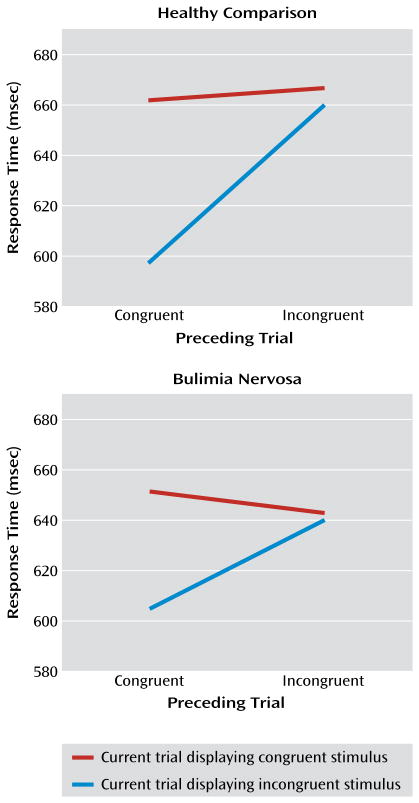
FIGURE 1
FIGURE 1. Response Times Among Female Adolescents With Bulimia Nervosa Relative to Age-Matched Female Healthy Comparison Subjects on the Simon Spatial Incompatibility Taska
a Response times are depicted as a function of preceding and current trial stimulus type (congruent, incongruent).
FIGURE 2
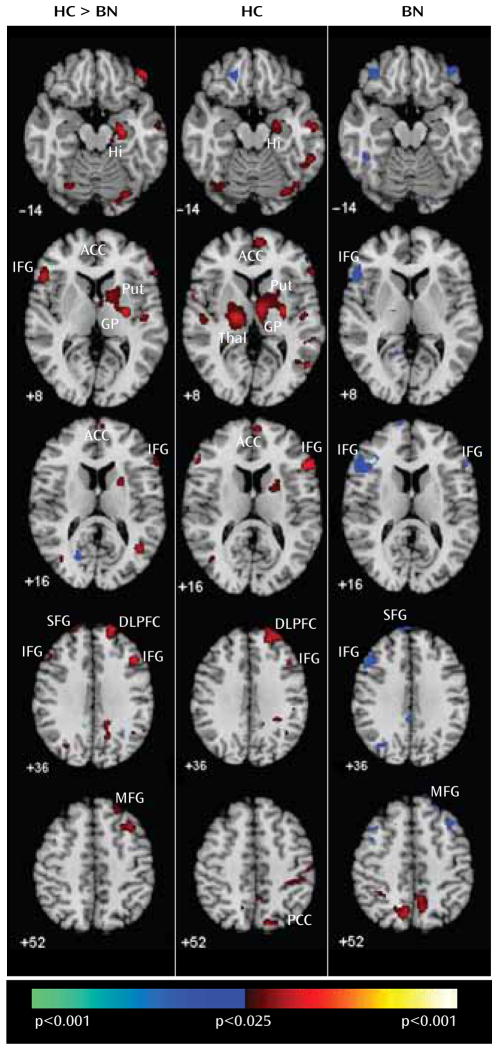
FIGURE 2. Group Average Brain Activations During Correct Trials Among Female Adolescents With Bulimia Nervosa Relative to Age-Matched Female Healthy Comparison Subjectsa
a The images depict axial slices positioned inferiorly to superiorly (top to bottom). Group-by-stimulus (congruent versus incongruent) interactions (left) were detected in frontostriatal regions (red). Main effects of stimulus condition (congruent versus incongruent) are shown for healthy (center) and bulimia nervosa (right) adolescents. Increases in signal during correct incongruent relative to correct congruent trials are shown in red, and decreases are shown in blue. Abbreviations: ACC=anterior cingulate cortex; BN=bulimia nervosa; DLPFC=dorsolateral prefrontal cortex; GP=globus pallidus; HC=healthy comparison; Hi=hippocampus; IFG=inferior frontal gyrus; MFG=medial frontal gyrus; PCC=posterior cingulate cortex; Put=putamen; SFG=superior frontal gyrus; Thal=thalamus.
FIGURE 3
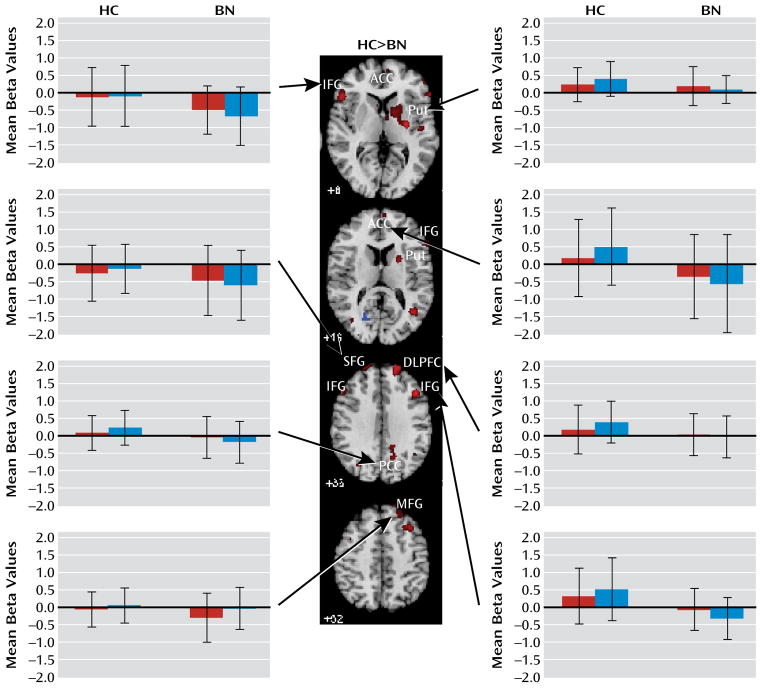
FIGURE 3. Region-of-Interest Analysis in Female Adolescents With Bulimia Nervosa Relative to Age-Matched Female Healthy Comparison Subjectsa
a The map of group-by-stimulus interactions is displayed again (as in Figure 2), along with plots of the mean beta estimates for congruent and incongruent stimuli for each region, plotted separately for the bulimia nervosa and healthy comparison groups. Error bars indicate standard error of the mean. The right side of the image shows the right lateralized frontostriatal regions that were more active during correct responses to incongruent versus congruent stimuli in healthy comparison subjects than in adolescents with bulimia nervosa. The left side of the image shows the regions in which deactivation associated with responses to incongruent stimuli (left inferior frontal gyrus [IFG], left superior frontal gyrus [SFG], and right posterior cingulate cortex [PCC]) and congruent stimuli (right SFG) was greater in adolescents with bulimia nervosa relative to healthy comparison subjects. Abbreviations: ACC=anterior cingulate cortex; BN=bulimia nervosa; DLPFC=dorsolateral prefrontal cortex; HC=healthy comparison; MFG=medial frontal gyrus; Put=putamen.
FIGURE 4
FIGURE 4. Context Effects in Female Adolescents With Bulimia Nervosa Relative to Age-Matched Female Healthy Comparison Subjectsa
a Posterior probability maps depict the group average brain activity associated with the processing and resolution of cognitive interference. Postcongruent interference=activation contrast between incongruent and congruent stimuli in trial following a congruent trial; Postincongruent interference=activation contrast between incongruent and congruent stimuli in trial following an incongruent trial. Column A shows group-by-stimulus (congruent versus incongruent) interactions and main effects of stimulus following congruent trials in healthy comparison subjects (column B) and bulimia nervosa participants (column C). Column D shows group-by-stimulus interactions and main effects of stimulus following incongruent trials in healthy comparison subjects (column E) and bulimia nervosa participants (column F). Increases in signal during incongruent relative to congruent trials are shown in red; decreases are shown in blue (columns A–F). Abbreviations: BN=bulimia nervosa; DLPFC=dorsolateral prefrontal cortex; HC=healthy comparison; IFG=inferior frontal gyrus; MFG=medial frontal gyrus; PCC=posterior cingulate cortex; Put=putamen; SFG=superior frontal gyrus.
FIGURE 5
FIGURE 5. Main Effects of Symptom Severity in Female Adolescents With Bulimia Nervosaa
a Inverse correlations of the magnitude of activation during correct responding to postcongruent interference (incongruent preceded by congruent-congruent preceded by congruent contrast) with A) the number of objective bulimic episodes (OBEs), B) the number of vomiting episodes, and C) ratings of preoccupation with body shape and weight (from the Eating Disorders Examination) are shown. Positive correlations (red) of the magnitude of activation during correct responding to postincongruent interference (incongruent preceded by incongruent-congruent preceded by incongruent contrast) with D) the number of OBEs, E) the number of vomiting episodes, and F) ratings of preoccupation with body shape and weight are also shown. Scatterplots depict the associations of OBEs with postcongruent interference activity. Abbreviations: IFG=inferior frontal gyrus; Ins=insula; Preocc=preoccupation ratings; Pcu=precuneus; Put=putamen; SFG=superior frontal gyrus; Thal=thalamus.
FIGURE 6
FIGURE 6
Processing of Congruent and Incongruent Stimuli on the Simon Spatial Incompatibility Task Among Female Adolescents With Bulimia Nervosa Relative to Age-Matched Female Healthy Comparison Subjects

Comment in

References

    1. Walsh BT, Klein DA. Eating disorders. Int Rev Psychiatry. 2003;15:205–216. - PubMed
    1. Kaye W, Strober M, Jimerson DC. The neurobiology of eating disorders. In: Charney D, Nestler EJ, editors. The Neurobiology of Mental Illness. New York: Oxford University Press; 2004. pp. 1112–1128.
    1. Marsh R, Steinglass JE, Gerber AJ, O’Leary KG, Walsh BT, Peterson BS. Deficient activity in the neural systems that mediate self-regulatory control in bulimia nervosa. Arch Gen Psychiatry. 2009;66:1–13. - PMC - PubMed
    1. Wühr P, Ansorge U. Exploring trial-by-trial modulations of the Simon effect. Q J Exp Psychol A. 2005;58:705–731. - PubMed
    1. Sturmer B, Leuthold H, Soetens E, Schroter H, Sommer W. Control over location-based response activation in the Simon task: behavioral and electrophysiological evidence. J Exp Psychol Hum Percept Perform. 2002;28:1345–1363. - PubMed

Publication types

LinkOut - more resources