Comparative Study
. 2011 Jul 15;187(2):613-7.
doi: 10.4049/jimmunol.1100613. Epub 2011 Jun 15.

Cutting edge: reactive oxygen species inhibitors block priming, but not activation, of the NLRP3 inflammasome

Affiliations
Comparative Study

Cutting edge: reactive oxygen species inhibitors block priming, but not activation, of the NLRP3 inflammasome

Franz Bauernfeind et al. J Immunol. .

Abstract

A common denominator among the multiple damage-inducing agents that ultimately lead to activation of NLRP3 has not yet been identified. Recently, production of reactive oxygen species (ROS) has been suggested to act as a common event upstream of the NLRP3 inflammasome machinery. Because de novo translation of NLRP3 is an essential step in the activation of NLRP3, we investigated the role of substances that inhibit either ROS production or its oxidative activity. Although we observe that NLRP3 inflammasome activation is unique among other known inflammasomes in its sensitivity to ROS inhibition, we have found that this phenomenon is attributable to the fact that NLRP3 strictly requires priming by a proinflammatory signal, a step that is blocked by ROS inhibitors. Although these data do not exclude a general role for ROS production in the process of NLRP3-triggered inflammation, they would put ROS upstream of NLRP3 induction, but not activation.


Figures
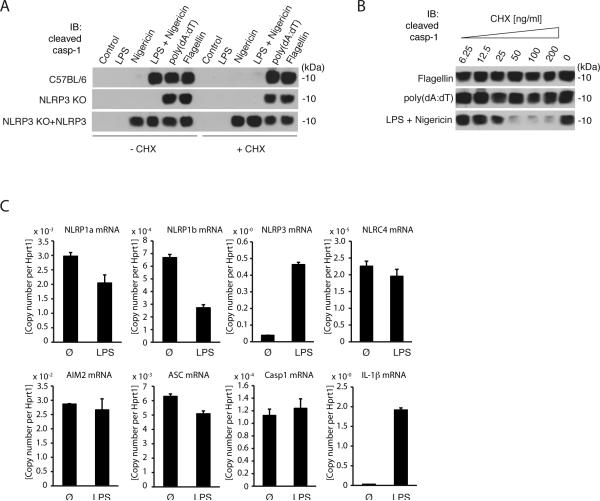
Figure 1
Figure 1. The requirement of priming is a distinctive feature of the NLRP3 inflammasome
A, immunoblot of cleaved caspase-1 from supernatants of wild type (C57BL/6), NLRP3-deficient or NLRP3-deficient macrophages reconstituted with NLRP3 (NLRP3-KO + NLRP3) treated with 100 ng/ml cycloheximide (CHX) or left untreated. Stimulation was performed as indicated. B, immunoblotting of caspase-1 from supernatants of wild-type macrophages pretreated with CHX for 1 h and stimulated as indicated. C, Messenger RNA expression in LPS primed (200 ng/ml) or untreated macrophages. Relative expression data per Hprt1 are shown. Readouts were performed 6 h (A and B) or 3h (C) after stimulation and data are from one representative experiment of three (A and B) or of four (C) experiments.
Figure 2
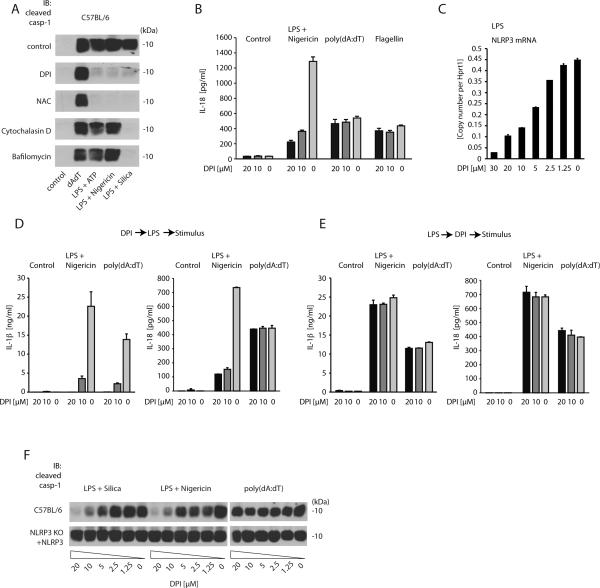
Figure 2. Inhibitors of the ROS system block NLRP3-mediated caspase-1 activation byinhibiting cell priming
A, wild type macrophages were pretreated for 1 h with DPI (20 μM), NAC (20 mM), Cytochalasin D (5 μM) or Bafilomycin (250 nM), thenstimulated as indicatedand subsequently assessed for cleavage ofcaspase-1. B, wild type macrophages were pretreated for 1 h with 0, 10 or 20 μM DPI, then stimulated as indicated and subsequently IL-18 release was measured by ELISA. C, wild type macrophages were treated with ascending doses of DPI, subsequently primed with LPS and then assessed for NLRP3 mRNA expression. D and E, wild type macrophages were treated with DPI (1h) and then primed with LPS (3h) or alternatively, macrophages were primed with LPS (3h), then treated with DPI (1h) and subsequently stimulated as indicated. 6 h following stimulation IL-1β and IL-18 release were assessed in the supernatant. F, Cleaved caspase-1 of wild type and NLRP3-deficient macrophages reconstituted with NLRP3 is depicted. Data from one representative experiment of two (A, B, D and E) or three (C and F) are presented.

References

    1. Dinarello CA. Immunological and inflammatory functions of the interleukin-1 family. Annu Rev Immunol. 2009;27:519–550. - PubMed
    1. Hornung V, Ablasser A, Charrel-Dennis M, Bauernfeind F, Horvath G, Caffrey DR, Latz E, Fitzgerald KA. AIM2 recognizes cytosolic dsDNA and forms a caspase-1-activating inflammasome with ASC. Nature. 2009;458:514–518. - PMC - PubMed
    1. Burckstummer T, Baumann C, Bluml S, Dixit E, Durnberger G, Jahn H, Planyavsky M, Bilban M, Colinge J, Bennett KL, Superti-Furga G. An orthogonal proteomic-genomic screen identifies AIM2 as a cytoplasmic DNA sensor for the inflammasome. Nat Immunol. 2009;10:266–272. - PubMed
    1. Fernandes-Alnemri T, Yu JW, Datta P, Wu J, Alnemri ES. AIM2 activates the inflammasome and cell death in response to cytoplasmic DNA. Nature. 2009;458:509–513. - PMC - PubMed
    1. Kanneganti TD, Ozoren N, Body-Malapel M, Amer A, Park JH, Franchi L, Whitfield J, Barchet W, Colonna M, Vandenabeele P, Bertin J, Coyle A, Grant EP, Akira S, Nunez G. Bacterial RNA and small antiviral compounds activate caspase-1 through cryopyrin/Nalp3. Nature. 2006;440:233–236. - PubMed

Publication types

MeSH terms