


Hands-on therapy interventions for upper limb motor dysfunction following stroke
- PMID: 21678359
- PMCID: PMC6464865
- DOI: 10.1002/14651858.CD006609.pub2
Hands-on therapy interventions for upper limb motor dysfunction following stroke
Abstract
Background: Recent studies have attempted to disaggregate therapeutic intervention packages by looking at the impact of structure and process characteristics of environment upon outcome. However, what is commonly referred to as the 'black box' of therapy has yet to be comprehensively unpacked. This failure to analyse the components of therapy means that it remains unclear how much therapy should be provided, who should provide it, and which patients should be targeted to ensure that functional outcomes are maximized. This review, therefore, seeks to assess the effectiveness of specific therapeutic interventions in the rehabilitation of the paretic upper limb post stroke.
Objectives: To identify if specific hands-on therapeutic interventions enhance motor activity and function of the upper limb post stroke.
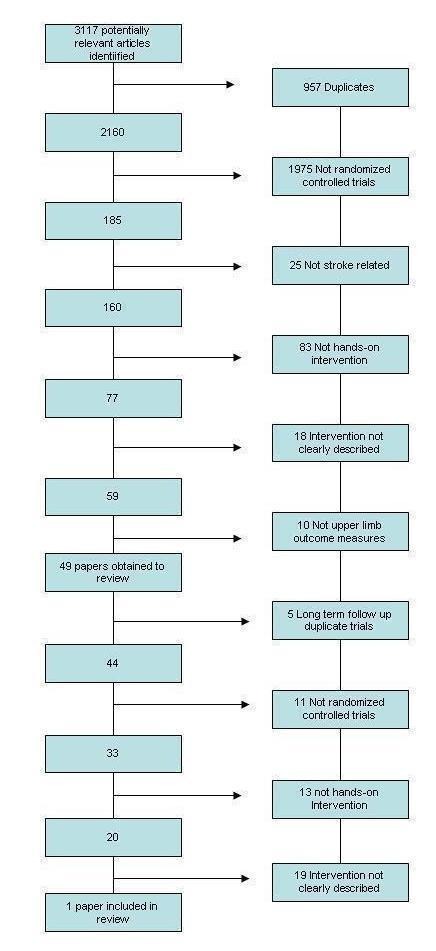
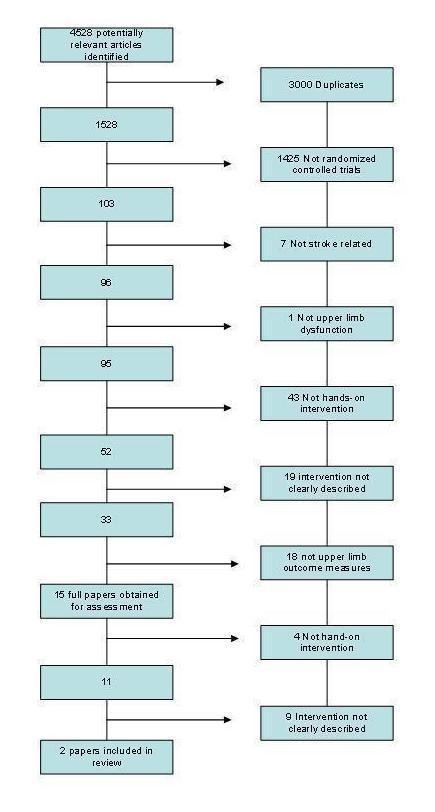
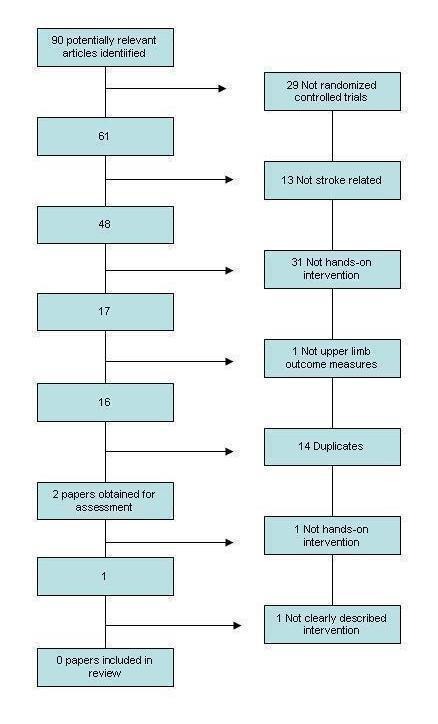
Search strategy: We searched the trials registers of the Cochrane Stroke Group (March 2010), the Cochrane Complementary Medicine Field (March 2010) and the Cochrane Rehabilitation and Related Therapies Field (March 2010); MEDLINE (1966 to March 2010); AMED (1985 to March 2010); EMBASE (1980 to March 2010); CINAHL (1982 to March 2010); the Physiotherapy Evidence Database (PEDro) (March 2010); and the Cochrane Central Register of Controlled Trials (CENTRAL) (The Cochrane Library 2010, Issue 1). In an effort to identify other published, unpublished and ongoing trials we planned to handsearch journals, searched ongoing trials registers, reviewed reference lists, and contacted relevant professional organizations.
Selection criteria: Randomized controlled trials (RCTs) involving adults aged 18 years or over and including descriptions of specific hands-on interventions and techniques, rather than packages or approaches to treatment.
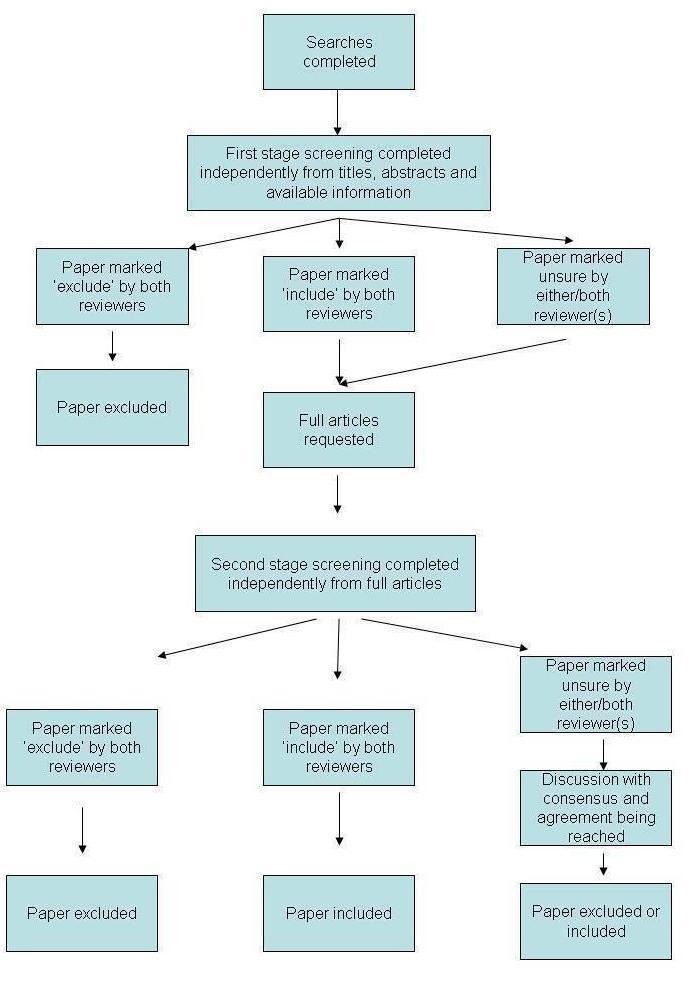
Data collection and analysis: Following completion of the searches, two review authors independently assessed the trials and extracted data using a data extraction pro forma. The same two review authors independently recorded and documented the methodological quality of the trials.
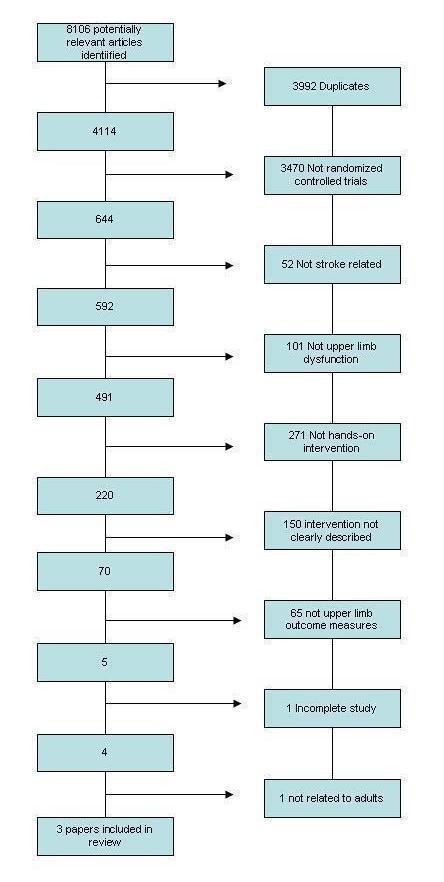
Main results: Three studies, involving a total of 86 participants, met all the selection criteria and were included in the review. However, extreme levels of heterogeneity were evident. Therefore, we could not undertake a meta-analysis of the results and completed a narrative synthesis instead.
Authors' conclusions: Overall, the review demonstrated that the limited evidence of benefit of stretching, passive exercises and mobilization, when applied to the hemiplegic upper limb following stroke, merits further research.
Conflict of interest statement
P Crome is employed by North Staffordshire Combined Healthcare NHS Trust and Keele University, both of which are involved in stroke research.
Figures
Comment in
-
EJPRM systematic continuous Update on Cochrane reviews in rehabilitation: news from April 2011 to July 2011.Eur J Phys Rehabil Med. 2011 Sep;47(3):507-11. Eur J Phys Rehabil Med. 2011. PMID: 21946407
References
References to studies included in this review
-
- Carey JR. Manual stretch: effect on finger movement control and force control in stroke subjects with spastic extrinsic finger flexor muscles. Archives of Physical Medicine and Rehabilitation 1990;71:888‐94. - PubMed
-
- Mann GE, Burridge JH, Malone LJ, Strike PW. A pilot study to investigate the effects of electrical stimulation on recovery of hand function and sensation in subacute stroke patients. Neuromodulation 2005;8:193‐202. - PubMed
-
- Mikulecka E, Petruskava L, Mayer M, Vlachova I. Differentiated manual treatment of the hand and forearm in early rehabilitation of stroke patients (a controlled study). Rehabilitacia 2005;42:52‐61.
References to studies excluded from this review
-
- Hunter SM. Definition and effects of physical therapy treatment for sensorimotor dysfunction in the hemiplegic upper limb after stroke. Unpublished PhD thesis, University of Keele.
-
- Hunter SM, Crome P, Sim, J, Donaldson C, Pomeroy VM. Development of treatment schedules for research: a structured review to identify methodologies used and a worked example of 'Mobilisation and Tactile Stimulation' for stroke patients. Physiotherapy 2006;92:195‐207.
-
- Hunter SM, Crome P, Sim J, Pomeroy VM. Effects of Mobilization and Tactile Stimulation on recovery of the hemiplegic upper limb: a series of replicated single‐system studies. Archives of Physical Medicine and Rehabilitation 2008;89:2003‐10. - PubMed
Additional references
-
- Altman DG, Doré CJ. Randomisation and baseline comparisons in clinical trials. Lancet 1990;335:149‐53. - PubMed
-
- Ashburn A, Partridge C, DeSouza L. Physiotherapy in the rehabilitation of stroke: a review. Clinical Rehabilitation 1993;7:337‐45.
-
- Ballinger C, Ashburn A, Low J, Roderick P. Unpacking the black box of therapy ‐ a pilot study to describe occupational therapy and physiotherapy interventions for people with stroke. Clinical Rehabilitation 1991;13:301‐9. - PubMed
-
- British Heart Foundation. Coronary heart disease statistics. British Heart Foundation1999.
-
- Bobath B. Adult hemiplegia: evaluation and treatment. 3rd Edition. Elsevier Health Sciences, 1990.
Publication types
MeSH terms
Grants and funding
LinkOut - more resources
Full Text Sources
Medical
Miscellaneous
