Review
. 2011 Jul;53(5):466-75.
doi: 10.1002/dev.20557.

Reflections of experience-expectant development in repair of the adult damaged brain

Affiliations
Review

Reflections of experience-expectant development in repair of the adult damaged brain

Theresa A Jones et al. Dev Psychobiol. 2011 Jul.

Abstract

Behavioral experience has long been known to influence functional outcome after brain injury, but only recently has its pervasive role in the reorganization of the adult brain after damage become appreciated. We briefly review findings from animal models on the role of experience in shaping neuronal events after stroke-like injury. Experience-dependent neural plasticity can be enhanced or impaired by brain damage, depending upon injury parameters and timing. The neuronal growth response to some experiences is heightened due to interactions with denervation-induced plasticity. This includes compensatory behavioral strategies developed in response to functional impairments. Early behavioral experiences can constrain later experience-dependent plasticity, leading to suboptimal functional outcome. Time dependencies and facets of neural growth patterns are reminiscent of experience-expectant processes that shape brain development. As with sensitive periods in brain development, this process may establish behavioral patterns early after brain injury which are relatively resistant to later change.


Figures

Figure 1
Figure 1
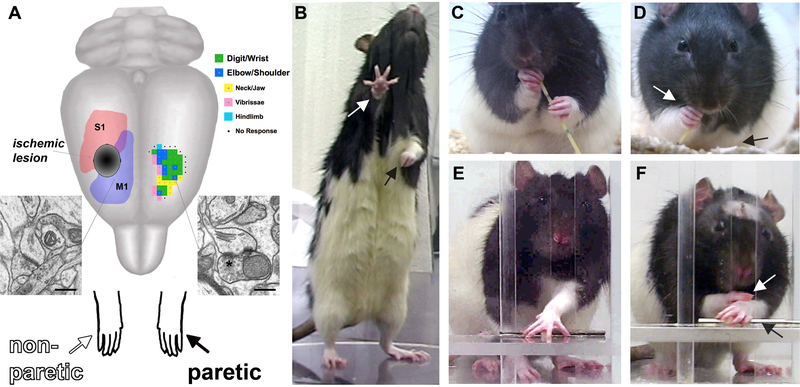
(A) Ischemic lesions of the sensorimotor cortex result in impairments in the contralesional, paretic, forelimb (black arrows) and compensation with the nonparetic limb (white arrows). Synaptic structural plasticity in the contralesional motor cortex occurs due to denervation of transcallosal projections and increased reliance on the nonparetic limb. The residual cortex of the injured hemisphere can be driven to undergo greater neuronal plasticity with focused training (“rehabilitative training) of the paretic limb. A representative map of forelimb movement representations (green and blue, an average of n = 7 maps) is shown in the intact hemisphere. M1, primary motor cortex, S1, primary somatosensory cortex, *perforated synapse, scale bars = 400nm. (B) Rats rely more on the nonparetic limb for postural support. (C) In handling food pieces (in this example, a piece of uncooked vermicelli pasta), normal rats use dexterous forepaw movements. (D) After unilateral SMC lesions, rats use the paretic forelimb less and in less coordinated ways. (E) In skilled reaching, normal rats retrieve food pellets using a coordinated sequence of proximal and distal forelimb movements. (F) After unilateral SMC lesions, rats have movement abnormalities and frequently compensate with the nonparetic paw.

References

    1. Adkins DL, Bury SD, & Jones TA (2002). Laminar-dependent dendritic spine alterations in the motor cortex of adult rats following callosal transection and forced forelimb use. Neurobiology of Learning and Memory, 78, 35–52. - PubMed
    1. Allred RP, Adkins DL, Woodlee MT, Husbands LC, Maldonado MA, Kane JR, Schallert T, & Jones TA (2008). The vermicelli handling test: a simple quantitative measure of dexterous forepaw function in rats. Journal of Neuroscience Methods, 170, 229–244. - PMC - PubMed
    1. Allred RA, Cappellini C and Jones TA (2010). The “good” limb makes the “bad” limb worse: Experience-dependent interhemispheric disruption of functional outcome after cortical stroke in rats. Behavioral Neuroscience, 124, 124–132. - PMC - PubMed
    1. Allred RP, & Jones TA (2008a). Experience--a double edged sword for restorative neural plasticity after brain damage. Future Neurology, 3, 189–198. - PMC - PubMed
    1. Allred RP, & Jones TA (2008b). Maladaptive effects of learning with the less-affected forelimb after focal cortical infarcts in rats. Experimental Neurology, 210, 172–181. - PMC - PubMed

Publication types