Review
. 2011 Jun;8(3):309-16.
doi: 10.1586/epr.11.23.

Searching for biomarkers: humoral response profiling with luciferase immunoprecipitation systems

Affiliations
Review

Searching for biomarkers: humoral response profiling with luciferase immunoprecipitation systems

Peter D Burbelo et al. Expert Rev Proteomics. 2011 Jun.

Abstract

B-cell-mediated humoral responses are triggered in many human diseases, including autoimmune diseases, cancer, and neurologic and infectious diseases. However, the full exploitation of the information contained within a patient's antibody repertoire for diagnosis, monitoring and even disease prediction has been limited due to the poor diagnostic performance of many immunoassay formats. We have developed luciferase immunoprecipitation systems (LIPS) that harnesses light-emitting proteins to generate high-definition antibody profiles that are optimal for both diagnostics and biomarker discovery. Here, we describe the results and implications from a range of LIPS-antibody profiling studies performed in our laboratory. These include highly sensitive diagnostics for domestic and global pathogens, insights into infection-related diseases, discovery of new biomarkers for human diseases, subcategorization of symptoms and identification of pathogenic autoantibodies against self-proteins. These investigations highlight the types of humoral response profiles associated with different diseases, provide new information related to disease pathogenesis and offer a framework for incorporating LIPS antibody profiling into global health initiatives and disease monitoring.


Figures
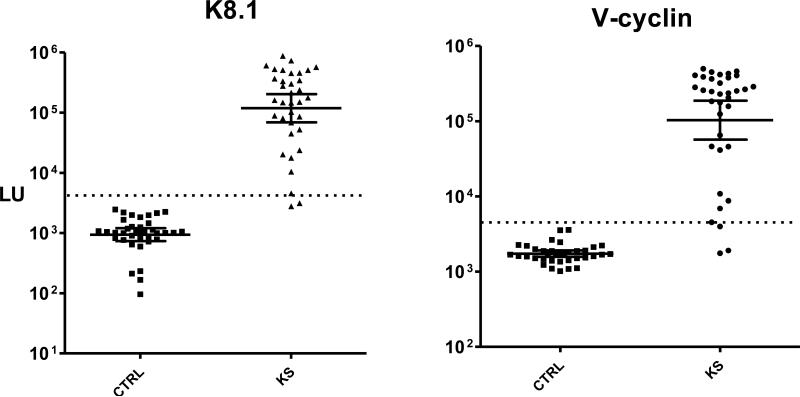
Figure 1
Figure 1. Anti-K8.1 and anti-v-cyclin antibodies in uninfected controls and KS patients
Shown are antibody titer results from LIPS screening of 36 uninfected normal controls (CTRL) and 35 KS patients. Each symbol represents the average antibody titer from duplicate testing from an individual patient or control. The geometric mean antibody titer and 95% CI for anti-K8.1 lytic antibodies anti-v-cyclin latent antibody in light units (LU) are plotted on the Y-axis using a log10 scale.
Figure 2
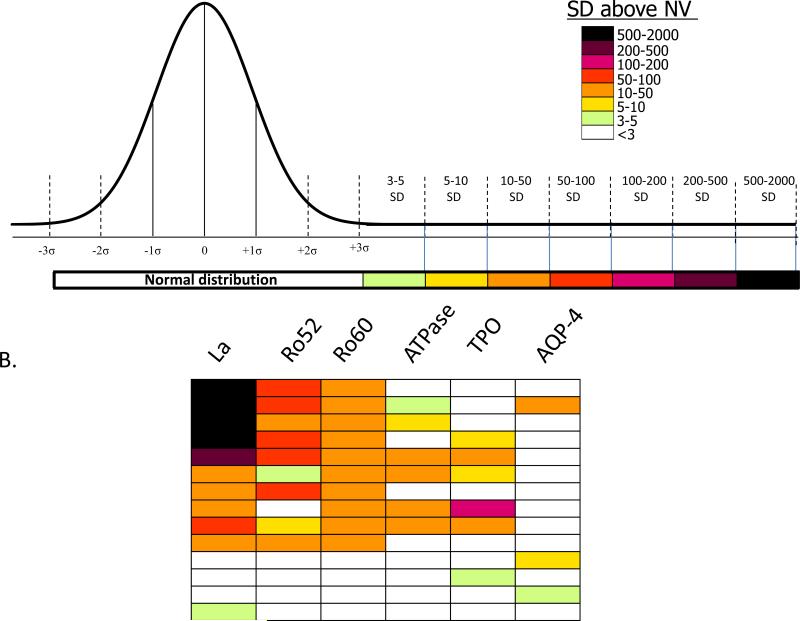
Figure 2. Autoantibody biomarker detection by LIPS
(A) Autoantibodies detected by LIPS often show a wide range of titers. Autoantibody titers are determined in a control normal volunteer (NV) group as a reference scale. Antibody titer values for each antigen-antibody measurement greater than the control mean plus 3 SD were color-coded to signify the relative number of standard deviations above these cut-off values. In some autoimmune diseases antibody responses ranging from the mean plus 3 standard deviations (SD) to over 2000 standard deviations greater than control subjects can be detected. (B) A heatmap of autoantibody responses in Sjögren's syndrome (SjS). The heatmap shows the heterogeneity of responses and antibody titers to the different antigens in selected SjS patients, whereby each row in the heatmap represents one patient. Of note, approximately 15% of the SjS cohort examined by LIPS did not show statistical response to any of the autoantigens tested [21].
Figure 3
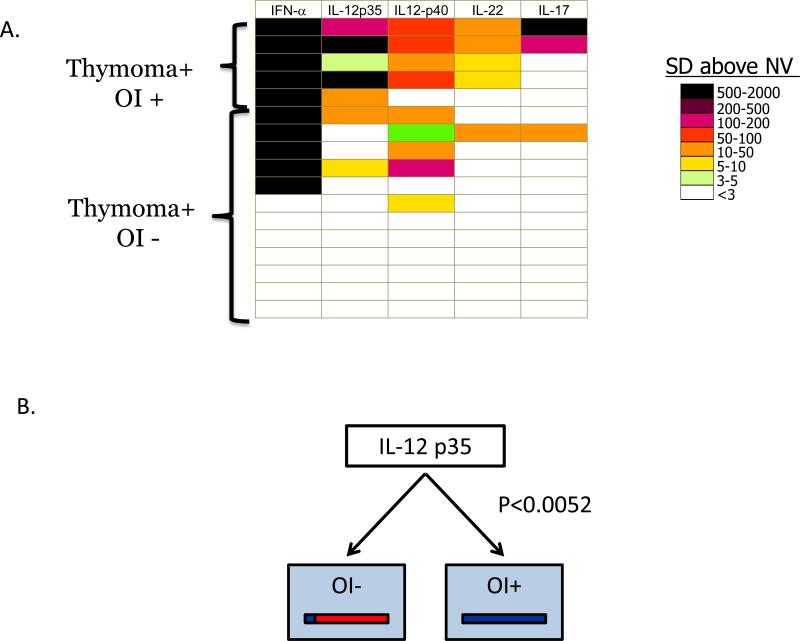
Figure 3. Anti-cytokine autoantibodies detected by LIPS in thymoma patients with opportunistic infection correlate with immunodeficiency
(A) Heatmap analysis of anti-cytokine autoantibody profiles in thymoma patients. Anti-cytokine autoantibody titers to 5 informative cytokines are shown for each of five thymoma patients with and twelve thymoma patients without opportunistic infection (OI). Each row in the heatmap represents one patient from a total of 17 thymoma patients analyzed. The titer values greater than the mean of the 30 normal volunteers plus 3 standard deviations were color-coded from green to black to signify the relative number of standard deviations above these reference values. (B) Anti-IL-12 p35 autoantibodies correlate with OI. A decision tree algorithm using rapid miner (www.rapidminer.com) identified IL-12 p35 as the most informative anti-cytokine response for distinguishing thymoma patient with and without OI.

References

    1. Notkins AL. New predictors of disease. Molecules called predictive autoantibodies appear in the blood years before people show symptoms of various disorders. Tests that detected these molecules could warn of the need to take preventive action. Scientific American. 2007;296(3):72–79. [Provides an overview of how autoantibodies can be used as disease predictors.] - PubMed
    1. Burbelo PD, Ching KH, Bush ER, Han BL, Iadarola MJ. Antibody-profiling technologies for studying humoral responses to infectious agents. Expert review of vaccines. 2010;9(6):567–578. - PMC - PubMed
    1. Liu E, Eisenbarth GS. Accepting clocks that tell time poorly: fluid-phase versus standard ELISA autoantibody assays. Clin Immunol. 2007;125(2):120–126. - PMC - PubMed
    1. Burbelo PD, Ching KH, Klimavicz CM, Iadarola MJ. Antibody profiling by Luciferase Immunoprecipitation Systems (LIPS). J Vis Exp. 2009;(32) [Contains a detailed protocol and video describing the technical aspects of performing LIPS.] - PMC - PubMed
    1. Burbelo PD, Leahy HP, Iadarola MJ, Nutman TB. A four-antigen mixture for rapid assessment of Onchocerca volvulus infection. PLoS Negl Trop Dis. 2009;3(5):e438. - PMC - PubMed

Publication types