


doi: 10.1126/science.1202723.
SIRT6 promotes DNA repair under stress by activating PARP1
Affiliations
- PMID: 21680843
- PMCID: PMC5472447
- DOI: 10.1126/science.1202723
Item in Clipboard
SIRT6 promotes DNA repair under stress by activating PARP1
Science.
.
Abstract
Sirtuin 6 (SIRT6) is a mammalian homolog of the yeast Sir2 deacetylase. Mice deficient for SIRT6 exhibit genome instability. Here, we show that in mammalian cells subjected to oxidative stress SIRT6 is recruited to the sites of DNA double-strand breaks (DSBs) and stimulates DSB repair, through both nonhomologous end joining and homologous recombination. Our results indicate that SIRT6 physically associates with poly[adenosine diphosphate (ADP)-ribose] polymerase 1 (PARP1) and mono-ADP-ribosylates PARP1 on lysine residue 521, thereby stimulating PARP1 poly-ADP-ribosylase activity and enhancing DSB repair under oxidative stress.
Figures
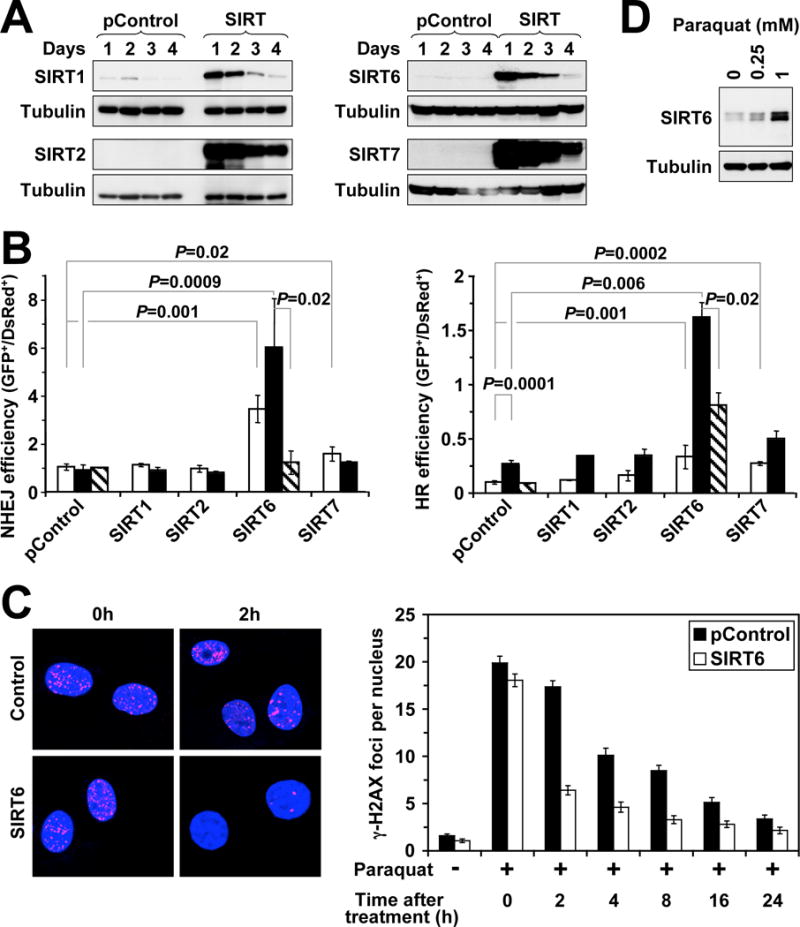
A, Overexpression of SIRT1, 2, 6, and 7 in human fibroblasts. Western blot with sirtuin-specific antibodies after transfection with a control vector encoding HPRT mini gene (pControl) or SIRT-expressing vector. B, Effect of sirtuin overexpression on the efficiency of NHEJ and HR. Human fibroblasts containing chromosomally integrated reporter cassettes (Supplementary Figure 1) were co-transfected with I-SceI endonuclease to induce DSBs, SIRT expression vectors or pControl, and DsRedN-1 plasmid as transfection control. Prior to transfection the cells were untreated (open bars) or treated with 1 mM paraquat (filled bars) or paraquat plus 5 mM nicotinamide (striped bars) for 16 h. Values represent the ratio between the numbers of GFP+ cells corresponding to successful repair events to the DsRed+ transfection controls. Error bars indicate s.d.; n=8 (control and SIRT6); n=3 (other sirtuins). For some of the treatments error bars are too small to be visible. P-values were calculated by two-tailed Student’s t-test. C, SIRT6 overexpression accelerates disappearance of γH2AX foci after paraquat treatment. Cells were treated with 1 mM paraquat for 16h. After removal of paraquat cells were stained for γH2AX foci at indicated time points. Data represents an average of at least 50 nuclei. Error bars indicate s.e.m. For some of the treatments error bars are too small to be visible. D, Induction of endogenous SIRT6 protein levels by oxidative stress. Human fibroblasts were treated with indicated doses of paraquat for 16 h.
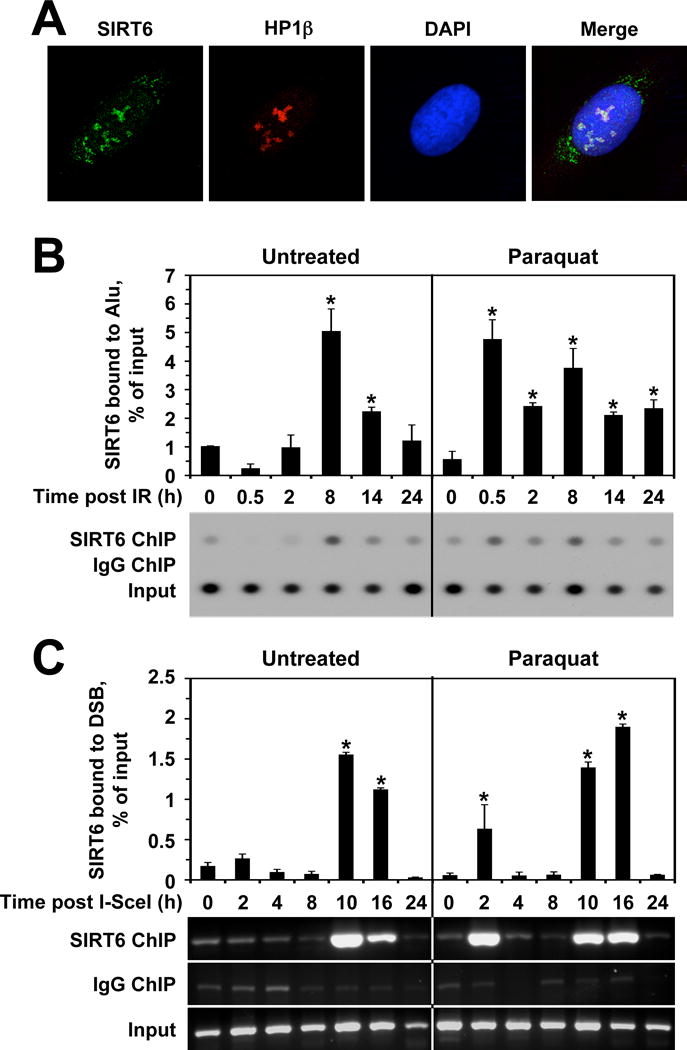
A, SIRT6 forms aggregates in the nucleus that co-localize with HP1β. In situ staining of human fibroblasts with SIRT6 and HP1β antibodies. B,C ChIP analysis showing kinetics of SIRT6 recruitment to Alu sequences following 8 Gy of γ-irradiation (B) and sequences flanking I-SceI-induced DSB after transfection with I-SceI expression vector (C). Control ChIP with SIRT6 knockout cells is shown in Supplementary Figure 6. Quantification of five ChIP experiments is shown. (*) indicates values significantly (P<0.05) different from corresponding 0 time points. Error bars indicate s.d.
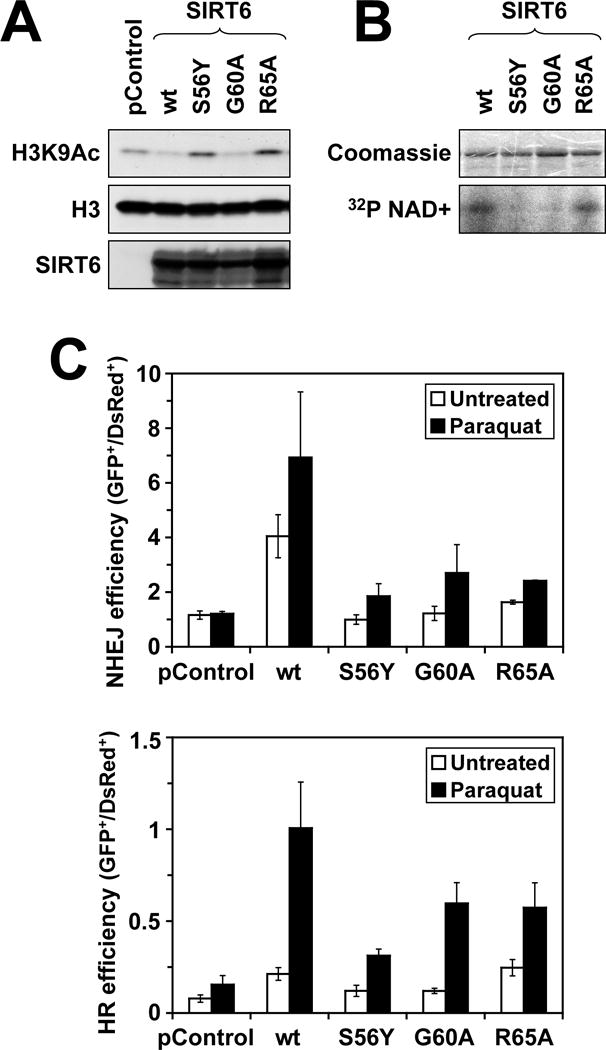
A, Western analysis of H3K9 deacetylation activity of SIRT6 in human fibroblasts showing that S56Y and R65A mutations abolish the activity and possibly have a dominant negative effect. B, In vitro assay of mono-ADP-ribosylation activity of SIRT6 showing that S56Y and G60A mutations abolish the activity. C, SIRT6 mutants for deacetylation and/or ribosylation activities have reduced ability to stimulate NHEJ and HR. Prior to transfection with SIRT6 expressing vectors or pControl, cells were untreated (open bars) or treated with paraquat (filled bars). Quantification of four independent experiments is shown. Error bars indicate s.d.
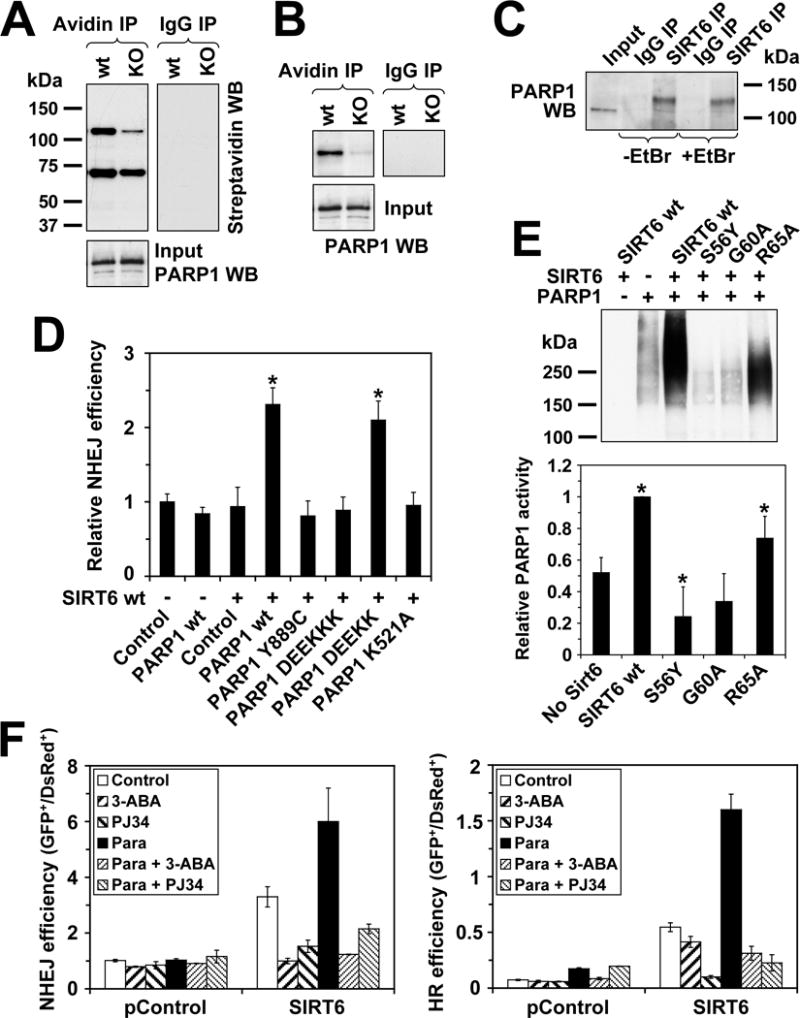
A, Analysis of mono-ADP-ribosylated proteins in the wild type and SIRT6 knockout MEFs stressed with paraquat for 16 h. Labeling with biotinylated NAD followed by depletion of poly-ADP-ribosylated proteins with PAR antibodies, and avidin immunoprecipitation of the mono-ADP-ribosylated proteins reveals two bands of 120 and 70 kDa. B, Western blot with PARP1 antibodies of the protein extract shown in (A). The 120 kDa band is recognized by PARP1 antibodies. C, Interaction of SIRT6 and PARP1 in human fibroblasts after treatment with 1 mM paraquat. Cell lysates were immunoprecipitated with SIRT6 antibodies in the presence of 50 μg/ml Etidium bromide followed by Western analysis with PARP1 antibodies. D, PARP1 K521 is essential for activation of NHEJ by SIRT6. NHEJ assay was performed in PARP1 knockout MEFs containing integrated NHEJ reporter. Cells were transfected with SIRT6 and/or PARP1 or PARP1 mutants. Both SIRT6 and PARP1 are required for the stimulation of repair. PARP1 Y889C is a catalytically inactive PARP1. PARP1 DEEKKK contains mutations in the all six poly-ADP-ribosylation sites. PARP1 DEEKK contains mutations in the all poly-ADP-ribosylation sites, but not K521. Error bars show s.d. (*) indicate values significantly different from control (P<0.01). E, In vitro assay of PARP1 poly-ADP-ribosylation activity showing that PARP1 is stimulated by the addition of the wild type SIRT6 and SIRT6 R65A mutant that has mono-ADP-ribosylation activity only. The graph shows quantification of six independent experiments. Error bars show s.d. (*) indicate values significantly different from control (P<0.01). F, Stimulation of NHEJ and HR by SIRT6 is abolished by addition of PARP1 inhibitors 5 mM 3-ABA, or 20 μM PJ34. Quantification of four independent experiments is shown. Error bars indicate s.d.
References
Publication types
MeSH terms
Substances
Grants and funding
LinkOut - more resources
Full Text Sources
Other Literature Sources
Molecular Biology Databases
Miscellaneous
