


Gender divergence on the impact of multiple cardiovascular risk factors on the femoral artery intima-media thickness in asymptomatic young adults: the Bogalusa Heart Study
- PMID: 21681071
- PMCID: PMC3179814
- DOI: 10.1097/MAJ.0b013e31821da9c0
Gender divergence on the impact of multiple cardiovascular risk factors on the femoral artery intima-media thickness in asymptomatic young adults: the Bogalusa Heart Study
Abstract
Introduction: Gender divergence on the impact of multiple cardiovascular risk factors on the femoral artery intima-media thickness (IMT) has not been studied in a biracial (black-white) community-based asymptomatic young adults.
Methods: Femoral IMT was measured by B-mode ultrasonography in 1080 individuals (age, 24-43 years; 71% white; 43% men) enrolled in the Bogalusa Heart Study.
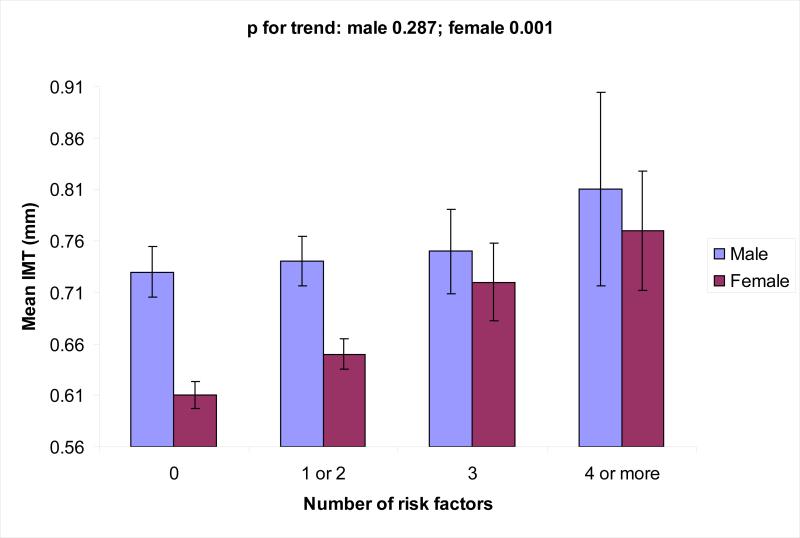
Results: Femoral IMT showed a gender difference (men > women; P = 0.001), but no racial difference. In a multivariate model, age, cigarette smoking, systolic blood pressure and total cholesterol to high-density lipoprotein cholesterol ratio related independently, in that order, to IMT in women, and age and low-density lipoprotein cholesterol in men. In women, mean IMT increased with increasing number of risk factors defined as values above the age-, race- and gender-specific 75th percentile of systolic blood pressure, waist circumference, total cholesterol to high-density lipoprotein cholesterol ratio and insulin along with positive smoking status (P for trend = 0.001), with respective mean IMT (mm) values of 0.61, 0.65, 0.72 and 0.77, for 0, 1 to 2, 3 and 4 to 5 risk factors. There was no such significant trend in men.
Conclusions: Although men versus women had thicker IMT, the observed increasing trend of femoral IMT with increasing number of risk factors in asymptomatic young women suggests that women may be relatively more susceptible to the burden of multiple risk factors.
Figures
References
-
- Criqui MH, Langer RD, Fronek A, et al. Mortality over a period of 10 years in patients with peripheral arterial disease. N Engl J Med. 1992;326(6):381–386. - PubMed
-
- Newman AB, Siscovick DS, Manolio TA, et al. Atherosclerosis: Ankle-arm index as a marker of atherosclerosis in the Cardiovascular Health Study. Circulation. 1993;88(3):837–845. - PubMed
-
- Criqui MH. Peripheral arterial disease-epidemiological aspects. Vasc Med. 2001;6(3 Suppl):3–75. - PubMed
-
- Schroll M, Munck O. Estimation of peripheral arteriosclerotic disease by ankle blood pressure measurements in a population study of 60 year-old men and women. J Chronic Dis. 1981;34:261–269. - PubMed
