


Review
doi: 10.1038/nri3007.
The light and dark sides of intestinal intraepithelial lymphocytes
Affiliations
- PMID: 21681197
- PMCID: PMC3140792
- DOI: 10.1038/nri3007
Item in Clipboard
Review
The light and dark sides of intestinal intraepithelial lymphocytes
Nat Rev Immunol.
.
Abstract
The intraepithelial lymphocytes (IELs) that reside within the epithelium of the intestine form one of the main branches of the immune system. As IELs are located at this critical interface between the core of the body and the outside environment, they must balance protective immunity with an ability to safeguard the integrity of the epithelial barrier: failure to do so would compromise homeostasis of the organism. In this Review, we address how the unique development and functions of intestinal IELs allow them to achieve this balance.
Conflict of interest statement
The authors declare no competing financial interests.
Figures

In the thymus, immature CD4+CD8αβ+CD8αα+ (triple positive) thymocytes undergo agonist (‘alternative’) selection and differentiate into double-negative T cell receptor-αβ (TCRαβ)+ cells that are the precursors of natural TCRαβ+ intraepithelial lymphocytes (IELs). The TCRαβ+ natural IEL precursor cells partly acquire their antigen-experienced phenotype ‘naturally’ during selection with self antigens. In addition, the precursor cells for TCRαβ+ and TCRγδ+ natural IELs upregulate intestinal homing receptors during their maturation in the thymus, which allows these cells to directly seed the intestinal epithelium after they leave the thymus. CD4+CD8αβ+ (double positive) thymocytes undergo ‘conventional’ thymic selection and differentiate into naive CD4+ and CD8αβ+ TCRαβ+ T cells that migrate to the periphery. These naive T cells can differentiate into effector T cells in response to peripheral antigens and subsequently migrate to the gut and become incorporated into the induced IEL compartment. APC, antigen-presenting cell; MLNs, mesenteric lymph nodes.
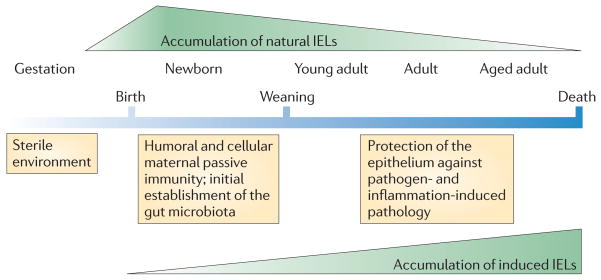
Natural intraepithelial lymphocytes (IELs) gain their antigen-experienced phenotype and gut-homing capacity in the thymus during their initial agonist-based selection in response to self antigens. They populate the gut compartment early, before environmental antigens have been encountered. Conventional naive T cells differentiate into effector cells in response to peripherally encountered antigens and gradually accumulate over time as antigen-experienced induced IELs in the gut.

a | The ‘light side’ shows the beneficial roles of natural and induced intraepithelial lymphocytes (IELs) in preserving the epithelium and restoring tissue integrity after injury. b | The ‘dark side’ depicts the pathogenic roles of natural and induced IELs. IELs can exert uncontrolled and/or excessive cytotoxicity and promote inflammatory responses, which may initiate and/or exacerbate inflammatory bowel diseases and coeliac disease.
References
-
- Hooper LV, Macpherson AJ. Immune adaptations that maintain homeostasis with the intestinal microbiota. Nature Rev Immunol. 2010;10:159–169. - PubMed
-
- Bonneville M, et al. Intestinal intraepithelial lymphocytes are a distinct set of γδ T cells. Nature. 1988;336:479–481. - PubMed
-
- Goodman T, Lefrancois L. Expression of the γ-δ T-cell receptor on intestinal CD8+ intraepithelial lymphocytes. Nature. 1988;333:855–858. References 3 and 4 describe the high frequency of TCR γδ-expressing T cells among IELs. - PubMed
Publication types
MeSH terms
Grants and funding
LinkOut - more resources
Full Text Sources
Other Literature Sources
Research Materials
