


Reduced pelvic pain in women with endometriosis: efficacy of long-term dienogest treatment
- PMID: 21681516
- PMCID: PMC3249203
- DOI: 10.1007/s00404-011-1941-7
Reduced pelvic pain in women with endometriosis: efficacy of long-term dienogest treatment
Abstract
Purpose: To investigate the efficacy and safety of dienogest as a long-term treatment in endometriosis, with follow-up after treatment discontinuation. The study included women with endometriosis, who had previously completed a 12-week, placebo-controlled study of dienogest, who participated in an open-label extension study for up to 53 weeks. Thereafter, a patient subgroup was evaluated in a 24-week follow-up after treatment discontinuation.
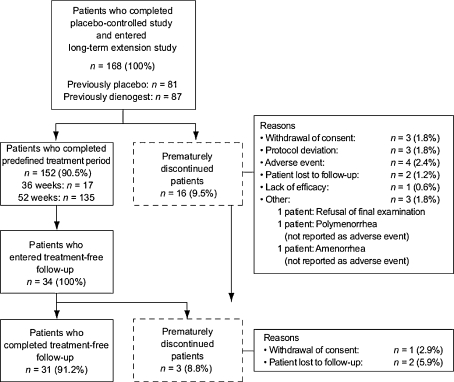
Methods: A multicenter study performed in Germany, Italy and Ukraine. Women with endometriosis were enrolled at completion of the placebo-controlled study (n = 168). All women received dienogest (2 mg once daily, orally) and changes in pelvic pain (on a visual analog scale), bleeding pattern, adverse events and laboratory parameters were evaluated during and after treatment.
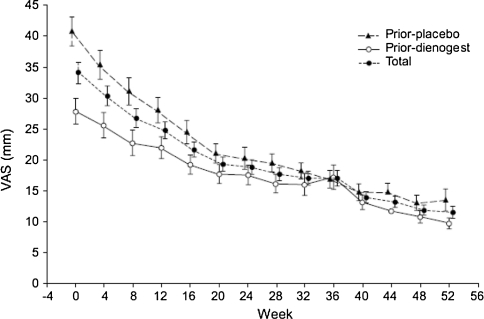
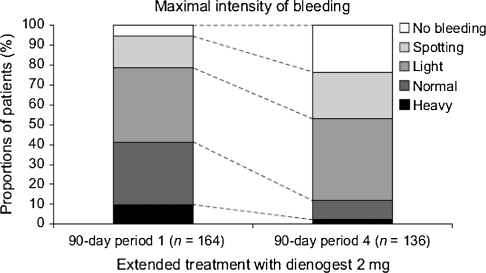
Results: The completion rate among women who entered the open-label extension study was 90.5% (n = 152). A significant decrease in pelvic pain was shown during continued dienogest treatment (P < 0.001). The mean frequency and intensity of bleeding progressively decreased. Adverse events, rated generally mild or moderate, led to withdrawal in four patients (2.4%). No clinically relevant changes in laboratory parameters were observed. During treatment-free follow-up (n = 34), the reduction in pelvic pain persisted, while bleeding frequency and intensity returned to normal patterns.
Conclusions: Long-term dienogest showed a favorable efficacy and safety profile, with progressive decreases in pain and bleeding irregularities during continued treatment; the decrease of pelvic pain persisted for at least 24 weeks after treatment cessation.
Figures
References
-
- Practice Committee of American Society for Reproductive Medicine Treatment of pelvic pain associated with endometriosis. Fertil Steril. 2008;90(5 Suppl):S260–S269. - PubMed
Publication types
MeSH terms
Substances
LinkOut - more resources
Full Text Sources
Other Literature Sources
Medical
