


Exploration of the rapid effects of personal fine particulate matter exposure on arterial hemodynamics and vascular function during the same day
- PMID: 21681997
- PMCID: PMC3094422
- DOI: 10.1289/ehp.1002107
Exploration of the rapid effects of personal fine particulate matter exposure on arterial hemodynamics and vascular function during the same day
Abstract
Background: Levels of fine particulate matter [≤ 2.5 μm in aerodynamic diameter (PM(2.5))] are associated with alterations in arterial hemodynamics and vascular function. However, the characteristics of the same-day exposure-response relationships remain unclear.
Objectives: We aimed to explore the effects of personal PM(2.5) exposures within the preceding 24 hr on blood pressure (BP), heart rate (HR), brachial artery diameter (BAD), endothelial function [flow-mediated dilatation (FMD)], and nitroglycerin-mediated dilatation (NMD).
Methods: Fifty-one nonsmoking subjects had up to 5 consecutive days of 24-hr personal PM(2.5) monitoring and daily cardiovascular (CV) measurements during summer and/or winter periods. The associations between integrated hour-long total personal PM(2.5) exposure (TPE) levels (continuous nephelometry among compliant subjects with low secondhand tobacco smoke exposures; n = 30) with the CV outcomes were assessed over a 24-hr period by linear mixed models.
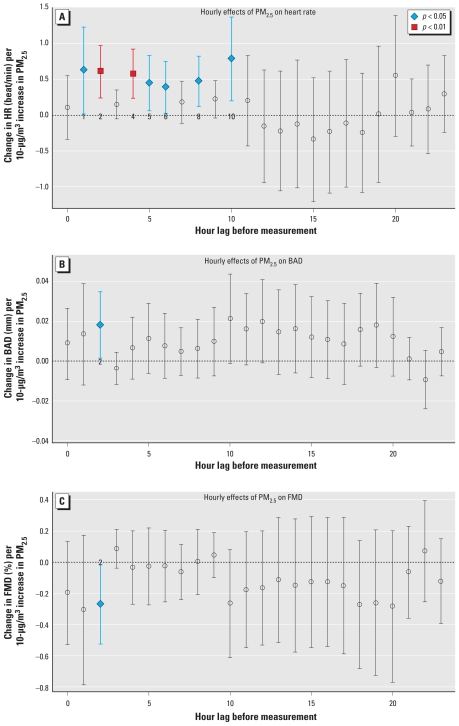
Results: We observed the strongest associations (and smallest estimation errors) between HR and TPE recorded 1-10 hr before CV measurements. The associations were not pronounced for the other time lags (11-24 hr). The associations between TPE and FMD or BAD did not show as clear a temporal pattern. However, we found some suggestion of a negative association with FMD and a positive association with BAD related to TPE just before measurement (0-2 hr).
Conclusions: Brief elevations in ambient TPE levels encountered during routine daily activity were associated with small increases in HR and trends toward conduit arterial vasodilatation and endothelial dysfunction within a few hours of exposure. These responses could reflect acute PM(2.5)-induced autonomic imbalance and may factor in the associated rapid increase in CV risk among susceptible individuals.
Figures
References
-
- Brook RD. Cardiovascular effects of air pollution. Clin Sci. 2008;115:175–187. - PubMed
-
- Brook RD, Bard RL, Burnett RT, Shin HH, Vette A, Croghan C, et al. Differences in blood pressure and vascular responses associated with ambient fine particulate matter exposures measured at the personal versus community level. Occup Environ Med. 2010 doi: 10.1136/oem.2009.053991. [Online 8 October 2010] - DOI - PubMed
-
- Brook RD, Grau M, Kehrer C, Rajagopalan S. Intra-subject variability of radial artery flow mediated dilatation: implications for use in prospective clinical trials. Am J Cardiol. 2005;96:1345–1348. - PubMed
-
- Brook RD, Rajagopalan S. Particulate matter air pollution and blood pressure. J Am Soc Hypertens. 2009;3:332–350. - PubMed
Publication types
MeSH terms
Substances
Grants and funding
LinkOut - more resources
Full Text Sources
Research Materials