


A comparison of online versus on-site training in health research methodology: a randomized study
- PMID: 21682858
- PMCID: PMC3141795
- DOI: 10.1186/1472-6920-11-37
A comparison of online versus on-site training in health research methodology: a randomized study
Abstract
Background: Distance learning may be useful for building health research capacity. However, evidence that it can improve knowledge and skills in health research, particularly in resource-poor settings, is limited. We compared the impact and acceptability of teaching two distinct content areas, Biostatistics and Research Ethics, through either on-line distance learning format or traditional on-site training, in a randomized study in India. Our objective was to determine whether on-line courses in Biostatistics and Research Ethics could achieve similar improvements in knowledge, as traditional on-site, classroom-based courses.
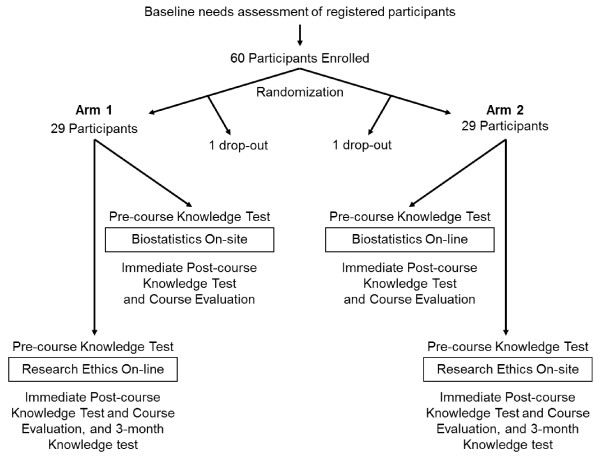
Subjects: Volunteer Indian scientists were randomly assigned to one of two arms.
Intervention: Students in Arm 1 attended a 3.5-day on-site course in Biostatistics and completed a 3.5-week on-line course in Research Ethics. Students in Arm 2 attended a 3.5-week on-line course in Biostatistics and 3.5-day on-site course in Research Ethics. For the two course formats, learning objectives, course contents and knowledge tests were identical.
Main outcome measures: Improvement in knowledge immediately and 3-months after course completion, compared to baseline.
Results: Baseline characteristics were similar in both arms (n = 29 each). Median knowledge score for Biostatistics increased from a baseline of 49% to 64% (p < 0.001) 3 months after the on-site course, and from 48% to 63% (p = 0.009) after the on-line course. For the on-site Research Ethics course, median score increased from 69% to 83% (p = 0.005), and for the on-line Research Ethics course from 62% to 80% (p < 0.001). Three months after the course, median gains in knowledge scores remained similar for the on-site and on-line platforms for both Biostatistics (16% vs. 12%; p = 0.59) and Research Ethics (17% vs. 13%; p = 0.14).
Conclusion: On-line and on-site training formats led to marked and similar improvements of knowledge in Biostatistics and Research Ethics. This, combined with logistical and cost advantages of on-line training, may make on-line courses particularly useful for expanding health research capacity in resource-limited settings.
Figures
References
-
- US Department of Education, Office of Planning, Evaluation and Policy Development. Evaluation of evidence-based practices in online learning: a meta-analysis and review of online learning studies. Washington DC; 2009. http://www2.ed.gov/rschstat/eval/tech/evidence-based-practices/finalrepo... Accessed May 1, 2010.
Publication types
MeSH terms
Grants and funding
LinkOut - more resources
Full Text Sources
