Trait and state hostile rumination facilitate alcohol-related aggression
- PMID: 21683036
- PMCID: PMC3125878
- DOI: 10.15288/jsad.2011.72.545
Trait and state hostile rumination facilitate alcohol-related aggression
Abstract
Objective: This investigation attempted to determine whether trait and state hostile rumination functioned as risk factors for the relation between acute alcohol intoxication and aggression.
Method: Participants were 516 social drinkers (252 men and 264 women). Trait hostile rumination was assessed using Caprara's Dissipation-Rumination Scale. Following the consumption of either an alcohol or a placebo beverage, participants were tested on a laboratory task in which electric shocks were received from and administered to a fictitious opponent under the guise of a competitive reaction-time task. Aggression was operationalized as the combined mean responses for shock intensity and duration across all trials. In a subset of the sample (n = 320), state hostile rumination was assessed following the aggression task using a self-report measure.
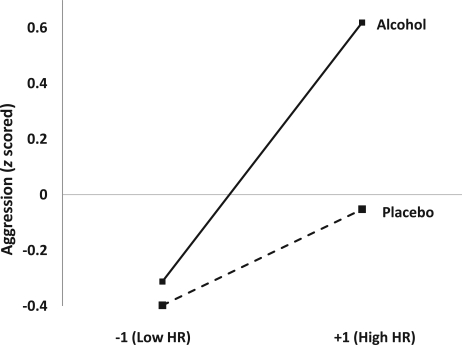
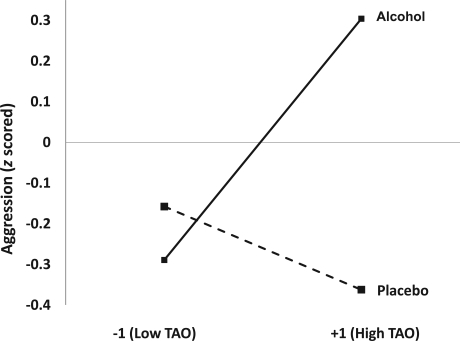
Results: As expected, both trait and state measures acted as moderators. Specifically, acute alcohol intoxication was more likely to increase aggression in persons with higher trait and state hostile rumination scores compared with their equally intoxicated lower rumination counterparts.
Conclusions: This was the first investigation to demonstrate that trait or state rumination significantly heighten the risk of intoxicated aggression. We believe that hostile rumination facilitates intoxicated aggression because ruminators have difficulty diverting their attention away from anger-provoking stimuli and related thoughts, thus making violent reactions more likely. Clinical and public health interventions would benefit by developing strategies to distract ruminative attention away from violence-promoting messages, especially when persons are under the influence of alcohol.
Figures
References
-
- Aiken LS, West SG. Multiple Regression: Testing and interpreting interactions. Newbury Park, CA: Sage; 1991.
-
- Anestis MD, Anestis JC, Selby EA, Joiner TE. Anger rumination across forms of aggression. Personality and Individual Differences. 2009;46:192–196.
-
- Baer RA. Mindfulness training as a clinical intervention: A conceptual and empirical review. Clinical Psychology: Science and Practice. 2003;10:125–143.
-
- Bailey DS, Taylor SP. Effects of alcohol and aggressive disposition on human physical aggression. Journal of Research in Personality. 1991;25:334–342.
-
- Barber L, Maltby J, Macaskill A. Angry memories and thoughts of revenge: The relationship between forgiveness and anger rumination. Personality and Individual Differences. 2005;39:253–262.
Publication types
MeSH terms
Substances
Grants and funding
LinkOut - more resources
Full Text Sources
Medical
Research Materials