


Outcome of myeloablative conditioning and unrelated donor hematopoietic cell transplantation for childhood acute lymphoblastic leukemia in third remission
- PMID: 21683798
- PMCID: PMC3372321
- DOI: 10.1016/j.bbmt.2011.05.014
Outcome of myeloablative conditioning and unrelated donor hematopoietic cell transplantation for childhood acute lymphoblastic leukemia in third remission
Abstract
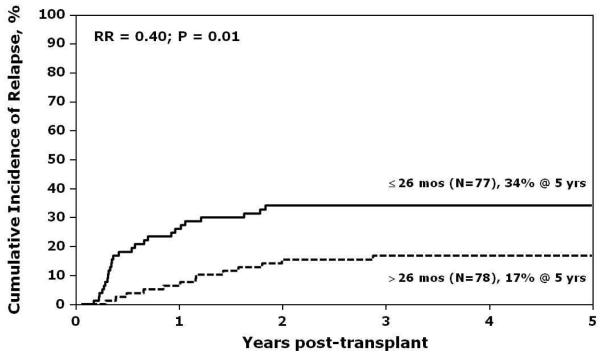
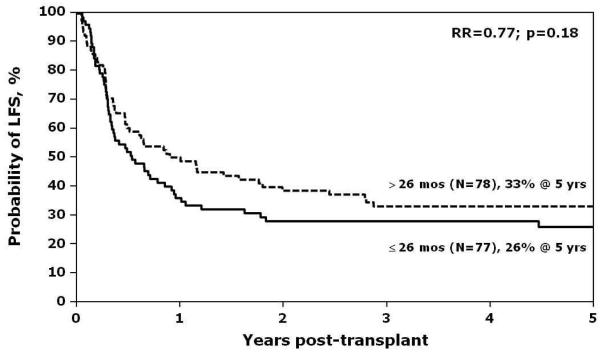
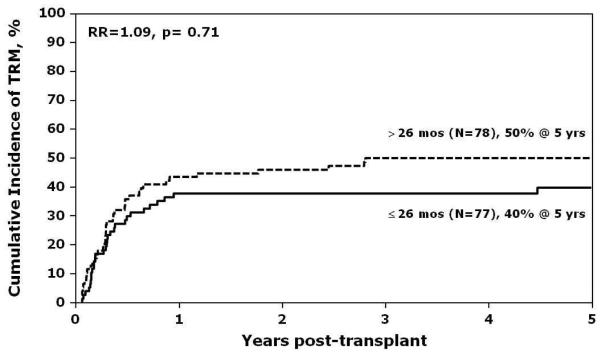
We conducted a retrospective study of 155 children who underwent unrelated donor hematopoietic cell transplantation (HCT) between 1990 and 2005 for acute lymphoblastic leukemia in third remission. The median patient age was 11 years, the median time from diagnosis to first relapse was 36 months, and the median time from first relapse to second relapse was 26 months. Stem cell sources were bone marrow (n = 115), peripheral blood (n = 11), and cord blood (n = 29). All patients received a myeloablative pretransplantation conditioning regimen. The 5-year estimates of leukemia-free survival, relapse, and nonrelapse mortality were 30%, 25%, and 45%, respectively. In multivariate analysis, the only risk factor associated with relapse was the interval between the first relapse and the second relapse. Second relapses occurring >26 months from the first relapse were associated with lower risk for post-HCT relapse compared with second relapses occurring at ≤26 months (relative risk, 0.4; P = .01). Relapse risk was lowest when late second relapse was preceded by late first relapse (>36 months from diagnosis), as demonstrated by a 3-year relapse rate of 9% (P = .0009). Our data indicate that long-term leukemia-free survival can be achieved in children with acute lymphoblastic leukemia in third remission using unrelated donor HCT, especially when the second relapse occurs late.
Copyright © 2011 American Society for Blood and Marrow Transplantation. Published by Elsevier Inc. All rights reserved.
Figures
References
-
- Tallen G, Ratei R, Mann G, et al. Long-term outcome in children with relapsed acute lymphoblastic leukemia after time-point and site-of-relapse stratification and intensified short-course multidrug chemotherapy: results of trial ALL-REZ BFM 90. J Clin Oncol. 2010;28:2339–2347. - PubMed
-
- Eapen M, Raetz E, Zhang MJ, et al. Outcomes after HLA-matched sibling transplantation or chemotherapy in children with B-precursor acute lymphoblastic leukemia in a second remission: a collaborative study of the Children’s Oncology Group and the Center for International Blood and Marrow Transplant Research. Blood. 2006;107:4961–4967. - PMC - PubMed
Publication types
MeSH terms
Grants and funding
LinkOut - more resources
Full Text Sources
