Cervical cancer risk for women undergoing concurrent testing for human papillomavirus and cervical cytology: a population-based study in routine clinical practice
- PMID: 21684207
- PMCID: PMC3272857
- DOI: 10.1016/S1470-2045(11)70145-0
Cervical cancer risk for women undergoing concurrent testing for human papillomavirus and cervical cytology: a population-based study in routine clinical practice
Erratum in
- Lancet Oncol. 2011 Aug;12(8):722
Abstract
Background: Concurrent testing for human papillomavirus (HPV) and cervical cytology (co-testing) is an approved alternative to cytology alone in women aged 30 years and older. We aimed to assess the safety in routine clinical practice of 3-year screening intervals for women testing negative for HPV with normal cytology and to assess if co-testing can identify women at high risk of cervical cancer or cervical intraepithelial neoplasia grade 3 (CIN3) or worse over 5 years.
Methods: We assessed the 5-year cumulative incidence, starting in 2003-05, of cervical cancer and CIN3 or worse for 331,818 women aged 30 years and older who enrolled in co-testing at Kaiser Permanente Northern California (Berkeley, CA, USA) and had adequate enrolment co-test results. Follow-up continued until Dec 31, 2009. We defined cumulative incidence to include prevalence at enrolment and incidence after enrolment. Prevalence at enrolment was defined as the ratio of women diagnosed with each outcome on the biopsy visit immediately after their enrolment screening visit to the total enrolled women. At screening visits only HPV test and Pap smear samples were collected, and at biopsy visits colposcopically directed biopsies were taken. To estimate post-enrolment incidence, we used Weibull survival models.
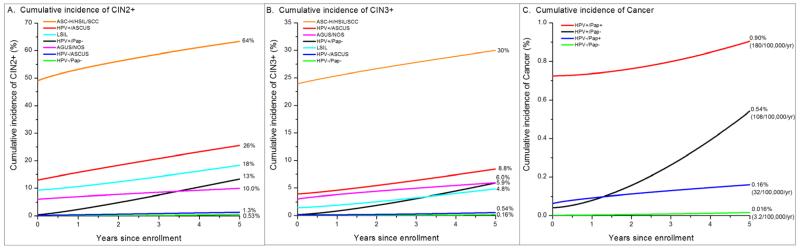
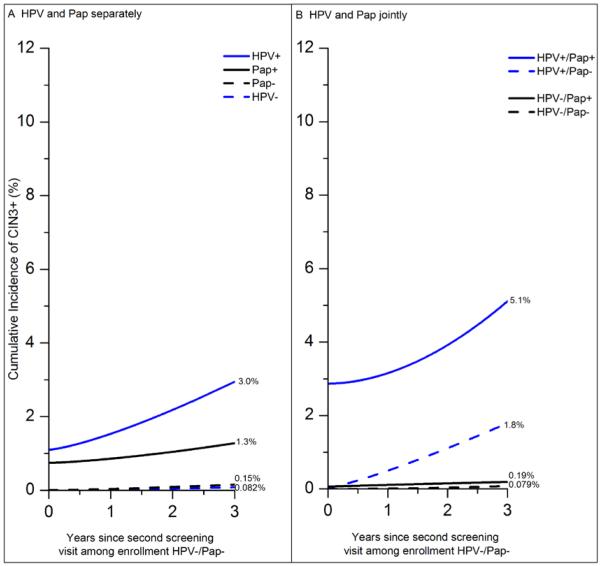
Findings: In 315,061 women negative by HPV testing, the 5-year cumulative incidence of cancer was 3.8 per 100,000 women per year, slightly higher than for the 306,969 who were both negative by HPV and Pap testing (3.2 per 100,000), and half the cancer risk of the 319,177 who were negative by Pap testing (7.5 per 100,000). 313,465 (99.5%) women negative by HPV testing had either normal cytology or equivocal abnormalities. Abnormal cytology greatly increased cumulative incidence of CIN3 or worse over 5 years for the 16,757 positive by HPV testing (12.1%vs 5.9%; p<0.0001). By contrast, although statistically significant, abnormal cytology did not increase 5-year risk of CIN3 or worse for women negative by HPV testing to a substantial level (0.86%vs 0.16%; p=0.004). 12,208 (73%) of the women positive by HPV testing had no cytological abnormality, and these women had 258 (35%) of 747 CIN3 or adenocarcinoma in situ, [corrected] 25 (29%) of 87 cancers, and 17 (63%) of 27 adenocarcinomas.
Interpretation: For women aged 30 years and older in routine clinical practice who are negative by co-testing (both HPV and cytology), 3-year screening intervals were safe because a single negative test for HPV was sufficient to reassure against cervical cancer over 5 years. Incorporating HPV testing with cytology also resulted in earlier identification of women at high risk of cervical cancer, especially adenocarcinoma. Testing for HPV without adjunctive cytology might be sufficiently sensitive for primary screening for cervical cancer.
Funding: Intramural Research Program of the US National Cancer Institute/NIH/DHHS, and the American Cancer Society.
Copyright © 2011 Elsevier Ltd. All rights reserved.
Figures

Comment in
-
A new approach to cervical screening.Lancet Oncol. 2011 Jul;12(7):612-3. doi: 10.1016/S1470-2045(11)70159-0. Epub 2011 Jun 16. Lancet Oncol. 2011. PMID: 21684206 No abstract available.
-
Premature conclusions on HPV-only testing.Lancet Oncol. 2011 Oct;12(11):992-3; author reply 993. doi: 10.1016/S1470-2045(11)70192-9. Lancet Oncol. 2011. PMID: 21968223 No abstract available.
References
-
- Cuzick J, Szarewski A, Cubie H, Hulman G, Kitchener H, Luesley D, et al. Management of women who test positive for high-risk types of human papillomavirus: the HART study. Lancet. 2003 Dec 6;362(9399):1871–6. - PubMed
-
- Schiffman M, Herrero R, Hildesheim A, Sherman ME, Bratti M, Wacholder S, et al. HPV DNA testing in cervical cancer screening: results from women in a high-risk province of Costa Rica. JAMA. 2000 Jan 5;283(1):87–93. - PubMed
-
- Sherman ME, Lorincz AT, Scott DR, Wacholder S, Castle PE, Glass AG, et al. Baseline cytology, human papillomavirus testing, and risk for cervical neoplasia: a 10-year cohort analysis. J Natl Cancer Inst. 2003 Jan 1;95(1):46–52. - PubMed
-
- Anttila A, Kotaniemi-Talonen L, Leinonen M, Hakama M, Laurila P, Tarkkanen J, et al. Rate of cervical cancer, severe intraepithelial neoplasia, and adenocarcinoma in situ in primary HPV DNA screening with cytology triage: randomised study within organised screening programme. BMJ. 2010;340:c1804. - PMC - PubMed
-
- Bulkmans NW, Berkhof J, Rozendaal L, van Kemenade FJ, Boeke AJ, Bulk S, et al. Human papillomavirus DNA testing for the detection of cervical intraepithelial neoplasia grade 3 and cancer: 5-year follow-up of a randomised controlled implementation trial. Lancet. 2007 Nov 24;370(9601):1764–72. - PubMed
Publication types
MeSH terms
Grants and funding
LinkOut - more resources
Full Text Sources
Medical
Research Materials