


The role of the extracellular matrix protein mindin in airway response to environmental airways injury
- PMID: 21684833
- PMCID: PMC3230443
- DOI: 10.1289/ehp.1003339
The role of the extracellular matrix protein mindin in airway response to environmental airways injury
Retraction in
-
Retraction: "The Role of the Extracellular Matrix Protein Mindin in Airway Response to Environmental Airways Injury".Environ Health Perspect. 2016 Apr;124(4):A69. doi: 10.1289/ehp.1003339RET. Environ Health Perspect. 2016. PMID: 27035681 Free PMC article. No abstract available.
Abstract
Background: Our previous work demonstrated that the extracellular matrix protein mindin contributes to allergic airways disease. However, the role of mindin in nonallergic airways disease has not previously been explored.
Objectives: We hypothesized that mindin would contribute to airways disease after inhalation of either lipopolysaccharide (LPS) or ozone.
Methods: We exposed C57BL/6J and mindin-deficient (-/-) mice to aerosolized LPS (0.9 μg/m3 for 2.5 hr), saline, ozone (1 ppm for 3 hr), or filtered air (FA). All mice were evaluated 4 hr after LPS/saline exposure or 24 hr after ozone/FA exposure. We characterized the physiological and biological responses by analysis of airway hyperresponsiveness (AHR) with a computer-controlled small-animal ventilator (FlexiVent), inflammatory cellular recruitment, total protein in bronchoalveolar lavage fluid (BALF), proinflammatory cytokine profiling, and ex vivo bronchial ring studies.
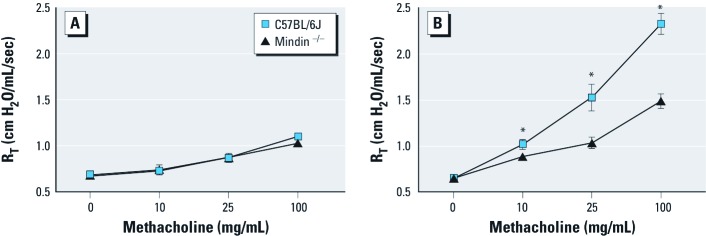
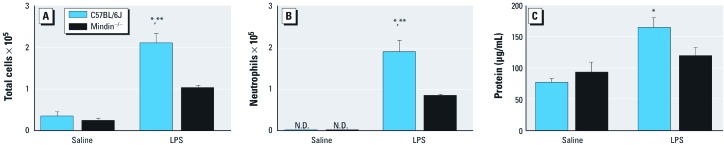
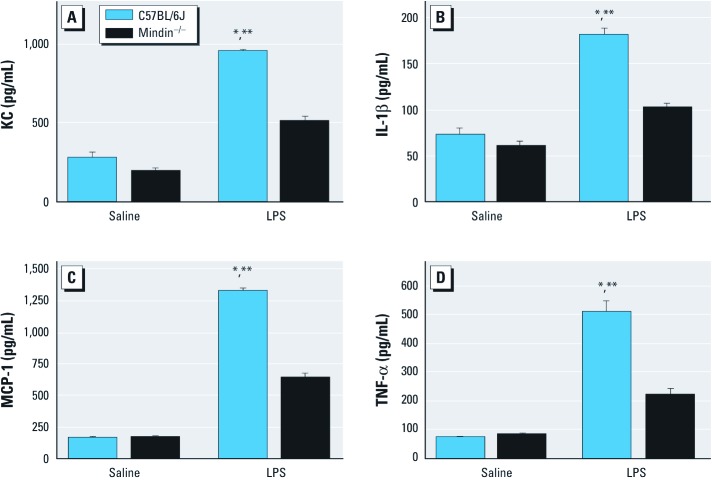
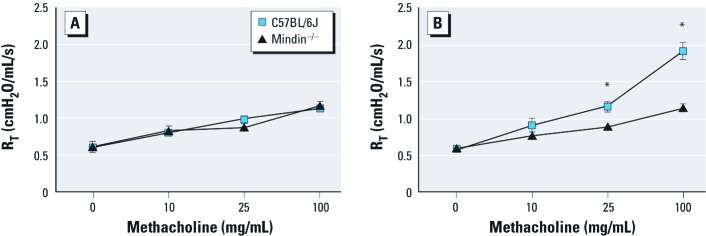
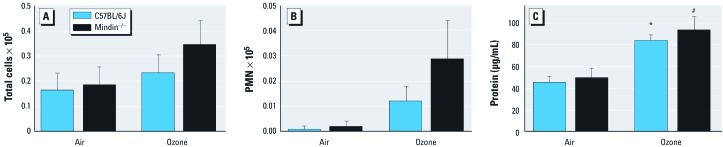
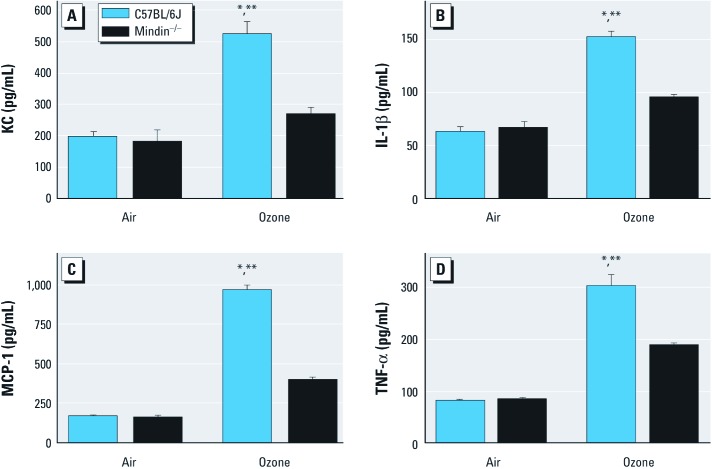
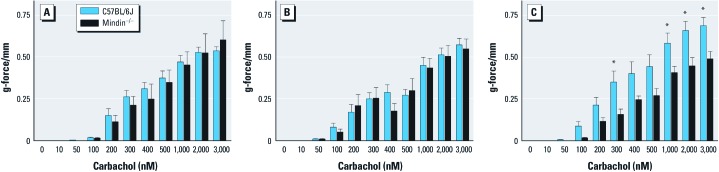
Results: After inhalation of LPS, mindin-/- mice demonstrated significantly reduced total cell and neutrophil recruitment into the airspace compared with their wild-type counterparts. Mindin-/- mice also exhibited reduced proinflammatory cytokine production and lower AHR to methacholine challenge by FlexiVent. After inhalation of ozone, mice had no detectible differences in cellular inflammation or total BALF protein dependent on mindin. However, mindin-/- mice were protected from increased proinflammatory cytokine production and AHR compared with their C57BL/6J counterparts. After ozone exposure, bronchial rings derived from mindin-/- mice demonstrated reduced constriction in response to carbachol.
Conclusions: These data demonstrate that the extracellular matrix protein mindin modifies the airway response to both LPS and ozone. Our data support a conserved role of mindin in production of proinflammatory cytokines and the development of AHR in two divergent models of reactive airways disease, as well as a role of mindin in airway smooth muscle contractility after exposure to ozone.
Conflict of interest statement
The authors declare they have no actual or potential competing financial interests.
Figures
Comment in
-
Findings of Research Misconduct.Fed Regist. 2019 Nov 7;84(216):60097-60098. Fed Regist. 2019. PMID: 37547121 Free PMC article. No abstract available.
References
-
- Balmes JR, Chen LL, Scannell C, Tager I, Christian D, Hearne PQ, et al. Ozone-induced decrements in FEV1 and FVC do not correlate with measures of inflammation. Am J Respir Crit Care Med. 1996;153(3):904–909. - PubMed
-
- Chassin C, Picardeau M, Goujon JM, Bourhy P, Quellard N, Darche S, et al. TLR4- and TLR2-mediated B cell responses control the clearance of the bacterial pathogen, Leptospira interrogans. J Immunol. 2009;183(4):2669–2677. - PubMed
-
- Cho HY, Zhang LY, Kleeberger SR. Ozone-induced lung inflammation and hyperreactivity are mediated via tumor necrosis factor-alpha receptors. Am J Physiol Lung Cell Mol Physiol. 2001;280(3):L537–L546. - PubMed
Publication types
MeSH terms
Substances
Grants and funding
LinkOut - more resources
Full Text Sources