. 2011 Aug;77(15):5412-9.
doi: 10.1128/AEM.00320-11. Epub 2011 Jun 17.

Pseudomonas fluorescens F113 mutant with enhanced competitive colonization ability and improved biocontrol activity against fungal root pathogens

Affiliations

Pseudomonas fluorescens F113 mutant with enhanced competitive colonization ability and improved biocontrol activity against fungal root pathogens

Emma Barahona et al. Appl Environ Microbiol. 2011 Aug.

Abstract

Motility is one of the most important traits for efficient rhizosphere colonization by Pseudomonas fluorescens F113rif (F113). In this bacterium, motility is a polygenic trait that is repressed by at least three independent pathways, including the Gac posttranscriptional system, the Wsp chemotaxis-like pathway, and the SadB pathway. Here we show that the kinB gene, which encodes a signal transduction protein that together with AlgB has been implicated in alginate production, participates in swimming motility repression through the Gac pathway, acting downstream of the GacAS two-component system. Gac mutants are impaired in secondary metabolite production and are unsuitable as biocontrol agents. However, the kinB mutant and a triple mutant affected in kinB, sadB, and wspR (KSW) possess a wild-type phenotype for secondary metabolism. The KSW strain is hypermotile and more competitive for rhizosphere colonization than the wild-type strain. We have compared the biocontrol activity of KSW with those of the wild-type strain and a phenotypic variant (F113v35 [V35]) which is hypermotile and hypercompetitive but is affected in secondary metabolism since it harbors a gacS mutation. Biocontrol experiments in the Fusarium oxysporum f. sp. radicis-lycopersici/Lycopersicum esculentum (tomato) and Phytophthora cactorum/Fragaria vesca (strawberry) pathosystems have shown that the three strains possess biocontrol activity. Biocontrol activity was consistently lower for V35, indicating that the production of secondary metabolites was the most important trait for biocontrol. Strain KSW showed improved biocontrol compared with the wild-type strain, indicating that an increase in competitive colonization ability resulted in improved biocontrol and that the rational design of biocontrol agents by mutation is feasible.


Figures
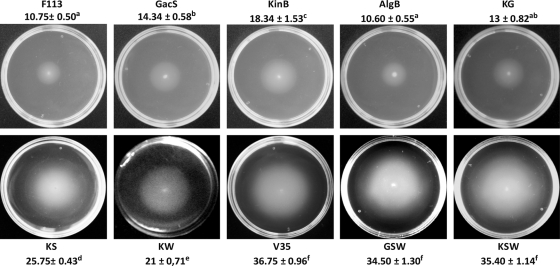
Fig. 1.
Fig. 1.
Swimming motility of P. fluorescens F113 and derivatives. Bacteria were inoculated with a toothpick just below the surface of SA 0.3% agar plates. Swimming haloes were determined after 18 h of incubation at 28°C. Average swimming halo diameters (mm) and standard deviations are presented. Different letters indicate statistically significant differences (P < 0.05). No differences in growth rates were observed for any of the tested strains. The motility phenotypes of the sadB and wspR mutants have been previously reported (29).
Fig. 2.
Fig. 2.
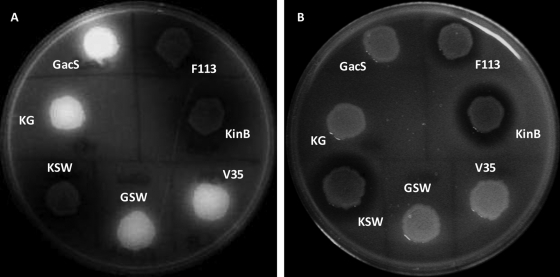
Pyoverdine (left) and exoprotease (right) production by P. fluorescens F113 and derivatives. Pyoverdine overproduction under iron-sufficient conditions was detected by fluorescence emission under UV illumination on LB plates. Exoprotease production was observed on skim milk plates by the appearance of a degradation halo corresponding to casein degradation.
Fig. 3.
Fig. 3.
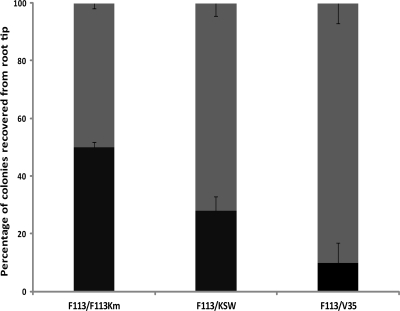
Competitive colonization root tip assay. The wild-type strain was used as the competitor in all the experiments. Alfalfa plants were inoculated 1:1 with the test strain and the competitor, root tips were collected after 2 weeks, and the bacteria present were resuspended and plated. Gray bars represent the percentages of colonies recovered from the tested strains; black bars represent the percentages of colonies recovered from the competitor (wild-type) strain. Arithmetic means and standard deviations are presented. Average recovered bacteria were 3.63 × 10⁶ CFU/g root tip (fresh weight).
Fig. 4.
Fig. 4.
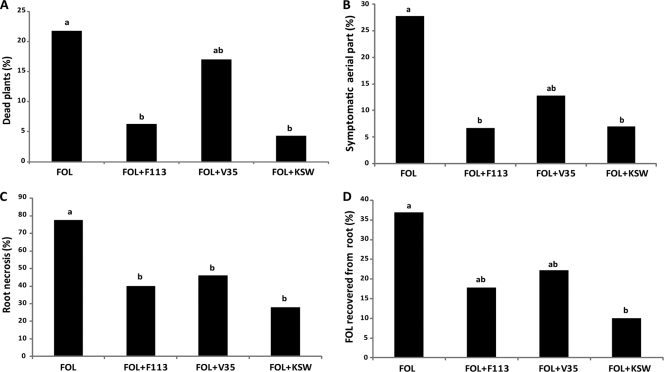
Biocontrol of P. fluorescens F113 and derivatives on the Fusarium oxysporum f. sp. radicis-lycopersici (FOL)/Lycopersicum esculentum (tomato) system. (A) Plant mortality; (B) plants showing symptoms in the aerial part; (C) plants showing necrotic roots; (D) pathogen recovery. Different letters indicate statistically significant differences (P < 0.05). No dead or symptomatic plants were observed in control experiments without the pathogen.
Fig. 5.
Fig. 5.
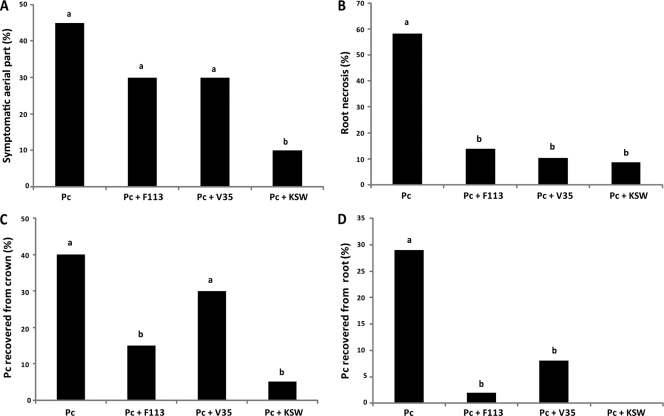
Biocontrol of P. fluorescens F113 and derivatives on the Phytophthora cactorum (Pc)/Fragaria vesca (strawberry) system. (A) Plants showing symptoms in aerial parts; (B) plants showing necrotic roots; (C) pathogen recovery from crown; (D) pathogen recovery from root. Different letters indicate statistically significant differences (P < 0.05). No dead or symptomatic plants were observed in control experiments without the pathogen.

References

    1. Aarons S., Abbas A., Adams C., Fenton A., O'Gara F. 2000. A regulatory RNA (Prrb RNA) modulates expression of secondary metabolite genes in Pseudomonas fluorescens F113. J. Bacteriol. 182:3913–3919 - PMC - PubMed
    1. Bainton N. J., Lynch J. M., Naseby D., Way J. A. 2004. Survival and ecological fitness of Pseudomonas fluorescens genetically engineered with dual biocontrol mechanisms. Microb. Ecol. 48:349–357 - PubMed
    1. Barahona E., et al. 2010. Efficient rhizosphere colonization by Pseudomonas fluorescens F113 mutants unable to form biofilms on abiotic surfaces. Environ. Microbiol. 12:3185–3195 - PubMed
    1. Blumer C., Heeb S., Pessi G., Haas D. 1999. Global GacA-steered control of cyanide and exoprotease production in Pseudomonas fluorescens involves specific ribosome binding sites. Proc. Natl. Acad. Sci. U. S. A. 96:14073–14078 - PMC - PubMed
    1. Brazil G. M., et al. 1995. Construction of a rhizosphere pseudomonad with potential to degrade polychlorinated biphenyls and detection of bph gene expression in the rhizosphere. Appl. Environ. Microbiol. 61:1946–1952 - PMC - PubMed

Publication types

MeSH terms