Call-Fleming syndrome associated with subarachnoid haemorrhage: three new cases
- PMID: 21686521
- PMCID: PMC3029638
- DOI: 10.1136/bcr.09.2008.0989
Call-Fleming syndrome associated with subarachnoid haemorrhage: three new cases
Abstract
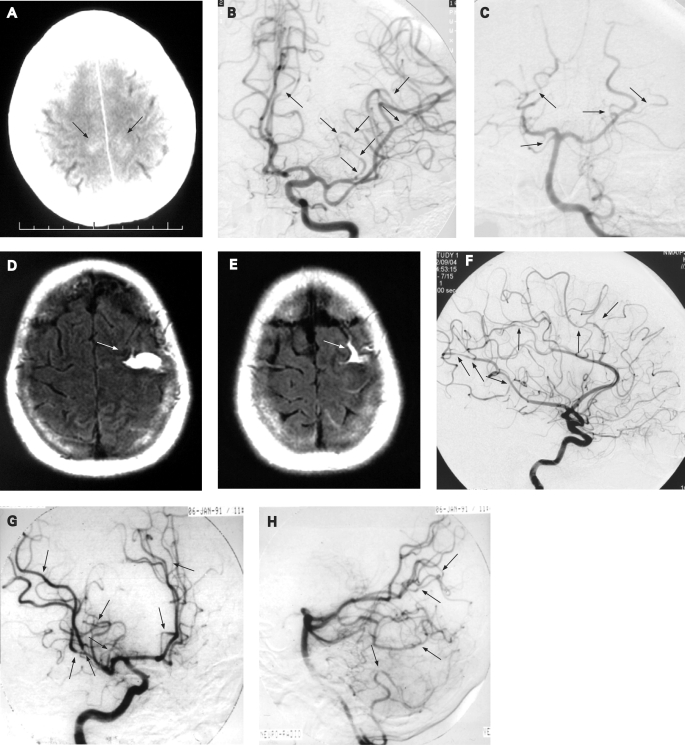
The Call-Fleming syndrome (CFS) comprises acute severe recurrent (thunderclap) headaches, occasional transient or fluctuating neurological abnormalities and reversible segmental cerebral vasoconstriction. It is a benign condition with an excellent prognosis, yet because it is often clinically and radiologically similar to a number of commonly encountered conditions, diagnostic difficulties may arise, leading to inappropriate, and even potentially harmful, investigative and therapeutic approaches. Three personal cases are presented to highlight the occurrence of subarachnoid haemorrhage (SAH) as part of CFS. In two patients with a positive CT head, SAH involved the sulci in the upper cerebral convexity, an unusual location in aneurysmal SAH. SAH is not an uncommon feature of CFS, occurring in approximately 25% of reported cases, and may pose a diagnostic challenge. CFS has a relatively characteristic spectrum of features, allowing a confident diagnosis in most cases, even when atypical features such as SAH are present. Recognising the spectrum of abnormalities seen in CFS, including particularly SAH, allows a sound approach to a safe diagnosis.
Figures
References
-
- Call GK, Fleming MC, Sealfon S, et al. Reversible cerebral segmental vasoconstriction. Stroke 1988; 19: 1159–70 - PubMed
-
- Lee KY, Sohn YH, Kim SH, et al. Basilar artery vasospasm in postpartum cerebral angiopathy. Neurology 2000; 54: 2003–5 - PubMed
-
- Singhal AB. Postpartum angiopathy with reversible posterior leukoencephalopathy. Arch Neurol 2004; 61: 411–16 - PubMed
-
- Hajj-Ali RA, Furlan A, Abou-Chebel A, et al. Benign angiopathy of the central nervous system: cohort of 16 patients with clinical course and long-term followup. Arthritis Rheum 2002; 47: 662–9 - PubMed
-
- Wakamoto H, Kume A, Nakano N, et al. Benign angiopathy of the central nervous system associated with phenytoin intoxication. Brain Dev 2006; 28: 336–8 - PubMed
LinkOut - more resources
Full Text Sources
Miscellaneous