


Consciousness, plasticity, and connectomics: the role of intersubjectivity in human cognition
- PMID: 21687435
- PMCID: PMC3110420
- DOI: 10.3389/fpsyg.2011.00020
Consciousness, plasticity, and connectomics: the role of intersubjectivity in human cognition
Abstract
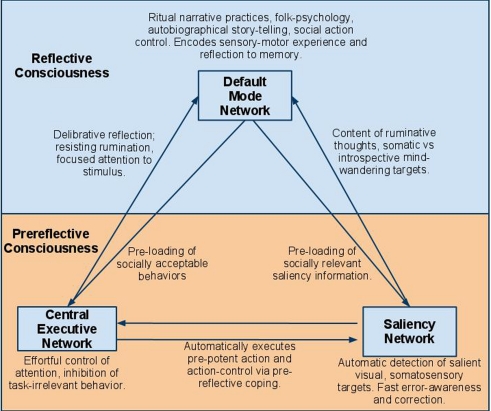
Consciousness is typically construed as being explainable purely in terms of either private, raw feels or higher-order, reflective representations. In contrast to this false dichotomy, we propose a new view of consciousness as an interactive, plastic phenomenon open to sociocultural influence. We take up our account of consciousness from the observation of radical cortical neuroplasticity in human development. Accordingly, we draw upon recent research on macroscopic neural networks, including the "default mode," to illustrate cases in which an individual's particular "connectome" is shaped by encultured social practices that depend upon and influence phenomenal and reflective consciousness. On our account, the dynamically interacting connectivity of these networks bring about important individual differences in conscious experience and determine what is "present" in consciousness. Further, we argue that the organization of the brain into discrete anti-correlated networks supports the phenomenological distinction of prereflective and reflective consciousness, but we emphasize that this finding must be interpreted in light of the dynamic, category-resistant nature of consciousness. Our account motivates philosophical and empirical hypotheses regarding the appropriate time-scale and function of neuroplastic adaptation, the relation of high and low-frequency neural activity to consciousness and cognitive plasticity, and the role of ritual social practices in neural development and cognitive function.
Keywords: cognition; consciousness; culture; development; intersubjectivity; phenomenology; plasticity; resting-state networks.
Figures
References
-
- Amodio D., Frith C. (2006). Meeting of minds: the medial frontal cortex and social cognition. Nat. Rev. Neurosci. 7, 268–277 - PubMed
-
- Armstrong D. (1997). “What is consciousness?” in The Nature of Consciousness: Philosophical Debates, eds Block N., Flanagan O., Güzeldere G. (Cambridge, MA: MIT Press; ), 721–728 [Original edition, 1978].
-
- Baars B. J. (1997). In the Theater of Consciousness. New York: Oxford University Press
-
- Bavelier D., Neville H. (2002). Cross-modal plasticity: where and how? Nat. Rev. Neurosci. 3, 443–452 - PubMed
-
- Biswal B. B., Mennes M., Zuo X.-N., Gohel S., Kelly C., Smith S. M., Beckmann C. F., Adelstein J. S., Buckner R. L., Colcombe S., Dogonowski A.-M., Ernst M., Fair D., Hampson M., Hoptman M. J., Hyde J. S., Kiviniemi V. J., Kötter R., Li S.-J., Lin C.-P., Lowe M. J., Mackay C., Madden D. J., Madsen K. H., Margulies D. S., Mayberg H. S., McMahon K., Monk C. S., Mostofsky S. H., Nagel B. J., Pekar J. J., Peltier S. J., Petersen S. E., Riedl V., Rombouts, Serge A. R. B., Rypma B., Schlaggar B. L., Schmidt S., Seidler R. D., Siegle G. J., Sorghh C., Teng G.-J., Veijola J., Villringer A., Walter M., Wang L., Weng X.-C., Whitfield-Gabrieli S., Williamson P., Windischberger C., Zang Y.-F., Zhang H.-Y., Castellanos F. X., Milham M. P. (2010). Toward discovery science of human brain function. Proc. Natl. Acad. Sci. U.S.A. 107, 4734. - PMC - PubMed
LinkOut - more resources
Full Text Sources
