. 2011 Mar 7:2:35.
doi: 10.3389/fpsyg.2011.00035. eCollection 2011.

The perspective matters! Multisensory integration in ego-centric reference frames determines full-body ownership

Affiliations

The perspective matters! Multisensory integration in ego-centric reference frames determines full-body ownership

Valeria I Petkova et al. Front Psychol. .

Abstract

Recent advances in experimental science have made it possible to investigate the perceptual processes involved in generating a sense of owning an entire body. This is achieved by full-body ownership illusions which make use of specific patterns of visual and somatic stimuli integration. Here we investigate the fundamental question of the reference frames used in the process of attributing an entire body to the self. We quantified the strength of the body-swap illusion in conditions where the participants were observing this artificial body from the perspective of the first or third person. Consistent results from subjective reports and physiological recordings show that the first person visual perspective is critical for the induction of this full-body ownership illusion. This demonstrates that the multisensory integration processes producing the sense of corporeal self operates in an ego-centric reference frame.

Keywords: body ownership; first person perspective; multisensory integration; perceptual illusion.


Figures
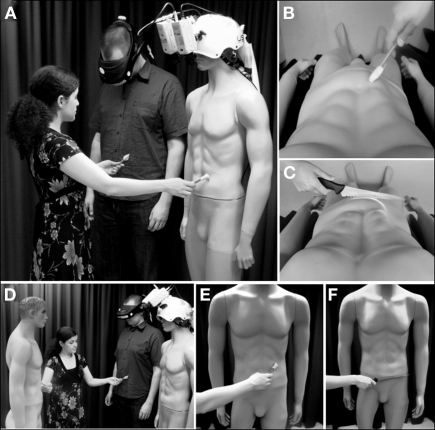
Figure 1
Figure 1
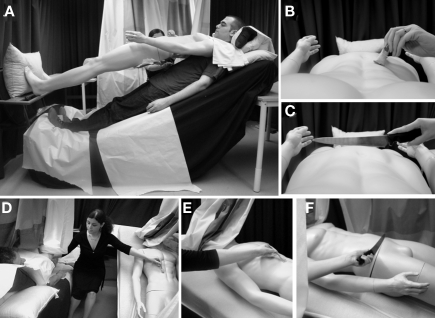
Experimental set-up in experiments #1 and #2. (A) Set-up used to create the full-body illusion when the mannequin's body is perceived from the first person perspective. (B,C) Depict what the participants see when they observe the touches or the knife-induced threats in the first person perspective condition. (D) Set-up designed to probe the full-body illusion when the mannequin's body is perceived from the third person perspective. (E,F) Depict the participants’ perspective when they received touches or knife threats in the condition presented from the third person perspective.
Figure 2
Figure 2
Experimental set-up developed to induce the body-swap illusion without head-mounted displays and video-technology (experiment #3). (A–C) The experimental set-up and the participant's field of sight in the conditions in which the mannequin's body was viewed directly from the first person perspective. (D–F) The set-up developed to probe the full-body illusion when the mannequin's body was perceived from the third person perspective.
Figure 3
Figure 3
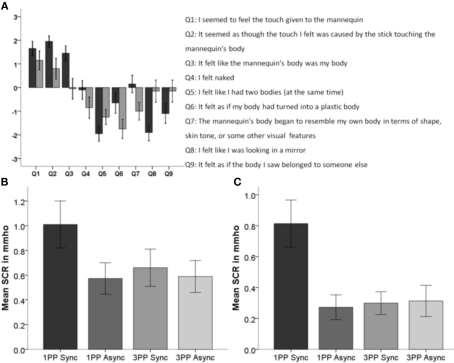
Introspective and objective evidences from the three experiments. (A) Experiment #1: The participants rated the illusion-related questions significantly higher than the control questions; this difference was significantly greater when the mannequin's body was perceived from the first person perspective (i.e., significant interaction of the main factors “Perspective” vs. “Question type”). Dark bars represent the ratings in the first person perspective and light bars represent the ratings in the third person perspective respectively. The error bars indicate standard errors. (B) Experiment #2: The threat-evoked increase in the skin conductance responses (SCR) was significant only in the condition in which the participant observed the synchronized visuo-tactile stimulation from the first person perspective. The error bars indicate standard errors. (C) Experiment #3: The full-body illusion can be evoked without the help of HMDs and video-technology. The specific threat-evoked increase in the SCR when the body was observed from the first person perspective again emphasizes the importance of this visual perspective for the mechanism of attributing a body to oneself. The error bars indicate standard errors.

References

    1. Aspell J. E., Lenggenhager B., Blanke O. (2009). Keeping in touch with one's self: multisensory mechanisms of self-consciousness. PLoS ONE 4, e6488. 10.1371/journal.pone.0006488 - DOI - PMC - PubMed
    1. Blanke O., Landis T., Spinelli L., Seeck M. (2004). Out-of-body experience and autoscopy of neurological origin. Brain 127, 243–258 10.1093/brain/awh040 - DOI - PubMed
    1. Blanke O., Metzinger T. (2009). Full-body illusions and minimal phenomenal selfhood. Trends Cogn. Sci. 13, 7–13 - PubMed
    1. Blanke O., Mohr C. (2005). Out-of-body experience, heautoscopy, and autoscopic hallucination of neurological origin: implications for neurocognitive mechanisms of corporeal awareness and self-consciousness. Brain Res. Rev. 50, 184–199 - PubMed
    1. Blanke O., Ortigue S., Landis T., Seeck M. (2002). Neuropsychology: stimulating illusory own-body perceptions. Nature 419, 269–270 10.1038/419269a - DOI - PubMed

LinkOut - more resources