


Naturally resident and exogenously applied T4-like and T5-like bacteriophages can reduce Escherichia coli O157:H7 levels in sheep guts
- PMID: 21687531
- PMCID: PMC3109454
- DOI: 10.4161/bact.1.1.14175
Naturally resident and exogenously applied T4-like and T5-like bacteriophages can reduce Escherichia coli O157:H7 levels in sheep guts
Abstract
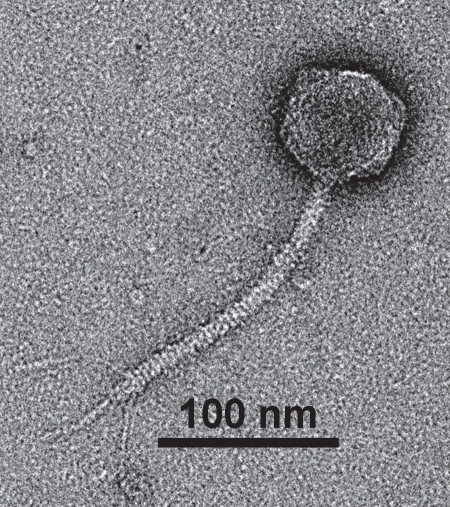
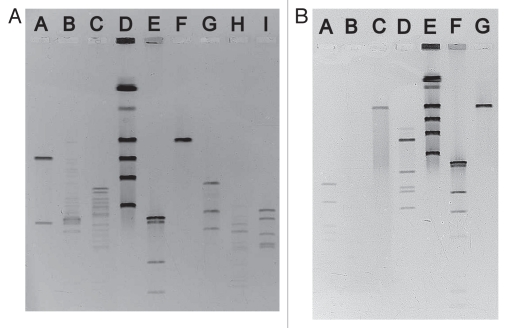
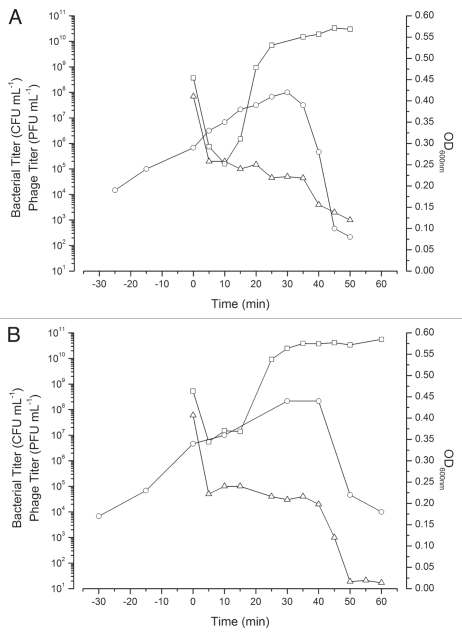
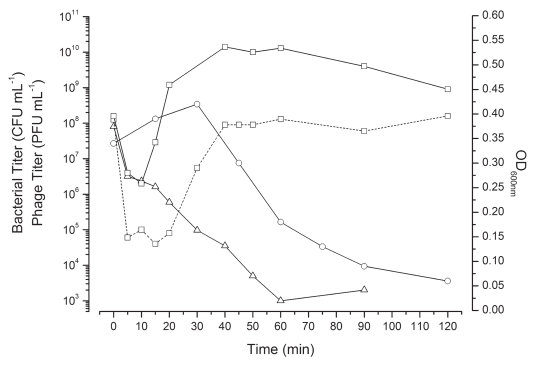
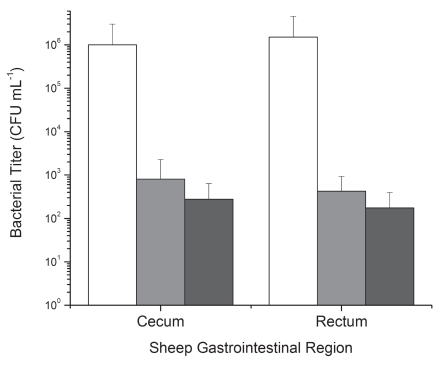
In preparing sheep for an in vivo Escherichia coli O157:H7 eradication trial, we found that 20/39 members of a single flock were naturally colonized by O157:H7-infecting phages. Characterization showed these were all one phage type (subsequently named CEV2) infecting 15/16 O157:H7, 7/72 ECOR and common lab strains. Further characterization by PFGE (genome∼120 kb), restriction enzyme digest (DNA appears unmodified), receptor studies (FhuA but not TonB is required for infection) and sequencing (>95% nucleotide identity) showed it is a close relative of the classically studied coliphage T5. Unlike T5, CEV2 infects O157:H7 in vitro, both aerobically and anaerobically, rapidly adsorbing and killing, but resistant mutants regrew within 24 h. When used together with T4-like CEV1 (MOI ∼2 per phage), bacterial killing was longer lasting. CEV2 did not reproduce when co-infecting the same cell as CEV1, presumably succumbing to CEV1's ability to shut off transcription of cytosine-containing DNA. In vivo sheep trials to remove resident O157:H7 showed that a cocktail of CEV2 and CEV1 (∼10(11) total PFU) applied once orally was more effective (>99.9% reduction) than CEV1 alone (∼99%) compared to the untreated phage-free control. Those sheep naturally carrying CEV2, receiving no additional phage treatment, had the lowest O157:H7 levels (∼99.99% reduction). These data suggest that phage cocktails are more effective than individual phage in removing O157:H7 that have taken residence if the phage work in concert with one another and that naturally resident O157:H7-infecting phages may prevent O157:H7 gut colonization and be one explanation for the transient O157:H7 colonization in ruminants.
Figures
References
-
- Brabban AD, Nelson DA, Kutter E, Edrington TS, Callaway TR. Approaches to controlling Escherichia coli O157:H7, a food-borne pathogen and an emerging environmental hazard. Environmental Practice. 2004;6:208–229. doi: 10.1017/S1466046604000365. - DOI
-
- Centers for Disease Control and Prevention (CDC), author Ongoing multistate outbreak of Escherichia coli serotype O157:H7 infections associated with consumption of fresh spinach—United States, September 2006. MMWR Morb Mortal Wkly Rep. 2006;55:1045–1046. - PubMed
Grants and funding
LinkOut - more resources
Full Text Sources
Other Literature Sources
Molecular Biology Databases
Miscellaneous
