


Comparing the performances of apes (Gorilla gorilla, Pan troglodytes, Pongo pygmaeus) and human children (Homo sapiens) in the floating peanut task
- PMID: 21687710
- PMCID: PMC3110613
- DOI: 10.1371/journal.pone.0019555
Comparing the performances of apes (Gorilla gorilla, Pan troglodytes, Pongo pygmaeus) and human children (Homo sapiens) in the floating peanut task
Abstract
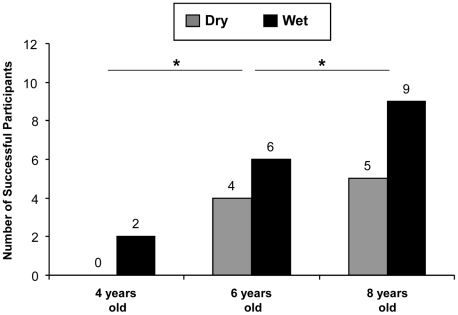
Recently, Mendes et al. [1] described the use of a liquid tool (water) in captive orangutans. Here, we tested chimpanzees and gorillas for the first time with the same "floating peanut task." None of the subjects solved the task. In order to better understand the cognitive demands of the task, we further tested other populations of chimpanzees and orangutans with the variation of the peanut initially floating or not. Twenty percent of the chimpanzees but none of the orangutans were successful. Additional controls revealed that successful subjects added water only if it was necessary to obtain the nut. Another experiment was conducted to investigate the reason for the differences in performance between the unsuccessful (Experiment 1) and the successful (Experiment 2) chimpanzee populations. We found suggestive evidence for the view that functional fixedness might have impaired the chimpanzees' strategies in the first experiment. Finally, we tested how human children of different age classes perform in an analogous experimental setting. Within the oldest group (8 years), 58 percent of the children solved the problem, whereas in the youngest group (4 years), only 8 percent were able to find the solution.
Conflict of interest statement
Figures
References
-
- Lefebvre L, Nicolakakis N, Boire D. Tools and Brains in Birds. Behaviour. 2002;139:939–973.
-
- Tomasello M, Call J. New York, NY, USA: Oxford University Press; 1997. Primate Cognition.517 ix.
-
- van Schaik CP, Deaner RO, Merrill MY. The Conditions for Tool Use in Primates: Implications for the Evolution of Material Culture. Journal of Human Evolution. 1999;36:719–741. - PubMed
-
- Boesch C, Boesch H. Tool Use and Tool Making in Wild Chimpanzees. Folia Primatologica. 1990;54:86–99. - PubMed
Publication types
MeSH terms
LinkOut - more resources
Full Text Sources
