. 2010:2:13-24.
doi: 10.4137/STI.S3994.

Signal Transduction Pathways Leading to Heat Shock Transcription

Affiliations

Signal Transduction Pathways Leading to Heat Shock Transcription

S K Calderwood et al. Sign Transduct Insights. 2010.

Abstract

Heat shock proteins (HSP) are essential for intracellular protein folding during stress and protect cells from denaturation and aggregation cascades that can lead to cell death. HSP genes are regulated at the transcriptional level by heat shock transcription factor 1 (HSF1) that is activated by stress and binds to heat shock elements in HSP genes. The activation of HSF1 during heat shock involves conversion from an inert monomer to a DNA binding trimer through a series of intramolecular folding rearrangements. However, the trigger for HSF1 at the molecular level is unclear and hypotheses for this process include reversal of feedback inhibition of HSF1 by molecular chaperones and heat-induced binding to large non-coding RNAs. Heat shock also causes a profound modulation in cell signaling pathways that lead to protein kinase activation and phosphorylation of HSF1 at a number of regulatory serine residues. HSP genes themselves exist in an accessible chromatin conformation already bound to RNA polymerase II. The RNA polymerase II is paused on HSP promoters after transcribing a short RNA sequence proximal to the promoter. Activation by heat shock involves HSF1 binding to the promoter and release of the paused RNA polymerase II followed by further rounds of transcriptional initiation and elongation. HSF1 is thus involved in both initiation and elongation of HSP RNA transcripts. Recent studies indicate important roles for histone modifications on HSP genes during heat shock. Histone modification occurs rapidly after stress and may be involved in promoting nucleosome remodeling on HSP promoters and in the open reading frames of HSP genes. Understanding these processes may be key to evaluating mechanisms of deregulated HSP expression that plays a key role in neurodegeneration and cancer.


Figures
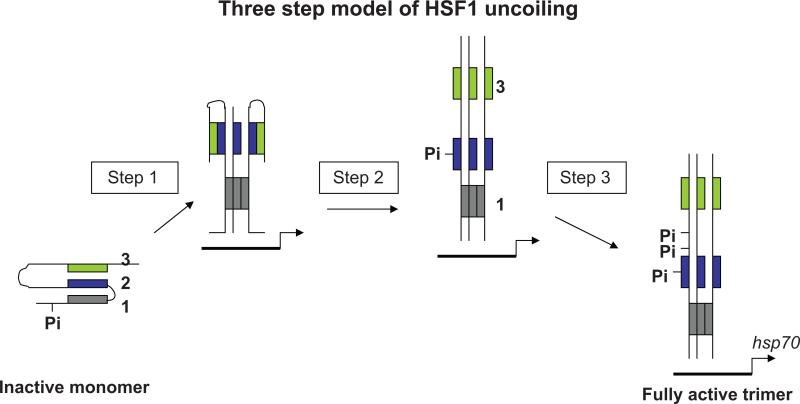
Figure 1
Figure 1
Model for multi-step HSF1 activation. We envisage at least three stages in the transition from inactive HSF1 maintained as a monomer by intramolecular triple-stranded coiled-coil interactions. Leucine zipper 1 (grey) binds to leucine zipper 2 (blue) and leucine zipper 3 (green). In step1, heat shock leads to severing the bond between LZ1 and LZ2, causing partial uncoiling and permitting DNA binding. In Step 2, the inactive trimers are then further activated by breaking the bond between LZ2 and LZ3, an event that appears to involve phosphorylation at S195 in the center of LZ2 (Fig. 2). This step is essential but not sufficient for trans-activation, which requires further steps including HSF1 phosphorylation at Step3. I the figure a single monomer of the activated trimer is depicted as being phosphorylated. however, the exact stoichiometry of HSF1 phosphorylation at S195 or indeed at any of its phosphorylation sites is not currently known.
Figure 2
Figure 2
Role of serine 195 phosphorylation in HSF1 activation. A Effect of S195 mutation on heat shock induced HSF1 trans-activation. Experiments involve wild-type Gal-HSF1, Gal-HSF1 S195S/A modification and Gal-HSF1 S/D modification. B Role of overexpression of wild-type HSF1, HSF1 S195S/A and HSF1 S/D in the repression of non-HSP target genes c-fos (four columns on left) and c-fms (four columns on right). Data are expressed as mean luciferase activity +/-SD after correction by transfection efficiency control (pCMV-lacZ). experiments were each performed at least 3 times.
Figure 3
Figure 3
Signaling kinase cascades activated by heat shock and their downstream targets.
Figure 4
Figure 4
Functional domains and phosphorylation motifs in HSF1. HSF1 contains four functional domains: the DNA binding, leucine zipper trimerization domain, a regulatory region and two trans-activation domains arranged in tandem. HSF1 contains both activating and inhibitory phosphorylation sites located mostly in the regulatory domain. Heat-induced phosphorylation at these sites may reflect the activation of kinases by heat (as in Fig. 3) or unmasking of cryptic sites by the unfolding changes during heat shock (Figs. 1, 2). On activation, the DNA binding domain contacts heat shock elements (HSE) on HSP promoters recruiting a range of activating molecules such as general transcription factors, mediator, elongation factors, chromatin remodeling proteins and histone modifying proteins such as CBP/p300. Some of these proteins as well as RNA polymerase II (Pol II) are depicted in (b).
Figure 5
Figure 5
Chromatin modifications on HSP genes after binding HSF1 and TAC1 in heat shocked cells. Heat shock-induced modification of lysines within tail residues of histones H3 and H4, within nucleosomes (each containing histones H1, H2A, H2B, H3, H4) on chromatin may alter the accessibility of factors to HSP genes, provide binding sites for nucleasome modeling proteins and lead to transcriptional initiation and elongation. Histone acetylases and methyltransferases may be recruited during stress by the binding of HSF1 to HSE on the promoter as well as TAC1 association with downstream residues 3’ to the promoter. In the hsp70 promoter, histone H3 may be targeted by HATs of the SAGA protein complex family and H4 by CREB binding protein (CBP). Histone acetylation may permit binding of the SWI/SNF complex to the promoter and subsequent nucleosome remodeling. In the downstream ORF region, binding of the TAC1 complex after heat shock leads to methylation of histone H3 on lysine 4 (MeK4) and acetylation of H4 on lysine 9 (AcK9). This may facilitate the release of promoter proximal paused PolII in a process that involves interaction of Pol II with P-TEFb, phosphorylation and transcriptional elongation. We depict the activated Pol II complex negotiating a nucleosomes during elongation, a process that may be facilitated by lysine modifications induced by heat shock.

References

    1. Calderwood SK, Ciocca DR. Heat shock proteins: stress proteins with Janus-like properties in cancer. Int J Hyperthermia. 2008;24:31–9. - PubMed
    1. Schlessinger MJ. How the cell copes with stress and the function of heat shock proteins. Pediatric Research. 1994;36:1–6. - PubMed
    1. Li GC, Hahn GM. A proposed operational model for thermotolerance. Cancer Research. 1981;40:4501–8. - PubMed
    1. Sekhar KR, Sonar VN, Muthusamy V, et al. Novel chemical enhancers of heat shock increase thermal radiosensitization through a mitotic catastrophe pathway. Cancer Res. 2007;67:695–701. - PubMed
    1. Lindquist S, Craig EA. The heat shock proteins. Ann Rev Genet. 1988;22:631–7. - PubMed

LinkOut - more resources