Review
. 2011 Aug;130(2):307-27.
doi: 10.1007/s00439-011-1029-2. Epub 2011 Jun 18.

Evolutionary diversity and developmental regulation of X-chromosome inactivation

Affiliations
Review

Evolutionary diversity and developmental regulation of X-chromosome inactivation

Martin Escamilla-Del-Arenal et al. Hum Genet. 2011 Aug.

Abstract

X-chromosome inactivation (XCI) results in the transcriptional silencing of one X-chromosome in females to attain gene dosage parity between XX female and XY male mammals. Mammals appear to have developed rather diverse strategies to initiate XCI in early development. In placental mammals XCI depends on the regulatory noncoding RNA X-inactive specific transcript (Xist), which is absent in marsupials and monotremes. Surprisingly, even placental mammals show differences in the initiation of XCI in terms of Xist regulation and the timing to acquire dosage compensation. Despite this, all placental mammals achieve chromosome-wide gene silencing at some point in development, and this is maintained by epigenetic marks such as chromatin modifications and DNA methylation. In this review, we will summarise recent findings concerning the events that occur downstream of Xist RNA coating of the inactive X-chromosome (Xi) to ensure its heterochromatinization and the maintenance of the inactive state in the mouse and highlight similarities and differences between mammals.


Figures
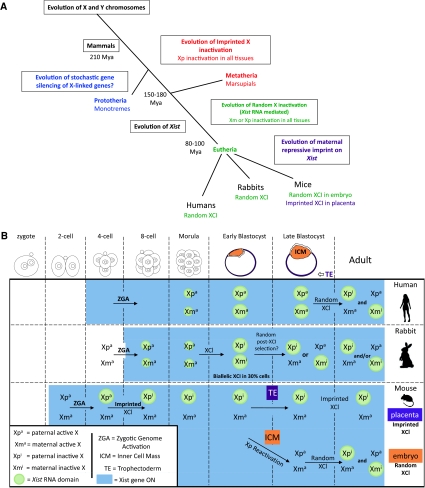
Fig. 1
Fig. 1
Strategies and timing of XCI regulation in eutherians. a Hypothetical time line of events during evolution for the appearance of different XCI strategies in different mammals. b Developmental timing of Xist/XIST up-regulation and XCI in humans, rabbits and mice during pre-implantation embryogenesis. In humans, XIST is not imprinted and upregulation is observed on both X-chromosomes from the morula stage with partial coating of both chromosomes. Random XCI initiates at or after the blastocyst stage in both extra and embryonic lineages—the exact timing is not clear. In the rabbit, Xist is not imprinted and upregulation occurs on one or both of the X-chromosomes in some cells of female embryos, and eventually leads to XCI. By the late blastocyst only one of the X-chromosomes shows Xist coating and X-linked gene inactivation. How XCI goes from a biallelic to monoalleic situation is unclear. In the mouse, Xist is imprinted to stay silent on the maternal X-chromosome. Paternal XCI is initiated by triggering Xist RNA coating from 4 to 8 cell stage onwards exclusively on the paternal chromosome. This imprinted form of XCI is found in the extra-embryonic tissues such as placenta. However, in the ICM of the late blastocyst, the Xp is re-activated, so that one of the two X-chromosomes then has an equal chance of being inactivated in the lineages that will give rise to the adult mouse
Fig. 2
Fig. 2
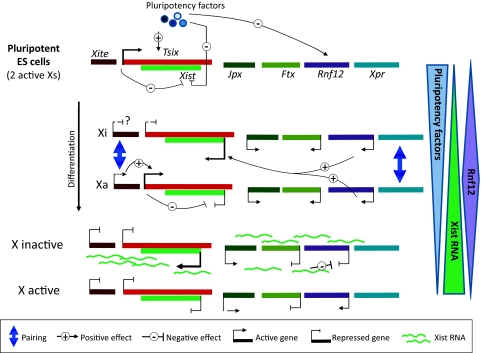
Initiation of random XCI and the monoallelic regulation of Xist in the mice. In pluripotent ES cells, Xist is expressed at low levels and this repression is partly due to pluripotency factors that repress Xist. Xist regulation via pluripotency factors could be direct through binding to the intron 1 of Xist gene and/or indirect, via activation of Xist’s repressive antisense transcript, Tsix or repression of Xist activators such as the X-linked gene Rnf12. During differentiation the levels of pluripotency factors decrease, while the levels of Xist activators such as Rnf12 increase (the only activator reported so far). Other long-range elements possibly involved in this process are the non-coding RNAs (Xite, Jpx, Ftx) or Xpr (X-pairing region). Xist activation on only one allele is believed to be partly regulated by monoallelic regulation of Tsix and its enhancer Xite. The Xpr and Xite/Tsix regions have been shown to undergo transient “pairing” events that could potentially help in establishment the monoallelic expression of Xist. Other mechanisms could underlie monoallelic Xist regulation such as stochastic events and negative feedback loops involving X-linked activators such as Rnf12. Xist upregulation results in cis-coating of the X-chromosome and results in silencing of genes, including the activator Rnf12
Fig. 3
Fig. 3
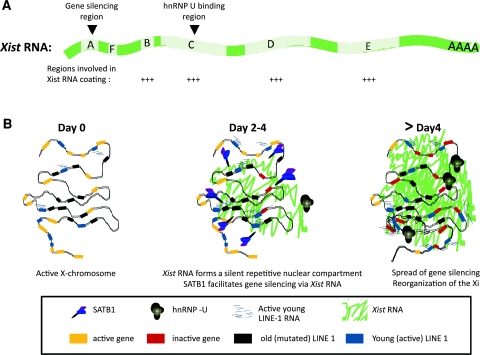
Xist and the formation of the inactive compartment. a Structure of the Xist gene showing the conserved repeat regions labelled A to F. Specific functions and characteristics of the different regions of Xist are highlighted by arrowheads. b Model for the formation of the silent nuclear compartment by Xist RNA: Xist RNA coating occurs immediately upon differentiation and forms a nuclear silent compartment where X-linked genes are recruited as they become silent in a locus-specific manner. The formation of this silent and heterochromatic compartment is probably helped by the silent repetitive elements, especially LINE elements that are abundant on the X-chromosome; this occurs when the matrix attachment protein SATB1 is present and might facilitate gene relocation into the Xi. At this stage of differentiation (day 4), young LINE-1 elements are highly expressed and they might play a role in the spread of silencing into regions prone to escape, but which will eventually become silenced later (not shown). The hnRNP U matrix attachment protein becomes enriched on the Xi around days 4–5 of differentiation and participates in the maintenance of Xist RNA coating
Fig. 4
Fig. 4
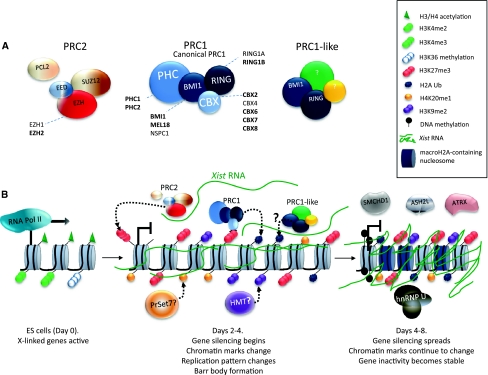
Chromatin dynamics at the initiation of the XCI. a Composition of the polycomb group 2 and the polycomb group 1 complexes. PRC2 is composed of three core elements SUZ12, EED and EZH and several co-factors including PCL2. The PRC1 complex has four core components: CBX, BMI1, RING and PHC. RING and the BMI1 component can also be found in other kind of complexes that we mention as PRC1-like complexes. All the alternative components are shown and in bold highlights the ones that have been documented as enriched in the Xi. b Schematic representation of the epigenetics events during XCI. In undifferentiated ES cells, the chromatin around the promoter of an X-linked gene is shown transcribed, with the presence of euchromatic marks such as H3K4me2/3, H3K36 methylation and H3 and H4 acetylation. Days 2–4: when differentiation is induced, Xist is upregulated on one X-chromosome and coats the X-chromosome from which it is expressed in cis. Gene silencing is initiated and Xist-mediated chromatin modifying complexes such as PRC1 and PRC2 and others are recruited to the Xi, resulting in the accumulation of PTMs typical of facultative heterochromatin such as H3K27me3, H2AK199ub, H3K9me2 and H4K20me1. The replication pattern of the Xi changes and the condensation of the Xi become apparent. Days 4–8: during this period, gene silencing is spread and maintained thereafter. Further epigenetic events take place such as the acquisition of DNA methylation at the CpGs of the 5′ end of genes and the incorporation of macroH2A histone variant; chromatin modifications acquired previously are maintained; there is also the recruitment of different proteins such as SMCHD1, ASH2L, ATRX and hnRNP U that will lock in the inactive state

References

    1. Agrelo R, Souabni A, Novatchkova M, Haslinger C, Leeb M, Komnenovic V, Kishimoto H, Gresh L, Kohwi-Shigematsu T, Kenner L, Wutz A. SATB1 defines the developmental context for gene silencing by Xist in lymphoma and embryonic cells. Dev Cell. 2009;16:507–516. - PMC - PubMed
    1. Altun G, Loring JF, Laurent LC. DNA methylation in embryonic stem cells. J Cell Biochem. 2010;109:1–6. - PMC - PubMed
    1. Augui S, Filion GJ, Huart S, Nora E, Guggiari M, Maresca M, Stewart AF, Heard E. Sensing X chromosome pairs before X inactivation via a novel X-pairing region of the Xic. Science. 2007;318:1632–1636. - PubMed
    1. Bacher CP, Guggiari M, Brors B, Augui S, Clerc P, Avner P, Eils R, Heard E. Transient colocalization of X-inactivation centres accompanies the initiation of X inactivation. Nat Cell Biol. 2006;8:293–299. - PubMed
    1. Bailey JA, Carrel L, Chakravarti A, Eichler EE. Molecular evidence for a relationship between LINE-1 elements and X chromosome inactivation: the Lyon repeat hypothesis. Proc Natl Acad Sci USA. 2000;97:6634–6639. - PMC - PubMed

Publication types

MeSH terms

LinkOut - more resources