Pharmacokinetics and pharmacodynamics following maintenance doses of prasugrel and clopidogrel in Chinese carriers of CYP2C19 variants
- PMID: 21689142
- PMCID: PMC3248259
- DOI: 10.1111/j.1365-2125.2011.04049.x
Pharmacokinetics and pharmacodynamics following maintenance doses of prasugrel and clopidogrel in Chinese carriers of CYP2C19 variants
Abstract
Aims: This open-label, two-period, randomized, crossover study was designed to determine the effect of CYP2C19 reduced function variants on exposure to active metabolites of, and platelet response to, prasugrel and clopidogrel.
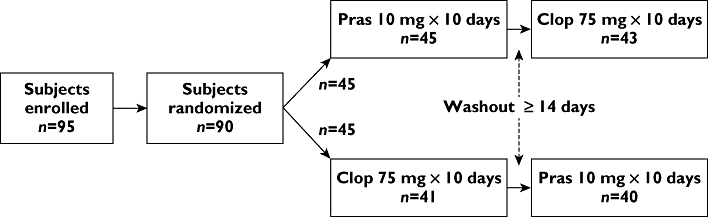
Methods: Ninety healthy Chinese subjects, stratified by CYP2C19 phenotype, were randomly assigned to treatment with prasugrel 10 mg or clopidogrel 75 mg for 10 days followed by 14 day washout and 10 day treatment with the other drug. Eighty-three subjects completed both treatment periods. Blood samples were collected at specified time points for measurement of each drug's active metabolite (Pras-AM and Clop-AM) concentrations and determination of inhibition of platelet aggregation (IPA) by light transmittance aggregometry. CYP2C19 genotypes were classified into three predicted phenotype groups: rapid metabolizers [RMs (*1/*1)], heterozygous or intermediate metabolizers [IMs (*1/*2, *1/*3)] and poor metabolizers [PMs (*2/*2, *2/*3)].
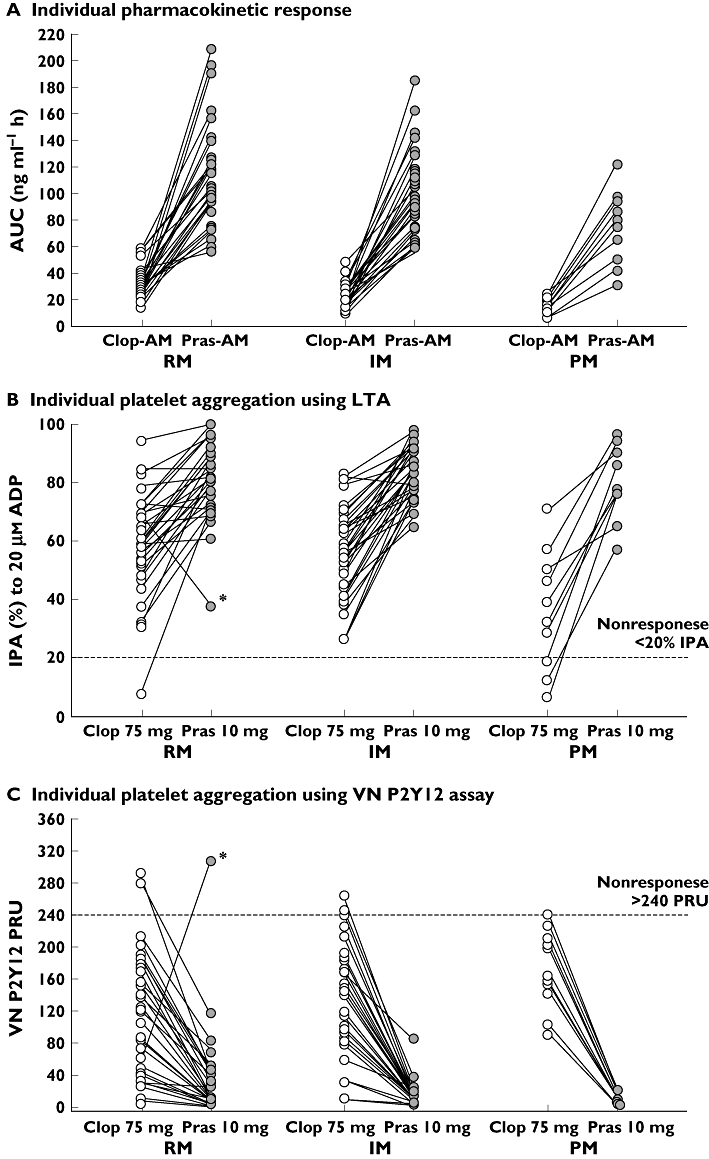
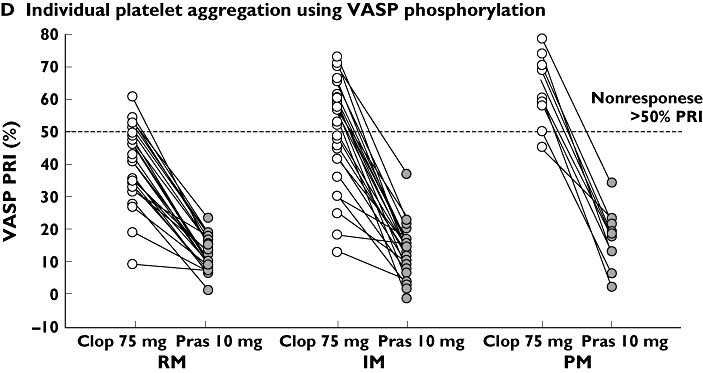
Results: Pras-AM exposure was similar in IMs and RMs (90% CI 0.85, 1.03) and slightly lower in PMs than IMs (90% CI 0.74, 0.99), whereas Clop-AM exposure was significantly lower in IMs compared with RMs (90% CI 0.62, 0.83), and in PMs compared with IMs (90% CI 0.53, 0.82). IPA was more consistent among RMs, IMs and PMs in prasugrel treated subjects (80.2%, 84.2% and 80.2%, respectively) than in clopidogrel treated subjects (59.7%, 56.2% and 36.8%, respectively; P < 0.001).
Conclusions: Prasugrel demonstrated higher active metabolite exposure and more consistent pharmacodynamic response across all three predicted phenotype groups compared with clopidogrel, confirming observations from previous research that CYP2C19 phenotype plays an important role in variability of response to clopidogrel, but has no impact on response to prasugrel.
© 2011 Eli Lilly and Company and Daiichi Sankyo Company, Ltd. British Journal of Clinical Pharmacology © 2011 The British Pharmacological Society.
Figures
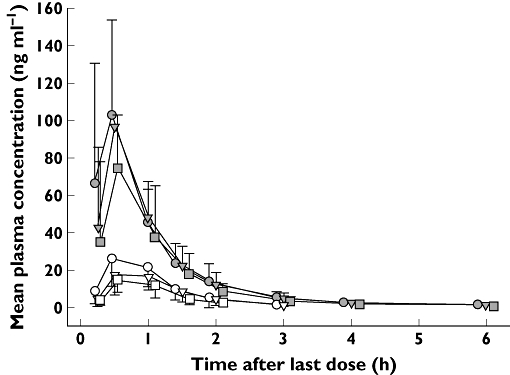
 ); Clopidogrel RM (
 ); Prasugrel IM (
 ); Clopidogrel IM (
 ); Prasugrel PM (
 ); Clopidogrel PM (
 )
)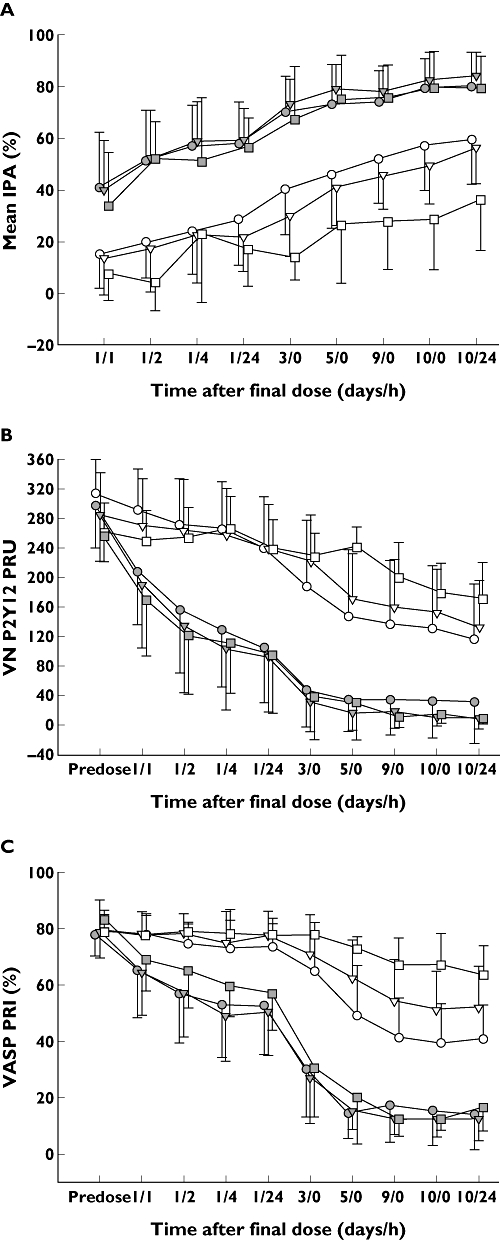
 ); Clopidogrel RM (
 ); Prasugrel IM (
 ); Clopidogrel IM (
 ); Prasugrel PM (
 ); Clopidogrel PM (
 )
)
References
-
- Farid NA, Kurihara A, Wrighton SA. Metabolism and disposition of the thienopyridine antiplatelet drugs ticlopidine, clopidogrel, and prasugrel in humans. J Clin Pharmacol. 2010;50:126–42. - PubMed
-
- Rehmel JL, Eckstein JA, Farid NA, Heim JB, Kasper SC, Kurihara A, Wrighton SA, Ring BJ. Interactions of two major metabolites of prasugrel, a thienopyridine antiplatelet agent, with the cytochromes P450. Drug Metab Dispos. 2006;34:600–7. - PubMed
-
- Kazui M, Nishiya Y, Ishizuka T, Hagihara K, Farid NA, Okazaki O, Ikeda T, Kurihara A. Identification of the human cytochrome P450 enzymes involved in the two oxidative steps in the bioactivation of clopidogrel to its pharmacologically active metabolite. Drug Metab Dispos. 2010;38:92–9. - PubMed
-
- Farid NA, Smith RL, Gillespie TA, Rash TJ, Blair PE, Kurihara A, Goldberg MJ. The disposition of prasugrel, a novel thienopyridine, in humans. Drug Metab Dispos. 2007;35:1096–104. - PubMed
Publication types
MeSH terms
Substances
LinkOut - more resources
Full Text Sources
Medical
Molecular Biology Databases