


Cardiovascular disease competes with breast cancer as the leading cause of death for older females diagnosed with breast cancer: a retrospective cohort study
- PMID: 21689398
- PMCID: PMC3218953
- DOI: 10.1186/bcr2901
Cardiovascular disease competes with breast cancer as the leading cause of death for older females diagnosed with breast cancer: a retrospective cohort study
Abstract
Introduction: Many women who survive breast cancer die of causes unrelated to their cancer diagnosis. This study was undertaken to assess factors that are related to breast cancer mortality versus mortality from other causes and to describe the leading causes of death among older women diagnosed with breast cancer.
Methods: Women diagnosed with breast cancer at age 66 or older between 1992 and 2000 were identified in the Surveillance, Epidemiology and End Results-Medicare linked database and followed through the end of 2005.
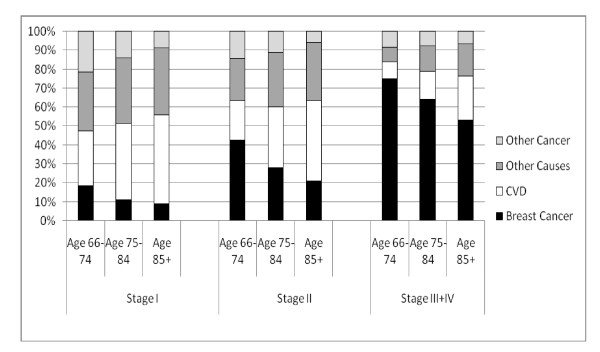
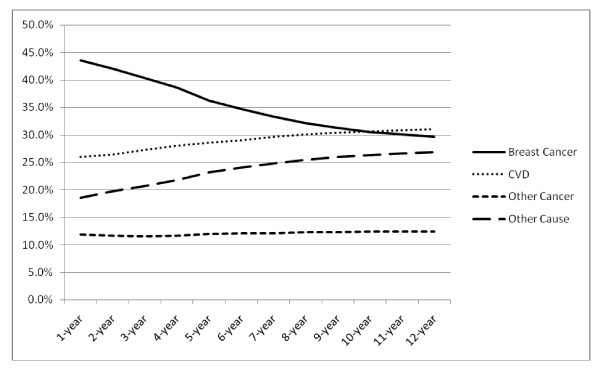
Results: A total of 63,566 women diagnosed with breast cancer met the inclusion criteria and were followed for a median of approximately nine years. Almost one-half (48.7%) were alive at the end of follow-up. Ages and comorbidities at the time of diagnosis had the largest effects on mortality from other causes, while tumor stage, tumor grade, estrogen receptor status, age and comorbidities at the time of diagnosis all had effects on breast cancer-specific mortality. Fully adjusted relative hazards of the effects of comorbidities on breast cancer-specific mortality were 1.24 (95% confidence interval (95% CI) 1.13 to 1.26) for cardiovascular disease, 1.13 (95% CI 1.13 to 1.26) for previous cancer, 1.13 (95% CI 1.05 to 1.22) for chronic obstructive pulmonary disease and 1.10 (95% CI 1.03 to 1.16) for diabetes. Among the total study population, cardiovascular disease was the primary cause of death in the study population (15.9% (95% CI 15.6 to 16.2)), followed closely by breast cancer (15.1% (95% CI 14.8 to 15.4)).
Conclusions: Comorbid conditions contribute importantly to both total mortality and breast cancer-specific mortality among breast cancer survivors. Attention to reducing the risk of cardiovascular disease should be a priority for the long-term care of women following the diagnosis and treatment of breast cancer.
Figures
References
-
- Horner MJ, Ries LAG, Krapcho M, Neyman N, Aminou R, Howlader N, Altekruse SF, Feuer EJ, Huang L, Mariotto A, Miller BA, Lewis DR, Eisner MP, Stinchcomb DG, Edwards BK, (editors) SEER Cancer Statistics Review, 1975-2006. Bethesda, MD: National Cancer Institute; 2009.
-
- Klabunde CN, Warren JL, Legler JM. Assessing comorbidity using claims data: an overview. Med Care. 2002;40(8 Suppl):IV26–IV35. - PubMed
Publication types
MeSH terms
Grants and funding
LinkOut - more resources
Full Text Sources
Medical
Miscellaneous
