


Early acquisition and high nasopharyngeal co-colonisation by Streptococcus pneumoniae and three respiratory pathogens amongst Gambian new-borns and infants
- PMID: 21689403
- PMCID: PMC3129300
- DOI: 10.1186/1471-2334-11-175
Early acquisition and high nasopharyngeal co-colonisation by Streptococcus pneumoniae and three respiratory pathogens amongst Gambian new-borns and infants
Abstract
Background: Although Haemophilus influenzae type b (Hib), Staphylococcus aureus and Moraxella catarrhalis are important causes of invasive and mucosal bacterial disease among children, co-carriage with Streptococcus pneumoniae during infancy has not been determined in West Africa.
Methods: Species specific PCR was applied to detect each microbe using purified genomic DNA from 498 nasopharyngeal (NP) swabs collected from 30 Gambian neonates every two weeks from 0 to 6 months and bi-monthly up to 12 months.
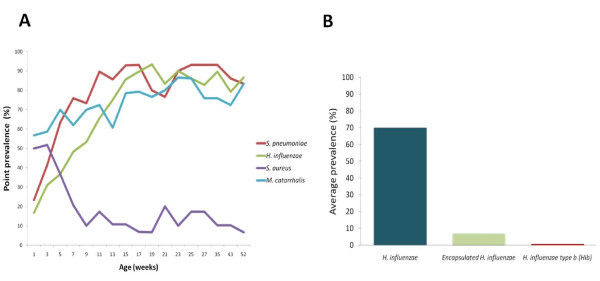
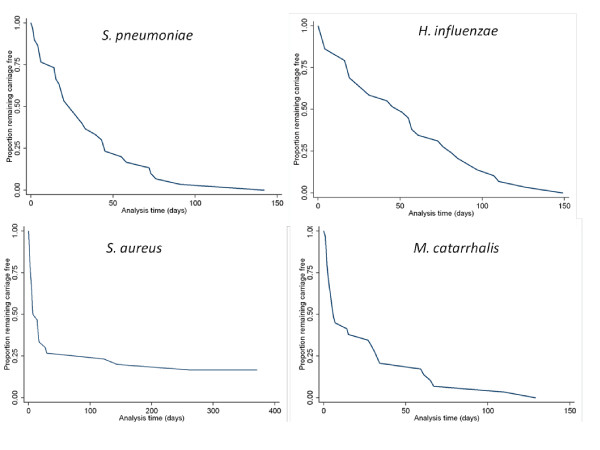
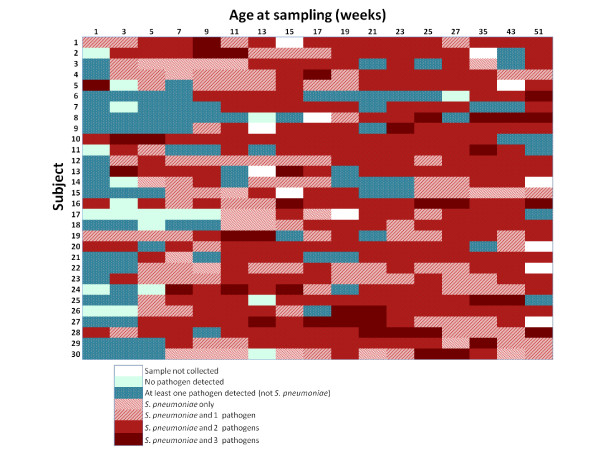
Results: All infants carried S. pneumoniae, H. influenzae and M. catarrhalis at several time points during infancy. S.pneumoniae co-colonized the infant nasopharynx with at least one other pathogen nine out of ten times. There was early colonization of the newborns and neonates, the average times to first detection were 5, 7, 3 and 14 weeks for S. pneumoniae, H. influenzae, M. catarrhalis and S. aureus respectively. The prevalence of S. pneumoniae, H. influenzae and M. catarrhalis increased among the neonates and exceeded 80% by 13, 15 and 23 weeks respectively. In contrast, the prevalence of S. aureus decreased from 50% among the newborns to 20% amongst nine-week old neonates. S. pneumoniae appeared to have a strong positive association with H. influenzae (OR 5.03; 95% CI 3.02, 8.39; p<0.01) and M. catarrhalis (OR 2.20; 95% CI 1.29; p<0.01) but it was negatively associated with S. aureus (OR 0.53; 95% CI 0.30, 0.94; p=0.03).
Conclusion: This study shows early acquisition and high co-carriage of three important respiratory pathogens with S. pneumoniae in the nasopharyngeal mucosa among Gambian neonates and infants. This has important potential implications for the aetiology of respiratory polymicrobial infections, biofilm formation and vaccine strategies.
Figures
References
-
- Black RE, Cousens S, Johnson HL, Lawn JE, Rudan I, Bassani DG, Jha P, Campbell H, Walker CF, Cibulskis R, Eisele T, Liu L, Mathers C. Global, regional, and national causes of child mortality in 2008: a systematic analysis. Lancet. 2010;375:1969–1987. doi: 10.1016/S0140-6736(10)60549-1. - DOI - PubMed
-
- The delicate balance of world health. Emerging plagues & resurrected pestilence. A report from the World Health Forum 1998. Caring. 2003;22:6–10, 12. - PubMed
-
- Daher M. [Report on world health, 1998] J Med Liban. 1998;46:212–217. - PubMed
-
- Rajaratnam JK, Marcus JR, Flaxman AD, Wang H, Levin-Rector A, Dwyer L, Costa M, Lopez AD, Murray CJ. Neonatal, postneonatal, childhood, and under-5 mortality for 187 countries, 1970-2010: a systematic analysis of progress towards Millennium Development Goal 4. Lancet. 2010;375:1988–2008. doi: 10.1016/S0140-6736(10)60703-9. - DOI - PubMed
Publication types
MeSH terms
Grants and funding
LinkOut - more resources
Full Text Sources
Medical
Miscellaneous
