


Multiscale modeling of calcium cycling in cardiac ventricular myocyte: macroscopic consequences of microscopic dyadic function
- PMID: 21689523
- PMCID: PMC3123916
- DOI: 10.1016/j.bpj.2011.05.031
Multiscale modeling of calcium cycling in cardiac ventricular myocyte: macroscopic consequences of microscopic dyadic function
Erratum in
- Biophys J. 2011 Aug 17;101(4):1014
Abstract
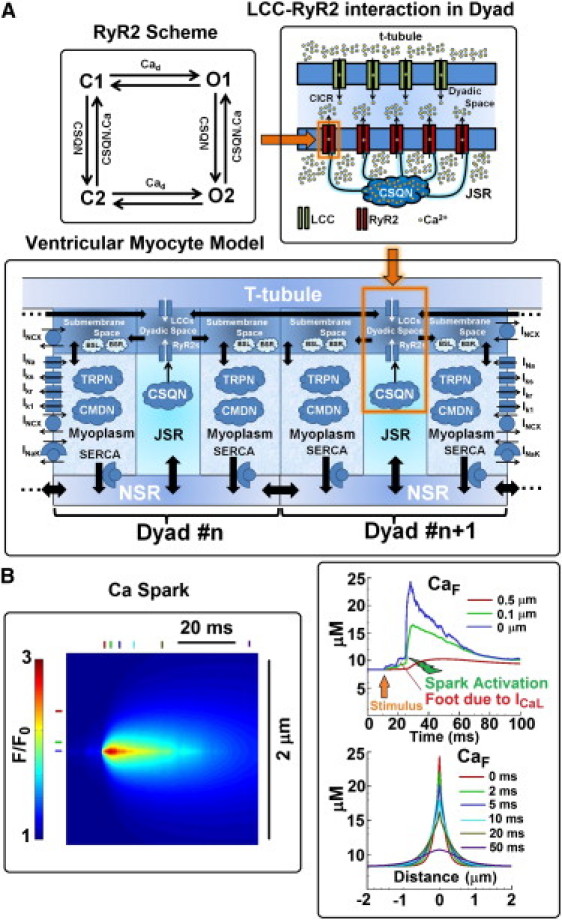
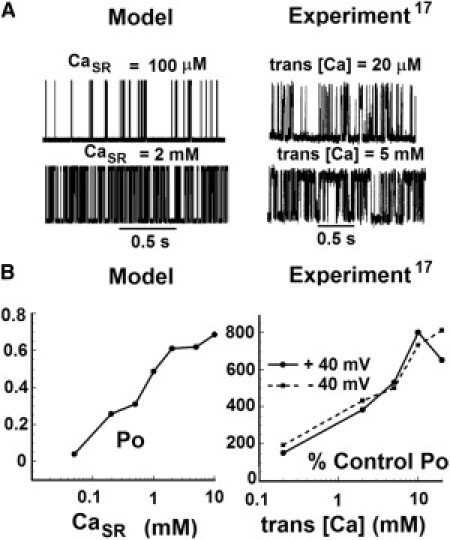
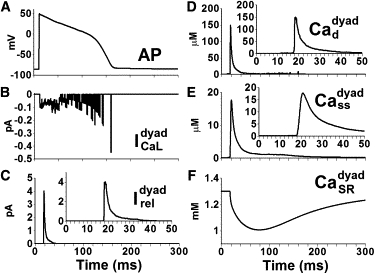
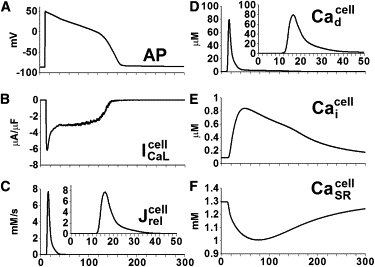
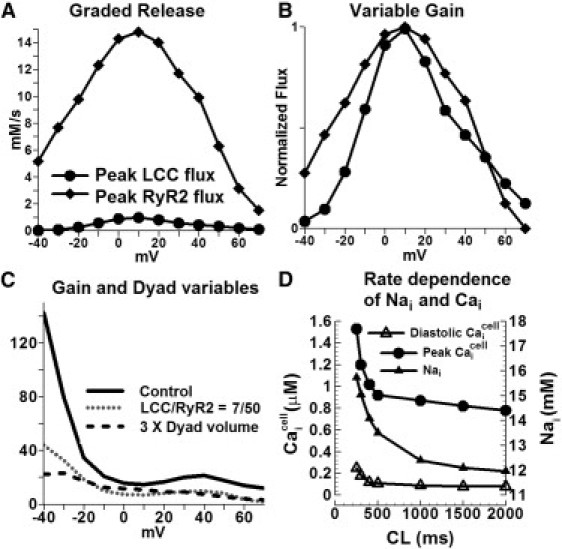
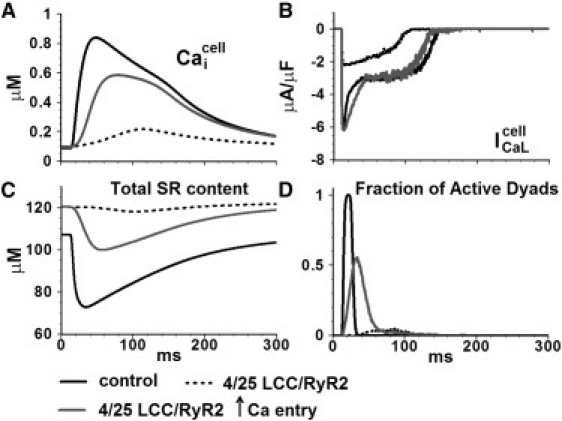
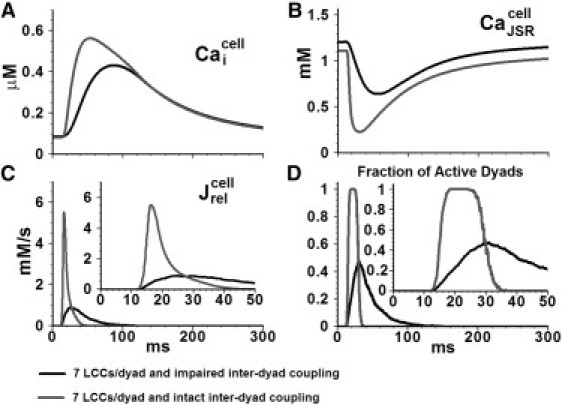
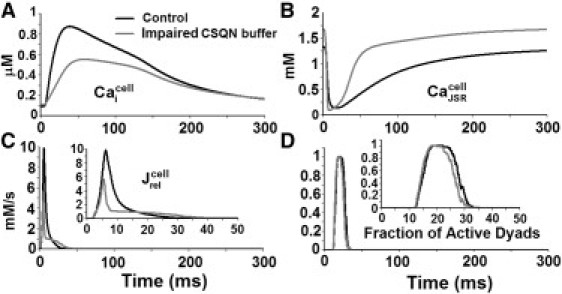
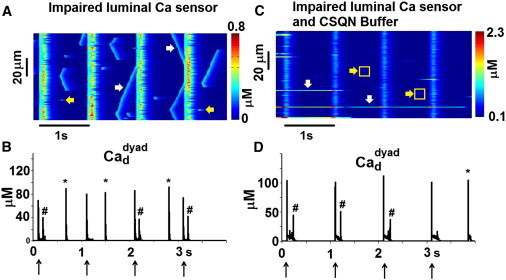
In cardiac ventricular myocytes, calcium (Ca) release occurs at distinct structures (dyads) along t-tubules, where L-type Ca channels (LCCs) appose sarcoplasmic reticulum (SR) Ca release channels (RyR2s). We developed a model of the cardiac ventricular myocyte that simulates local stochastic Ca release processes. At the local Ca release level, the model reproduces Ca spark properties. At the whole-cell level, the model reproduces the action potential, Ca currents, and Ca transients. Changes in microscopic dyadic properties (e.g., during detubulation in heart failure) affect whole-cell behavior in complex ways, which we investigated by simulating changes in the dyadic volume and number of LCCs/RyR2s in the dyad, and effects of calsequestrin (CSQN) as a Ca buffer (CSQN buffer) or a luminal Ca sensor (CSQN regulator). We obtained the following results: 1), Increased dyadic volume and reduced LCCs/RyR2s decrease excitation-contraction coupling gain and cause asynchrony of SR Ca release, and interdyad coupling partially compensates for the reduced synchrony. 2), Impaired CSQN buffer depresses Ca transients without affecting the synchrony of SR Ca release. 3), When CSQN regulator function is impaired, interdyad coupling augments diastolic Ca release activity to form Ca waves and long-lasting Ca release events.
Copyright © 2011 Biophysical Society. Published by Elsevier Inc. All rights reserved.
Figures
References
-
- Franzini-Armstrong C., Protasi F., Tijskens P. The assembly of calcium release units in cardiac muscle. Ann. N. Y. Acad. Sci. 2005;1047:76–85. - PubMed
-
- Cheng H., Lederer W.J., Cannell M.B. Calcium sparks: elementary events underlying excitation-contraction coupling in heart muscle. Science. 1993;262:740–744. - PubMed
-
- Soeller C., Cannell M.B. Examination of the transverse tubular system in living cardiac rat myocytes by 2-photon microscopy and digital image-processing techniques. Circ. Res. 1999;84:266–275. - PubMed
-
- Cheng H., Cannell M.B., Lederer W.J. Propagation of excitation-contraction coupling into ventricular myocytes. Pflugers Arch. 1994;428:415–417. - PubMed
Publication types
MeSH terms
Substances
Grants and funding
LinkOut - more resources
Full Text Sources
Research Materials
